

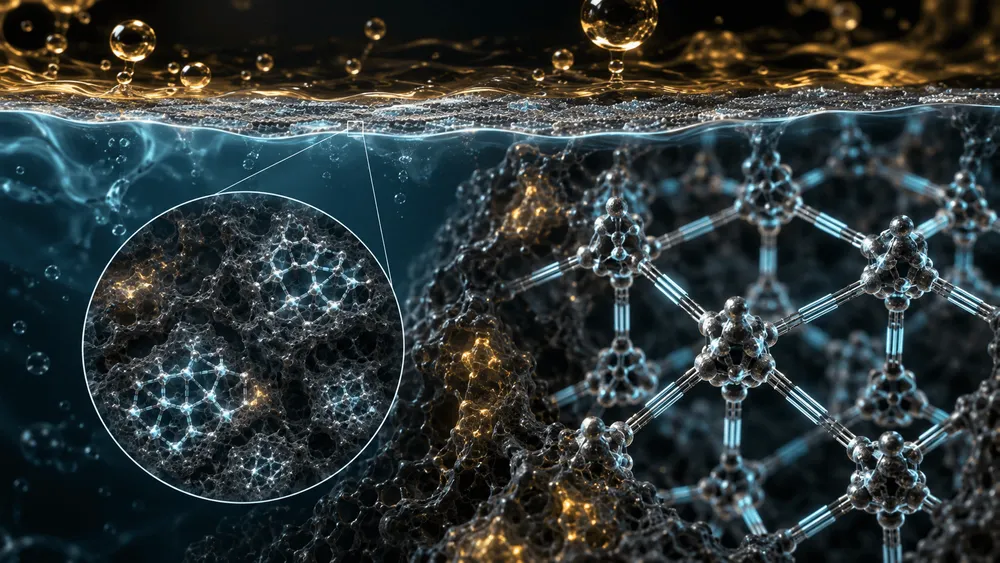
Carbon atoms form four bonds, giving rise to an astonishing range of structures—from the graphite in pencil lead to the diamonds in jewelry. Allotropes such as graphene, with its flat hexagonal lattice, spherical fullerenes, and rolled-up carbon nanotubes have profoundly reshaped modern materials science. Yet when it comes to carbon allotropes whose covalent bonds extend continuously in three dimensions, almost nothing besides diamond—natural or synthetic—has ever been confirmed to exist.
A joint research team from the University of Gothenburg, Chalmers University of Technology, and Stockholm University has announced the synthesis of a free-standing thin film containing microcrystals of a three-dimensional carbon framework called "Diamondyne," which combines single-bonded and triple-bonded carbon. The framework was produced through a chemical reaction at a liquid-liquid interface. The findings were published online as the Version of Record in the peer-reviewed journal Angewandte Chemie International Edition on September 14, 2026 (DOI: 10.1002/anie.4062963). The authors describe it as the first known carbon allotrope besides diamond to form a covalently bonded network extending in three dimensions.
While this is an attention-grabbing result, the constraints explicitly stated in the paper should not be overlooked. What was obtained is not a mass of pure single crystal, but rather a nanoscale thin film composed largely of amorphous carbon, with diamondyne crystalline domains roughly 10 nm across scattered throughout. Before discussing future applications such as porous diamond or alternatives to metal-organic frameworks (MOFs), it is worth sorting out—based on the primary data—exactly what has been confirmed experimentally and what remains unknown.
What exactly is this three-dimensional carbon network?
Databases of carbon allotropes list 1,635 structures that have been theoretically predicted but never actually synthesized. Among these, one that has long attracted attention is a network known as a "carbo-mer," in which the diamond skeleton is extended using acetylenic linkages—that is, carbon-carbon triple bonds.
In ordinary diamond, every carbon atom adopts hybridization, with four single bonds extending toward the vertices of a tetrahedron. This rigid three-dimensional structure gives rise to diamond's extreme hardness and dense crystal lattice.
In diamondyne, by contrast, the carbons that serve as the tetrahedral nodes are connected by chains of four -hybridized carbon atoms containing two triple bonds each (a "-diyne" chain). The name "-diyne" reflects the presence of two sets of triple bonds within the molecular structure.
In the idealized structure presented in the paper, the ratio of carbon atoms to carbon atoms is 8:1. Because the framework expands considerably while preserving tetrahedral connectivity, the unit cell edge length grows from diamond's roughly 3.57 Å to 16.22 Å. The idealized single network is classified in the face-centered cubic space group (No. 227), and its interior contains large voids.
However, when the actual nanocrystals were analyzed by electron microscopy and diffraction patterns, what was confirmed was not this single network. Because the voids are so large, a separate, unbonded copy of the same network was found to have inserted itself inside, producing "interpenetration," in which two frameworks intertwine with one another.
The crystals actually observed formed an asymmetrically offset, interpenetrated double network, analyzed as belonging to the tetragonal space group , with lattice constants and .
The authors state that transmission electron microscopy (TEM) observations support double interpenetration, while also noting that the evidence obtained is not yet sufficient to conclusively determine the exact number of interpenetrating networks. It is thought that a second network entering the large voids stabilizes the structure—one of the differences between the idealized single network and the crystal that actually formed.
A synthesis procedure that controls an irreversible reaction at a liquid-liquid interface
Synthesizing artificial diamond requires extreme pressures reaching several gigapascals and temperatures exceeding 1,000°C, or methods such as chemical vapor deposition (CVD), in which methane gas is decomposed by plasma.
By contrast, for synthesizing diamondyne, the research team employed an organic synthesis reaction that takes place at the interface between two solutions, near room temperature.
The biggest challenge was that carbon-carbon bond formation here is, in effect, an irreversible reaction that cannot be undone once it occurs.
In covalent organic frameworks (COFs), a subject of intense recent research, bond breaking and re-forming can repeat under equilibrium conditions, sometimes allowing incorrect bonds to be corrected and crystallinity to improve. However, no such self-healing operates in alkyne coupling reactions. Once a bond forms in the wrong direction, that portion remains as a defect, hindering orderly crystal growth.
To suppress this problem, the research team built a cascade reaction system that proceeds at the liquid-liquid interface between chloroform and water.
In the lower chloroform phase, the precursor monomer tetrakis(triethylsilylethynyl)methane was dissolved at a concentration of 4 mg/mL. In the upper phase—an equal mixture of Milli-Q water and pyridine—copper(II) fluoride () was dissolved at 25 mg/mL. Pyridine, an organic base, partitions into both phases.
Divalent copper fluoride plays two roles here. Fluoride ions () gradually remove the silyl protecting groups from the monomer, generating the highly reactive terminal alkyne tetraethynylmethane in situ. At the same time, divalent copper ions () promote oxidative homocoupling between terminal alkynes.
The research team set the initial monomer concentration at a low 7 mM. This was intended to suppress side reactions in which molecules react randomly throughout the bulk solution, and instead to favor the slower, interface-driven film formation.
Rather than relying on thermodynamic self-healing, this is a kinetic control strategy that exploits differences in reaction rates to favor formation of the target structure.
NMR measurements in deuterated chloroform showed clear signals from deprotected terminal alkynes appearing within one week, and depth-selective NMR measurements on day 7 also confirmed a concentration gradient of monomer moving toward the interface. The sample used for the detailed structural analysis by transmission electron microscopy was obtained by letting this interfacial reaction sit undisturbed for 12 days.
Measured scale and properties of the product
The diamondyne obtained is not a mineral crystal you could pick up between your fingers. It is a free-standing thin film, nanometers thick, formed at the chloroform-water interface.
Under optical microscopy, wrinkles appeared where the film was transferred onto a silicon wafer, but a continuous film extending up to 5 was confirmed. Atomic force microscopy (AFM) observations also showed a relatively smooth surface, free of through-holes or major cracks, with a representative film thickness of 16 nm.
Film thickness increased roughly in proportion to reaction time, and it was shown that thickness could be controlled within a range of a few nanometers to a few tens of nanometers. This linear increase suggests that, at least within the range measured, mass transport through the growing film does not strongly rate-limit the overall reaction.
However, films thinner than 5 nm lacked sufficient mechanical strength and were difficult to transfer onto substrates. Films thicker than 60 nm, on the other hand, could be transferred relatively stably as fragments on the order of $10^4$–$10^5\text{ }\mu\text{m}^2$.
The reaction yield, estimated by the research team from film area and thickness, remained on the order of "1% at most." Yield optimization was not attempted. The ratio of interfacial area to solvent volume is thought to strongly affect yield, but changing that condition would require re-optimizing concentration and solvent composition.
Nanoindentation testing by atomic force microscopy measured a Young's modulus of 2.7 GPa for the thin film.
This is comparable to typical acrylic resin (PMMA), and far below the theoretically predicted value of 19 GPa for an idealized diamondyne crystal. This gap reflects the fact that the actual thin film is not a single crystal but rather contains heterogeneous interpenetrated structures and extensive amorphous regions.
データを表で見る
| Young's modulus (GPa) | |
|---|---|
| Diamondyne (theoretical) | 19 |
| Synthesized thin film (measured) | 2.7 |
| PMMA (acrylic resin) | 3 |
| Natural diamond | 1,050 |
As this comparison shows, the rigidity of the actually synthesized thin film falls far short of natural diamond's roughly 1,050 GPa, and reaches only about one-seventh of diamondyne's theoretical value of 19 GPa.
Even when local bonding within the framework is strongly covalent, amorphous regions where long-range order breaks down dominate the mechanical properties of the film as a whole, so the measured mechanical strength ends up close to that of a resin.
Nanocrystalline structure confirmed by multiple analytical methods
That the thin film is not simply amorphous carbon but locally contains diamondyne's periodic structure was verified using a combination of analytical methods.
High-resolution transmission electron microscopy (HRTEM) revealed lattice fringes at 3.4 Å, close to the calculated diamondyne crystal's lattice spacing of 3.31 Å.
Further, using integrated differential phase contrast scanning transmission electron microscopy (iDPC-STEM), which can reduce damage from electron beam irradiation, contrast with a 9.6 Å periodicity accompanied by non-uniform fringe spacing was directly observed.
Nanobeam electron diffraction (NBED) and Fourier transform images along the [010] direction revealed a distinctive diffraction intensity distribution: the 222 reflection was extremely weak, while the higher-order 333, 444, and 555 reflections appeared strongly.
Comparing the experimental results with crystal structure simulations, the authors concluded that this intensity distribution can be explained by a structure in which two networks interpenetrate with an asymmetric offset.
Although lattice spacings varied somewhat between crystalline domains, the principal spacings were all distinguishable from the diffraction planes attributable to the copper fluoride catalyst. This supports the conclusion that the observed nanoscale patterns are not simply due to residual catalyst particles.
Confirmation of chemical bonding via spectroscopic analysis further reinforces the structural findings.
Raman spectroscopy showed a weak but reproducible signal around across the thin-film sample. Comparison with the peak from the model compound hexa-2,4-diyne () and the peak from the protected starting monomer () suggests that this peak is attributable to the stretching vibration of a diyne group () incorporated into the polymer backbone.
Fourier transform infrared spectroscopy (FTIR) found that absorption bands characteristic of silyl protecting groups (), the peak indicating unreacted terminal alkynes (), and the carbonyl absorption from oxidation (around ) were all below detection limits.
This result supports the conclusion that little starting material or reaction intermediate remained, and that coupling between alkynes had indeed proceeded.
Solid-state NMR showed a clear resonance peak around 65–75 ppm, corresponding to the diyne carbons of hexa-2,4-diyne (72.2 ppm and 64.9 ppm), confirming the presence of carbon.
At the same time, a byproduct peak attributable to undesired -hybridized carbon appeared around 120 ppm, and a signal corresponding to a trace amount of carbonyl groups was also confirmed around 220 ppm.
X-ray photoelectron spectroscopy (XPS) detected carbon and oxygen on the film surface, with an increase in oxygen concentration observed on the side facing the aqueous phase, likely attributable to oxidation of terminal alkynes.
Energy-dispersive X-ray spectroscopy (EDX) confirmed that oxygen concentration inside the film was substantially lower than at the surface, and that fluorine originating from the catalyst remained only in trace amounts.
Taken together, this data strongly supports the local formation of a diamondyne framework. However, the crystalline pattern confirmed by the Stockholm University electron microscopy team does not cover the entire thin film.
The University of Gothenburg's official announcement likewise explains that the crystalline structure was confirmed only in "patchy regions scattered across the surface of the thin film."
The limits of crystallinity, and porosity that has yet to be measured
In evaluating this achievement, it is important to consider how far the crystallinity and porosity of the material have actually been confirmed experimentally.
First, no quantitative evaluation of the material as a porous substance has yet been performed.
When evaluating the porosity of materials such as MOFs or activated carbon, it is standard practice to adsorb a gas such as nitrogen or argon onto a fixed quantity of sample and determine specific surface area () and pore size distribution from adsorption-desorption isotherms.
However, the samples obtained here were only a few thin films, each just a few square centimeters and tens of nanometers thick—not enough mass to obtain a gas adsorption isotherm.
The evidence for porosity presented in the paper is limited to qualitative suggestions from quartz crystal microbalance (QCM) responses. Values such as pore volume, specific surface area, or the degree to which specific molecules can be adsorbed have not been measured.
A second issue concerns why crystal growth appears to stop at the nanometer scale.
According to a defect model constructed by the authors, when a single incorrect ring-shaped defect—such as a five-membered ring—forms on a realistic, growth-constrained surface, the strain energy increases by more than 18 kJ/mol, and the equilibrium constant drops to roughly $10^{-3}$.
Thermodynamically, such a highly strained defect state is unfavorable, and under equilibrium conditions the system would move to eliminate it. However, alkyne coupling is an irreversible reaction in which self-healing through bond breaking and re-forming is difficult, meaning the reaction is governed far more strongly by kinetics than by thermodynamic equilibrium.
Once an incorrect bond forms, there is almost no mechanism to correct it afterward.
In a structure where covalent bonds extend continuously in three dimensions, a single deviation in bond angle also affects the surrounding framework. In a small crystal, some strain can be absorbed through deformation of the overall structure, but as the crystal grows larger, strain accumulates and it becomes increasingly difficult to maintain a regular lattice structure.
In the authors' model, this is considered one of the reasons crystalline domains remain around 10 nm in size, with amorphization tending to occur beyond that scale.
Some media reports described this as "the creation of porous diamond," but Professor Karl Baryshnikov of the University of Gothenburg himself explains that "there are countless factors that can prevent carbon atoms from forming diamondyne."
The regions where crystalline structure has actually been confirmed are extremely small, on the order of about 10 nanometers on a side.
| Comparison item | Natural/synthetic diamond | Diamondyne thin film (this study) | 2D carbon allotropes (graphene/graphdiyne) | Metal-organic frameworks (MOFs) |
|---|---|---|---|---|
| Dimensionality of covalent/coordination bonding | 3D covalent bonded network | 3D covalent bonding (nanocrystals scattered within amorphous film) | 2D planar network (weak van der Waals forces between layers) | 1D–3D (coordination bonds between organic ligands and metals) |
| Carbon hybridization and bonding | All carbon (single bonds) | Mixture of and carbon (single bonds and triple bonds) | Graphene is ; graphdiyne is | Depends on organic ligand (often includes aromatic rings) |
| Synthesis conditions | High pressure/high temperature (several GPa, >1000°C) or CVD | Near room temperature, cascade reaction at chloroform/water interface | CVD, liquid-phase exfoliation, interfacial cross-coupling, etc. | Hydrothermal/solvothermal synthesis, etc. (100–200°C) |
| Experimental evidence of porosity | None (dense, non-porous crystal) | Only qualitative suggestion from QCM. Gas adsorption isotherm not measured | The planar structure itself is not a bulk porous material | Many materials with large specific surface area confirmed via gas adsorption measurements |
| Structural confirmation and current limitations | Established via single-crystal X-ray diffraction, etc. | Approximately 10 nm microcrystals confirmed via electron diffraction and TEM. Yield below 1%, and most material is amorphous | Atomic-resolution observation well established; progress toward large-area synthesis | Many materials with established single-crystal structure analysis; stability varies by material |
Diamondyne stands apart from diamond and 2D nanocarbons in that it possesses a three-dimensional covalent bonded network and is synthesized via an interfacial reaction near room temperature.
On the other hand, in terms of quantitative evaluation of crystallinity, purity, and porosity, the research maturity is vastly different from that of MOFs, for which structure and adsorption properties have already been measured in detail across numerous materials.
More than 30 years of synthesis research
The research history leading up to diamondyne traces back to the early 1990s in the United States. As cited in the paper, an early attempt to synthesize this framework was made roughly 30 years ago by chemist K. S. Feldman and colleagues.
In 1993, Feldman and colleagues reported a method for synthesizing tetraethynylmethane, the central building-block molecule, and the following year, in the Journal of the American Chemical Society (JACS), they attempted to polymerize this molecule to form a three-dimensional carbon network.
However, unprotected tetraethynylmethane is thermally very unstable, carrying a high risk of self-decomposition or explosion, and a regular three-dimensional polymer could not be obtained.
Even when the silicon analog of diamondyne—a porous framework centered on silicon atoms rather than carbon—was synthesized in 2021, the carbon version was considered extremely difficult to achieve because of precursor instability.
The framing used in university press releases and general media coverage—"predicted theoretically 35 years ago"—and the paper's own description of "a three-decade quest" reflect this history of an unstable precursor and an irreversible bond-formation process that researchers could not previously control.
A key innovation in this study lies in using copper fluoride to generate the unstable monomer in situ at low concentration near the interface, allowing it to proceed immediately into the coupling reaction after formation—thereby advancing network formation while suppressing precursor decomposition.
Meanwhile, some of the applications and historical framing discussed in media coverage go beyond what the paper itself states.
One example is the narrative linking three Nobel Prizes in Chemistry: fullerenes in 1996, graphene in 2010, and MOFs in 2025.
While it is fair to describe this result as sitting at the intersection of carbon allotrope research and porous materials research, that framing comes from university public relations and science journalism—the paper itself does not claim any direct connection to the Nobel Prizes.
Some coverage also draws on Neal Stephenson's science fiction novel The Diamond Age, linking the work to a vision of nanotechnology-driven societies that freely manipulate carbon bonding.
However, as the research team itself acknowledges, what was actually obtained here are nanometer-scale crystalline regions present within a very small quantity of thin film. Applications such as carbon dioxide capture, molecular sieving, drug delivery, and hydrogen storage remain future possibilities that can only be seriously considered once high-purity, large-area, or bulk-scale material can be produced.
What can be confirmed from the paper's data can be organized into three points.
First, nanocrystals of an - carbon allotrope with a three-dimensional covalent network were synthesized via a liquid-liquid interfacial reaction.
Second, these crystals likely take the form of an asymmetrically offset, doubly interpenetrated structure.
Third, most of the resulting thin film is amorphous, the yield is below 1%, and quantitative measurement of porosity and evaluation of the material's function at a macroscopic scale have not yet been carried out.
Remaining challenges in three-dimensional carbon chemistry
The synthesis of diamondyne is an important experimental achievement in three-dimensional carbon chemistry, but many challenges remain before it can be developed into a practical material.
What is needed first is independent replication by other research groups. It will be important to determine whether the same interfacial synthesis protocol can reproduce the material, and whether the same crystal structure can be confirmed via electron microscopy and spectroscopic analysis.
The biggest technical challenge is enlarging the crystalline domains and reducing the amorphous component.
The key will be clarifying why crystalline order is lost at the boundaries of these small, roughly 10 nm domains, and whether catalyst systems or reaction conditions can be developed that either suppress incorrect bond formation or allow it to be repaired after the fact.
At present, even when the film's area is enlarged, much of its interior consists of low-crystallinity carbon, so the mechanical properties of the film as a whole fall far short of the values predicted for an idealized crystal.
Furthermore, evaluating this material as a porous substance will require developing the technology to synthesize larger quantities of sample.
Without preparing samples closer to gram-scale quantities and measuring gas adsorption isotherms to quantify BET specific surface area, pore volume, and pore size distribution, a full comparison with other porous materials will remain difficult.
The paper also provides no specific data on recovery or reuse of the copper fluoride catalyst, which would need to be separately verified when considering industrial-scale production.
The research team states that it intends to further investigate diamondyne's physical properties going forward, while also exploring more complex structures in which multiple networks interpenetrate through voids.
Through this achievement, one of the three-dimensional carbon networks that had long remained only a theoretical candidate has now been experimentally confirmed in the form of nanocrystals.
The next challenge is whether this localized crystalline order can be extended over larger regions—while reducing amorphous content and defects—to the point where the material can be synthesized in quantities sufficient for measurement as a genuine material.