

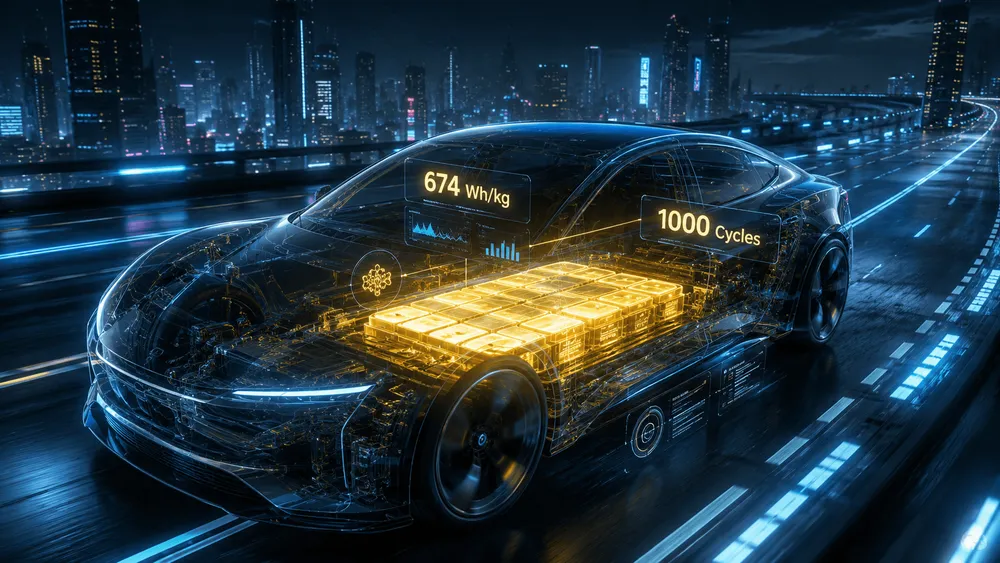
It's only been about a year since solid-state battery performance was proven at the level of an actual production vehicle.
The FEST® (Factorial Electrolyte System Technology) cell developed by Factorial Energy (hereafter "Factorial") boasts a capacity of 77 Ah and an energy density of 375 Wh/kg. In lab validation conducted by Stellantis, the cell maintained its performance over more than 600 cycles and completed fast charging from 15% to 90% in just 18 minutes. It also offers a wide operating temperature range, covering everything from extreme cold at -30°C to environments up to 45°C, while recording a discharge rate of up to 4C. The cell has already begun making its way into actual vehicles: Mercedes-Benz installed it in a modified EQS and drove 1,205 km (749 miles) on a single charge. Even upon reaching the destination, the vehicle reportedly still had roughly 135 km (84 miles) of remaining range. Stellantis has likewise incorporated cells using the same technology into prototypes of the Dodge Charger Daytona, and has begun full-scale real-world road testing on North American public roads starting in June 2026.
The One Wall Solid-State Batteries Haven't Yet Cleared
The issue isn't performance. It's manufacturing scale.
Solid-state batteries, which replace liquid electrolytes with solid materials, face extremely difficult challenges: achieving uniformity in the electrolyte layer and maintaining contact with the electrodes amid the volume changes that occur during charging and discharging. As a result, manufacturing yields remain low. Even Toyota, an industry frontrunner, has set its mass-production target for solid-state batteries at 2027 to 2028, and QuantumScape—which operates under a technology licensing model—remains at the pilot production stage as of 2026. The industry-wide consensus is that large-scale mass production won't arrive until sometime between 2027 and 2030 or later.
The MOU that Factorial signed with SK On on July 29, 2026 is aimed at breaking through this "mass-production wall." Rather than building a new gigafactory of its own from scratch, Factorial is seeking to determine whether solid-state batteries can be mass-produced using existing manufacturing infrastructure.
Why SK On, and Why Now?
SK On is one of the world's leading battery makers, with a combined global production capacity exceeding 200 GWh annually—roughly half of that, about 100 GWh, concentrated in the United States. Having supplied batteries to major automotive OEMs such as Hyundai Motor Group, Ford, Volkswagen, and Ferrari, the company has accumulated deep know-how in the rigorous process control required for large-scale mass production.
This is precisely why the approach Factorial is pursuing can be described as a "capital-light strategy." Rather than building manufacturing facilities worth hundreds of billions of yen from the ground up on its own, Factorial is moving into a partner's factory that already has world-class operational track record, and verifying there whether FEST® technology performs as designed. If a high-yield, quantitative manufacturing process can ultimately be established, Factorial calculates that it can dramatically compress the enormous cost and time required for commercialization by using SK On's existing lines.
Factorial CEO Siyu Huang has stated, "A battery breakthrough means nothing if it can't be mass-produced. SK On's manufacturing capabilities rank among the world's best facilities, and that know-how will be essential to integrating solid-state battery technology into the manufacturing ecosystem." For a startup backed by Mercedes-Benz, Stellantis, Hyundai, Kia, and IQT, SK On is an ideal partner to fill in the final missing piece: mass production.
There's also another layer of context behind the question of "why now." In building out a manufacturing ecosystem for solid-state batteries, Factorial has steadily deepened its ties with South Korean players. In November 2025, it signed an MOU with materials giant POSCO Future M, and in January 2026 received direct investment from the company. This was followed in February 2026 by a manufacturing collaboration MOU with Philenergy, which has strengths in manufacturing equipment, and an MOU has also already been signed with LG Chem. This latest partnership with SK On sits as an extension of this meticulously constructed network of South Korean manufacturing alliances.
The Context Surrounding SK On
However, it would be inaccurate to simply portray SK On as "a massive manufacturing partner." The company itself is also facing pressure to rapidly shift its strategy in the U.S. market.
At the end of 2025, SK On and Ford agreed to dissolve their U.S. battery manufacturing joint venture, BlueOval SK, completing the process in May 2026. This dissolution came at a heavy cost to both parties—Ford alone booked a $3.6 billion loss in mid-2026. The backdrop to this was the Trump administration's elimination of the $7,500 federal EV tax credit, which significantly dampened EV demand in the United States and upended the assumptions both companies had built their aggressive U.S. expansion plans on. The $9.6 billion Department of Energy (DOE) loan that had been supporting the joint venture has also been forced into restructuring and downsizing.
After the dissolution of BlueOval SK, SK On took sole ownership of the Tennessee plant, while also exploring a shift in production toward energy storage systems (ESS) to offset the decline in EV-related demand. Maintaining utilization rates at existing sites, such as the Commerce plant in Georgia (22 GWh), has become an urgent priority.
Against this difficult backdrop, this MOU can also be read as a move by SK On to seek new uses for infrastructure that is increasingly at risk of becoming surplus capacity. In parallel with the defensive move of converting facilities toward LFP (lithium iron phosphate) batteries for ESS use, the company is evaluating the manufacturing feasibility of Factorial's next-generation technology on its own lines—positioning itself with options in hand for a future recovery in the EV market.
Ki-soo Park, head of SK On's Future Technology research institute, stated that the agreement "leverages SK On's technology and manufacturing expertise to evaluate the technical feasibility and manufacturing readiness of solid-state battery technology," expressing, in carefully measured terms, an intent to continue collaborating on next-generation batteries.
What the "Chain of Non-Binding Agreements" Reveals About the Mass-Production Hurdle
This MOU is non-binding. Aside from specific provisions such as confidentiality obligations, either party can withdraw from the agreement at any time. The process is designed so that, only after technically confirming feasibility of manufacturing on existing lines, the two companies would move on to a quantitative, binding agreement—and the contracts Factorial has previously signed with various South Korean companies largely follow this same structure.
How one interprets this "chain of non-binding agreements" depends on one's vantage point. The fact that a startup with no manufacturing track record has brought multiple industrial giants to the table as evaluation partners can be seen as a strong vote of confidence in FEST® technology. On the other hand, the fact that not a single one of these agreements has yet advanced to a binding, final production contract also reflects both the sheer height of the wall standing in the way of solid-state battery mass production and the industry's cautious view of its feasibility.
The lineup of manufacturing partners and the overwhelming real-world driving data are already in place. What remains to be tested is a single question: "Can Factorial's cells actually be produced on SK On's massive existing lines at yields that justify mass-production costs?" As of now, there is no concrete timeline for when the results of that technical evaluation will be revealed, or whether they will culminate in a binding contract.