

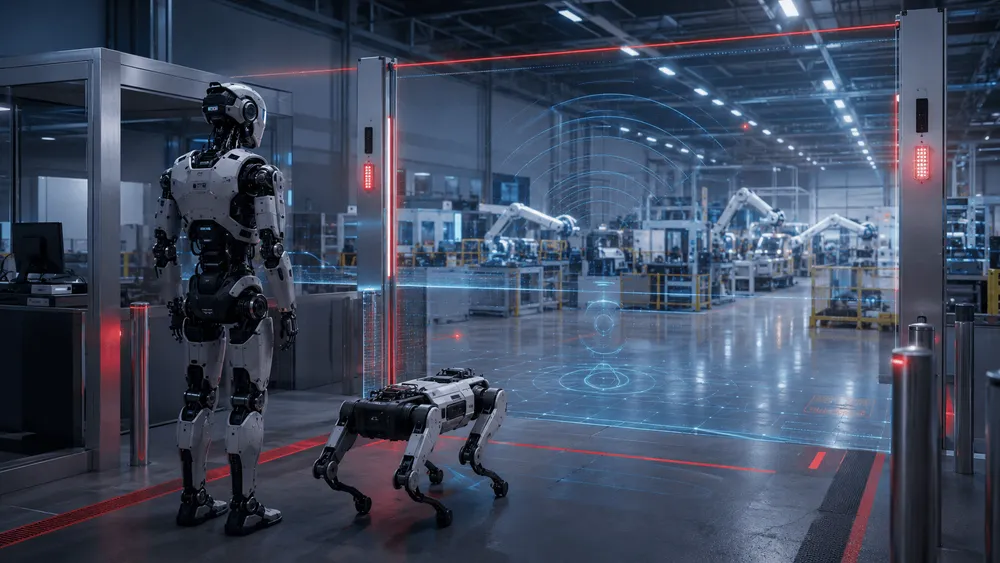
On July 28, 2026, the US Federal Communications Commission (FCC) added "advanced robotic devices" manufactured outside the United States to its Covered List—a roster of communications equipment and services subject to national-security restrictions. Newly covered models can no longer, in principle, obtain FCC equipment certification, meaning they cannot be imported, sold, or advertised in the US.
The measure is easily read as an exclusion targeting Chinese-made humanoid robots. However, the FCC's rule does not use a manufacturer's nationality as its determining factor. It broadly targets foreign-manufactured products based on where they are produced and federal procurement standards. US companies that manufacture autonomous mobile robots abroad could fall within scope, while Chinese companies could potentially avoid coverage by shifting production to the US and meeting the relevant criteria.
Moreover, the import, sale, and use of existing models that have already been certified can continue. Procurement intended exclusively for the federal government also faces no restriction. What has been established here is not a mechanism that simultaneously halts robots already on the market, but a certification gate placed at the entry point for new models.
Separating "Foreign Manufacture" from "Chinese Companies"
The FCC cannot update the Covered List based solely on its own judgment. Under the Secure and Trusted Communications Networks Act, it reflected a determination dated July 27, 2026—one day before the list update—following an "unacceptable risk" finding from an eligible national security agency. Once listed, new certification of covered equipment is prohibited, and applicants must prove that their products are not subject to the list.
The FCC's FAQ explicitly states that this measure is "country-neutral." Whether something counts as foreign-manufactured is determined by whether it qualifies as a "domestic end product" under the Federal Acquisition Regulation (FAR). Under the FAR's basic test, for products manufactured in the US and delivered between 2024 and 2028, the cost of domestic components must exceed 65% of the total cost of all components. Starting in 2029, this threshold rises to 75%. Because exceptions exist for commercial off-the-shelf items and other categories, this ratio cannot be mechanically applied to individual robots.
The treatment under the new rule breaks down as follows:
| Category | Treatment in the US |
|---|---|
| New foreign-manufactured models | In principle cannot obtain FCC certification; cannot be imported, sold, or advertised |
| Existing models certified before the addition | Import, sale, and use may continue |
| Units exclusively for federal/government agencies | Not subject to import, sale, or use restrictions |
| Uncertified units for development/testing | Limited-quantity import compliant with rules is permitted, but sale/advertising is not |
| Fixed-installation industrial/medical robots | Excluded from the definition of advanced robotic devices |
There is also a broad exemption allowing basic software and firmware updates to continue for existing covered equipment. This is therefore not a system designed to render units currently in use unfixable. On the other hand, new designs or next-generation models that cannot rely on existing certifications will require either domestic US manufacturing or conditional approval from the Department of Defense.
The Technical Boundary: Roughly 2kg and 200kbps
The scope of "advanced robotic devices" is broader than humanoid and quadrupedal robots. It covers mechanical mobile devices that travel over ground, choose paths while avoiding obstacles, and operate based on commands or sensor data at locations removed from human operators. Autonomous mobile robots that travel through warehouses or facilities can also meet these conditions.
The weight threshold is exceeding 4.4 pounds (approximately 2.0kg) for the combined weight of the unit and its station or dock. In addition, the device must have environmental sensors and a wired or wireless connection of at least 200kbps in at least one direction (upload or download). The definition also includes software responsible for the unit's navigation and movement. This extends to functions used for perceiving surroundings, collecting data, and remote command—covering even firmware and the weights of AI/machine learning models.
Connected vehicles and rail-dedicated vehicles are excluded. Aerial and underwater drones, as well as medical devices regulated by the US Food and Drug Administration, are also outside the scope. Fixed-installation factory robots—articulated arms, delta robots, Cartesian/gantry robots, and SCARA robots—are likewise not included. It would be inaccurate to read this as a measure that blocks all Chinese industrial robots wholesale.
This definition focuses less on a robot's shape and more on the combination of mobility, sensors, communications, and software control. What has changed here is that remotely connected units capable of perceiving their surroundings and moving through physical space have been brought into the equipment certification system for communications devices.
Remote Takeover Demonstrated, State-Sponsored Espionage Unproven
The national security determination notes that robots equipped with high-precision LiDAR alongside tactile, acoustic, and thermal sensors could gather information about their surroundings. The settings envisioned range widely, from homes and factories to critical infrastructure and battlefields. If network connections or wireless updates are compromised, this could escalate to capturing video and maps, remotely operating units, or causing physical interference.
The cases cited in the determination document involve real-world attack vectors. In an issue discovered with a home robot in early 2026, researchers were able to reach approximately 7,000 units across 24 countries. They could obtain live video and microphone audio, and view maps of homes. The device in question was DJI's home cleaning robot Romo, and the FCC cites the original reporting based on researchers' findings.
UniPwn, discovered in Unitree robots, enabled remote command execution and root access not only on the G1 and H1 but also on the Go2 and B2. The IEEE Robotics and Automation Society reported that it could automatically propagate to nearby units via Bluetooth. As of September 20, 2025, affected firmware remained in circulation, but Unitree stated it had completed fixes for most units by September 29 and would roll out updates progressively. The US vulnerability database also lists CVE-2025-60250, involving hardcoded encryption keys and initialization vectors in Unitree devices.
The national security determination also cited backdoor allegations reported in April 2025 involving a foreign-made quadrupedal robot. The concern raised was the potential ability to control the camera and the entire unit.
However, what has been confirmed are vulnerabilities, remote takeovers, and pathways to reach sensitive sensor data. The published FCC document does not present evidence of successful espionage operations conducted by the Chinese government using these robots, nor evidence that collected data was transmitted to the Chinese government. "Design-level risk that could enable espionage" and "proof of state-sponsored espionage" need to be read as distinct matters.
Conditional Approval: Ownership Structure and US Production Under Scrutiny
An exit path has also been provided for foreign-manufactured products. Equipment that receives individual Conditional Approval from the Department of Defense can apply for FCC certification as an exception to the Covered List. The application deadline is January 1, 2028, though submitting an application alone does not guarantee approval.
The review items go well beyond descriptions of security features. Applicant companies must disclose relationships with parent companies, subsidiaries, and joint ventures, as well as beneficial owners holding 5% or more. The nationality and residency of directors and executives, along with any influence or funding from foreign governments, are also subject to review.
For the product itself, companies must submit a detailed bill of materials along with the country of origin for each component and design element. Disclosure requirements also cover the entities managing intellectual property and software updates, as well as the locations of manufacturing through final assembly and testing. Furthermore, companies must present the value ratio and production volume by country and explain contingency plans in case a single source of supply is disrupted.
Additionally, applicants must present their current ratio of US domestic assembly, personnel, and facilities, and turn future capital investment, employment, and facility expansion over the next one to five years into a plan with deadlines. Quarterly progress reports are required after approval. Willfully violating the conditions, or making a materially false statement in information provided to the US government, results in loss of approval and disqualification from reapplying.
In other words, conditional approval is not a self-declaration of vulnerability countermeasures. It is a system that discloses ownership structure and supply chains to the Department of Defense, and in exchange for a commitment to a process of shifting toward US domestic manufacturing, conditionally preserves market access for new models. Plans and actual production shifts are separate matters—whether any companies actually receive approval, and whether investment plans are actually executed, will be the next points to watch.
Placing a Certification Gate on a Market Where China Leads
According to industry data introduced by China's State Council Information Office, China had more than 140 humanoid robot manufacturers in 2025, with shipments of 14,400 units accounting for 84.7% of the global market. China's Ministry of Industry and Information Technology also states there are more than 140 finished-product manufacturers and more than 330 announced products. While this is industry data drawn from government-affiliated sources rather than independently audited market statistics, it indicates that China's supply capacity is rapidly expanding.
In industrial robotics, the International Federation of Robotics tallied China's operational stock at 2,027,000 units and new installations at 295,000 units as of the end of 2024. New installations accounted for 54% of the global total, and the share of Chinese manufacturers within China's own market rose from 47% in 2023 to 57%. This statistic represents the population of factory-oriented industrial robots and cannot simply be added to the 14,400-unit humanoid robot shipment figure.
In Congress, the proposed GUARD Act would target humanoid and quadrupedal robots and their control software made by companies under the influence of countries of concern. This bill uses a company's location and control relationships as its standard, with a framework requiring national security agencies to issue determinations within one year—a scope different from the country-neutral, place-of-manufacture standard the FCC has adopted this time. The National Defense Authorization Act bill that passed the House on July 22, 2026, also includes a provision establishing a process for the Department of Defense to determine whether Chinese-made robots should be banned, though this has not yet become final law.
The FCC's measure is an administrative certification policy, existing at a different stage from permanent legislation by Congress. What warrants attention going forward is not the label "Chinese company" but rather which manufacturers shift to US domestic production and which models obtain conditional approval from the Department of Defense. Because only new models are halted while existing units remain on the market, the effectiveness of this regulation will hinge on how quickly manufacturers transition to next-generation models and how quickly domestic production gets off the ground.