

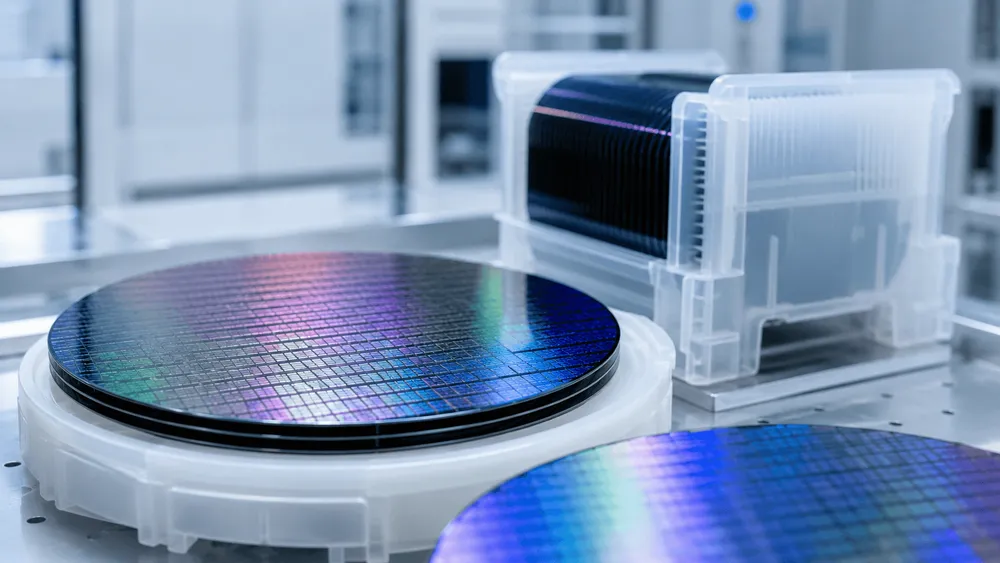
At its Q2 earnings briefing on August 4, 2026, GlobalWafers revealed that its existing 12-inch (300mm) silicon wafer capacity—excluding newly expanded lines—is running at full utilization. The company explained that growing demand for AI and advanced applications is driving up computing power and memory capacity, which in turn is increasing wafer consumption.
This does not mean that all silicon wafers are in short supply. GlobalWafers noted that while 8-inch utilization is also high, recovery in 6-inch products has been gradual. What the company disclosed was the utilization status of its existing 300mm capacity, and this should not be read as uniform tightness across all product grades, customers, or regions.
300mm wafers are polished silicon substrates used to fabricate semiconductors. Compared to smaller-diameter wafers, they offer a larger chip-processing area per wafer and have become the mainstay format for advanced memory and logic. What has now come into view is that AI-related semiconductor investment is beginning to extend beyond manufacturing equipment and back-end processes to securing the substrates that come earlier in the process.
Supply-Demand Shifts Beginning with 300mm
Beyond GlobalWafers' explanation, disclosures from other wafer manufacturers also point to shifting supply-demand dynamics. In its Q&A session during the July 24 earnings briefing, Shin-Etsu Chemical explained that the 300mm market for April–June 2026 grew in the mid-single digits year-over-year and high-single digits quarter-over-quarter, with June shipment volume reaching a monthly record high. The company attributed this to customers building inventory in preparation for future production increases, along with AI demand supporting the recovery.
Shin-Etsu also indicated that, in the 300mm segment, it appears all wafer manufacturers are operating at full capacity, with production capacity beginning to constrain supply. However, this reflects Shin-Etsu Chemical's own market assessment and is not a measured figure of global shortage rates. It cannot be read as indicating uniform tightness across all product grades, customers, or regions.
On July 30, Siltronic stated that 300mm demand remained solid in Q2 2026. For the full year 2026, the company expects 300mm utilization to remain at high levels. Volume growth in the first half was driven by 300mm memory and logic demand, while 200mm remained weak. Combined with GlobalWafers' comment on the gradual recovery in 6-inch products, this suggests that the pace of recovery differs by wafer diameter and application.
There is also more than one pathway driving demand volume upward. Shin-Etsu Chemical explained that currently just under 10% of its 300mm wafers go toward devices that use two wafers, and it expects this ratio to expand. In advanced memory and logic for AI applications, process transitions and increasing complexity are also progressing. While Shin-Etsu's figure cannot be treated as representative of the ratio for HBM or advanced packaging overall, it does illustrate that as device configurations change, device shipment volumes alone cannot measure wafer demand.
GlobalWafers reported consolidated revenue of NT$15.2 billion for Q2 2026, up 8.8% quarter-over-quarter but down 5.0% year-over-year. The company attributed the support to a recovery in semiconductor demand and advanced applications. This figure does not represent global 300mm supply-demand conditions as a whole. Demand for advanced applications and the pace of recovery by wafer diameter need to be viewed separately.
Long-Term Contracts Shifting Toward Capacity Reservations
As supply-demand conditions tighten, the meaning of contracts is also changing. The Elec reported that GlobalWafers explained its wafer long-term supply agreements (LTAs), previously roughly three years in length, are now extending to five to eight years, with some memory customers seeking allocations two to three years out. This reflects contract terms and customer behavior as reported by the media outlet; the specific terms and volumes of individual contracts have not been disclosed.
An example involving a 10-year term can be confirmed even in primary sources. On July 9, Micron announced plans to provide $500 million in strategic funding to support GlobalWafers' 300mm raw silicon plant in Sherman, Texas, along with plans to enter a 10-year supply agreement for a substantial volume of raw silicon capacity. Both the funding and the agreement are contingent on definitive agreements, approvals, and other customary closing conditions.
Therefore, this deal cannot be treated as one where funds have already been transferred or capacity is already operational. Nevertheless, it does suggest that LTAs designed to secure supply are increasingly becoming contracts that reserve future capacity at an early stage. Shin-Etsu Chemical also noted that this 10-year LTA between GlobalWafers and Micron reflects the customer's view that sales of AI-related devices will remain strong over the long term.
That said, supply capacity slack cannot be inferred backward from the length of contract terms. Micron's announcement did not disclose the specific product grades covered, exact volumes, or pricing formulas. While the duration of a supply contract reflects demand outlook, it does not indicate which customer will receive which wafer specification and when.
Movements in Spot Prices and LTA Prices
The Elec reported that GlobalWafers is negotiating price increases reflecting rising raw material and energy costs, with logistics and labor costs also factored in. The company reportedly expects spot prices in the second half of 2026 to exceed those in the first half, and while existing LTA contract prices will be maintained, future contracts may incorporate mechanisms reflecting market conditions, product mix, and industry trends.
Spot prices and existing contract prices do not necessarily move in tandem. An outlook for rising spot prices does not mean that the same price increases will extend to all customers and all wafer types.
Regarding Siltronic, The Elec reported that prices for 300mm wafers outside of LTAs have begun rising, and that some LTAs will be renegotiated in 2027–2028. This reflects price and contract renewal developments at Siltronic as reported by the outlet, not an industry-wide price index.
In Siltronic's own Q2 announcement, the company stated that the quarter-over-quarter revenue increase was driven by an increase in wafer area sold rather than by price. This does not mean the company announced a price increase.
Expansion Does Not Immediately Ease Supply
Even when wafer plants are expanded, this does not translate into supply capacity in the short term. GlobalWafers stated it has secured qualification from multiple Tier 1 customers at its Sherman facility, and that demand is strong for its new 12-inch SOI (Silicon On Insulator) line in Missouri, with products moving into mass production. However, new lines remain at the stage of ramping up in line with customer qualification and demand.
SEMI forecasts that equipment investment for 300mm memory fabs will reach $52 billion in 2026 and $57 billion in 2027. 300mm memory capacity is projected to reach 4.1 million wafers per month in 2026 and 4.2 million wafers per month in 2027. These figures represent capital expenditure outlooks for memory fabs and capacity forecasts for the 300mm memory segment; they do not directly measure wafer manufacturers' shipment capacity or immediate increases in supply of advanced wafers. SEMI notes that technology transitions and process complexity will constrain growth in effective capacity.
For AI-related HBM and advanced-node DRAM, technology transitions and process complexity compound one another. Therefore, SEMI's capacity outlook cannot be treated as equivalent to GlobalWafers' customer qualification progress or ramp to mass production. Assessing wafer supply-demand conditions requires looking not only at the scale of capital expenditure, but also at which generations of memory and logic have completed qualification and moved into mass production.
Wafer plants must have processes in place spanning from crystal growth through polishing and epitaxial processing. Even after equipment installation, customer qualification must be completed before moving to mass production. High utilization rates do not directly prove shortages of finished AI chips or rising semiconductor prices. The point that specific advanced 300mm products are experiencing supply constraints is something reported by The Elec. Going forward, key indicators for gauging supply-demand conditions will include which product types are affected by the 2027–2028 LTA renegotiations, and how quickly the new lines in Sherman and Missouri transition through qualification into mass production capacity.