

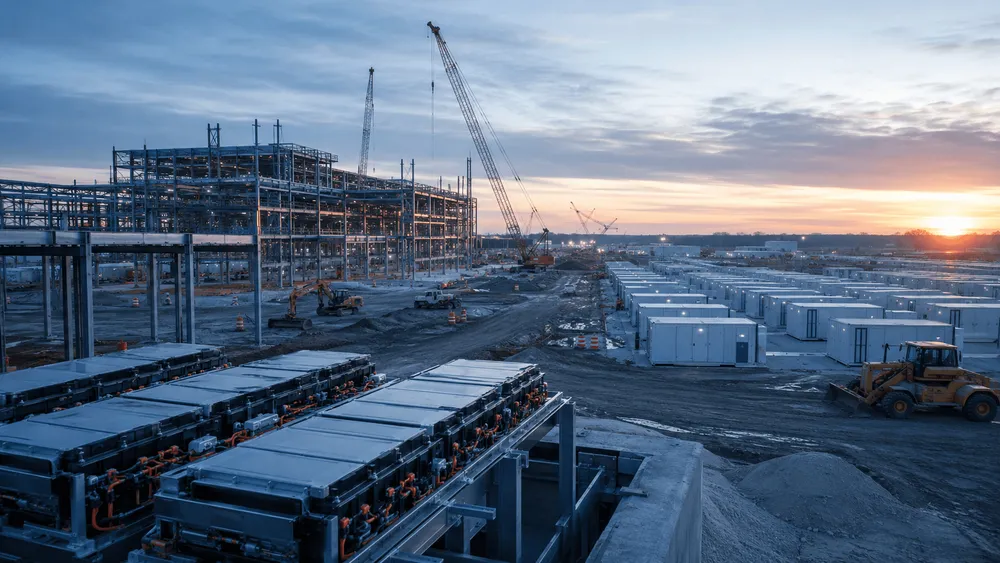
The battery plant in New Carlisle, Indiana, jointly planned by GM and Samsung SDI in 2024, has shifted from a plan to co-produce EV cells to a plan that will first produce batteries for energy storage systems (ESS). On August 11, Samsung SDI announced it had acquired GM's 49.99% stake in their joint venture, SynergyCells, and would turn the plant into its first independently operated production site in North America.
The plant is still under construction. Once completed, its initial use will not be GM-bound EV batteries but rather batteries for energy storage systems (ESS). Samsung SDI cited changing market conditions and EV demand growth that has been slower than expected as the reasons.
At the same time, this does not mean the relationship between GM and Samsung SDI itself is ending. The two companies will continue collaborating on the development of next-generation prismatic batteries, and are also considering the possibility of producing those batteries at New Carlisle in the future. The transfer of ownership and the collaboration on EV battery development need to be viewed separately.
The 49.99% Stake Sale Changes the Plant's Initial Use
What this announcement confirmed is that Samsung SDI will operate SynergyCells independently, and that the completed plant will initially be dedicated to ESS batteries. The plan has shifted from jointly producing EV cells with GM to first producing stationary batteries at a plant solely owned by Samsung SDI.
Even though EV and ESS batteries are both lithium-ion, the equipment requirements are not the same. For automotive batteries, range and weight are key factors determining product value, whereas for stationary batteries, cycle life, safety, cost, and stationary operating conditions strongly influence product design. Samsung SDI has not disclosed the chemistry or production line configuration to be used at New Carlisle, so the existing EV plan cannot simply be read across as an ESS production plan.
Also, the production destination for the future jointly developed cells remains unconfirmed. Samsung SDI's announcement mentioned the possibility of including the jointly developed prismatic batteries at New Carlisle, but it did not commit to EV cell production at that plant.
For GM, which relinquished its stake, this does not mean withdrawal from the battery business either. What has moved here is ownership of a specific joint plant and a decision about which demand to prioritize for the pre-completion facility.
The 2024 Plan Premised on 27GWh Is No Longer As It Was
Under the joint venture plan finalized in August 2024, the investment amount was expected to be approximately $3.5 billion, with an initial annual production capacity of 27GWh, expanding to 36GWh. The plan called for building the plant on a 680-acre site, with mass production starting in 2027 and creating more than 1,600 jobs.
The product at that time was a high-nickel NCA-based prismatic cell to be supplied for GM's future EVs. Therefore, both the 27GWh figure and the expansion to 36GWh were capacity figures for the original plan, which was premised on automotive demand. The August 2026 announcement changed the initial use to ESS, but it did not indicate the revised production capacity.
The completion timing is the same story. While Samsung SDI stated the plant is under construction, it has not clarified whether the previous mass production target of 2027 will be maintained, or how much change will be needed to set up equipment for ESS purposes. The acquisition price, the timing for job creation, and the ESS customers have also not been disclosed. The change in initial use does not mean the capacity at completion has been finalized.
This undisclosed information matters significantly for judging the business's profitability and utilization rate. The original investment amount of approximately $3.5 billion and the 27GWh capacity plan provide background, but they are not figures representing the scale of the new ESS plan at completion.
Bridging to AI Data Center Demand Through ESS
Behind Samsung SDI's choice of ESS as the initial use lies the U.S. market supply-demand situation the company presented in its Q2 2026 results. The company explained that while the U.S. EV market has been sluggish, demand tied to AI data centers—in grid-connected ESS, uninterruptible power supplies (UPS), and battery backup units (BBU)—supported a recovery in the first half of the year.
As renewable energy adoption expands, the role of energy storage facilities in absorbing fluctuations in power generation grows accordingly. AI data centers also face challenges in ensuring stable power supply, creating demand for UPS and BBU systems. For Samsung SDI, this creates an option to redirect physical assets that were being built with EVs in mind toward stationary demand instead.
The company has also indicated plans to advance preparations for mass production of prismatic lithium iron phosphate (LFP) batteries in the U.S. and to strengthen its local supply chain. However, this policy alone does not confirm that the ESS batteries at New Carlisle will be LFP. The chemistry, number of lines, and customers for the plant were not included in this announcement.
In the U.S., the Clean Vehicle Credit for new vehicle purchases (30D) is no longer available for vehicles acquired after September 30, 2025. While this is a change on the consumer side, Samsung SDI cited broader shifts in market conditions and slowing EV demand as the reasons behind the transaction. It would be premature to attribute the stake sale solely to the end of 30D.
The LG Energy Solution/ESS Options GM Retains
GM is pursuing the development of automotive and stationary batteries through other channels as well. GM and LG Energy Solution have already announced plans to begin commercial production of lithium manganese-rich (LMR) prismatic cells in the U.S. in 2028. GM projects that LMR will offer 33% higher energy density at a cost comparable to LFP, but this is GM's own estimate and does not pertain to the specifications of Samsung SDI's New Carlisle plant.
GM's options are not limited to a single path for stationary batteries either. In June 2026, GM explained that Ultium Cells would produce LFP batteries for LG Energy Solution's commercial energy storage business, and that it is also developing sodium-ion batteries for stationary use with Peak Energy. The LMR for automotive use, the LFP and sodium-ion batteries for energy storage, and the next-generation prismatic cell development with Samsung SDI each differ in timing and application.
For this reason, it would not be accurate to characterize the sale of the SynergyCells stake as GM stepping away from battery technology or ESS. While GM is transferring ownership of the joint plant under construction to Samsung SDI, it retains multiple pathways for development and production across different battery chemistries and applications.
Which chemistry the joint development with Samsung SDI will target, and when it will move toward commercialization, has not been disclosed. Whether it will lead to production at New Carlisle also depends on future discussions and equipment planning.
Conditions to Watch for New Carlisle at Startup
The value of New Carlisle cannot be measured at the point when the stake transfer is completed. What Samsung SDI presented was a direction toward independent operation and ESS as the initial use—not an announcement that the plant is already operational. The legal completion date and terms of the acquisition have also not been disclosed.
U.S. production could be relevant to the Advanced Manufacturing Production Credit (45X) if the battery components in question are produced and sold domestically. However, this is not support that is automatically available simply because production takes place in the U.S.; it requires meeting requirements related to eligible components and its relationship with 48C. At this stage, the tax implications cannot simply be overlaid onto the plant's profitability.
The point at which progress on this plan can be properly assessed will be when the completion date, revised GWh capacity, ESS cell chemistry and line configuration, and customer contracts are disclosed. Whether the jointly developed next-generation prismatic cells move toward a mass production plan will also serve as a benchmark for measuring whether the GM-Samsung SDI collaboration progresses toward implementation following the stake transfer.