

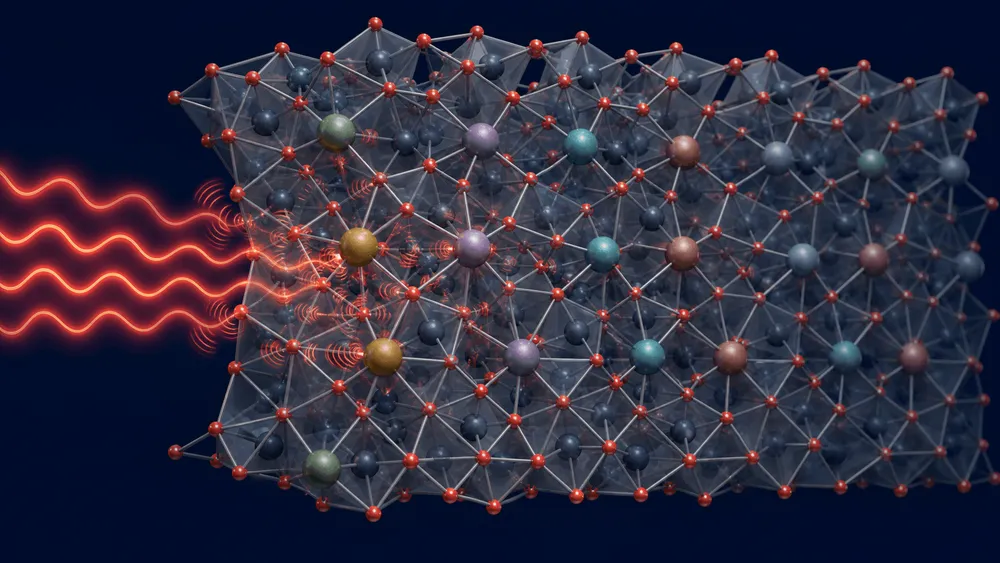
In an oxide that mixes six transition metals into a single crystal lattice, semiconductor-like electrical transport and low thermal conductivity were observed simultaneously. A research team from Penn State and Carnegie Mellon University, among others, measured a maximum thermal conductivity of 0.7 W/mK in the high-entropy oxide A6WO4 and investigated candidate mechanisms that alter charge and heat transport using computation and spectroscopy. The peer-reviewed paper was published in Communications Materials dated March 26, 2026, and became the Version of Record on July 27 (DOI: 10.1038/s43246-026-01103-2). The significance of the result lies not in completing a thermoelectric device but in expanding the design space for finding oxide semiconductors starting from insulating materials.
Comparing A6WO4 with Five Parent Phases at Low Temperature
Robert A. Robinson, Tara Karimzadeh Sabet, Francisco Marques dos Santos Vieira, and 21 authors in total investigated a wolframite-type A6WO4. At the same lattice position, called the A site, six elements adjacent in the periodic table—from Mn to Zn—are incorporated in equimolar amounts. Specifically, these are Mn/Fe/Co/Ni/Cu/Zn. This is a material in which dissimilar atoms are mixed into equivalent sites, raising the randomness of arrangement, that is, configurational entropy.
The research team milled 5 g of each raw material powder for 10 hours, then sintered it at 925°C for 12 hours followed by 975°C for 12 hours. Only FeWO4 was sintered in a 50 sccm argon gas flow, so the synthesis atmosphere was not identical across all phases. X-ray diffraction and electron microscopy, among other methods, confirmed the P2/c structure, phase purity, and distribution of the six elements. The comparison targets were single-cation WO4 phases of the five elements excluding copper (Mn/Fe/Co/Ni/Zn). CuWO4 was excluded from the thermal transport comparison because it cannot stabilize the same P2/c phase at ambient pressure.
In heat transport experiments from 5 to 300 K, the thermal conductivity of A6WO4 remained low across the entire temperature range, reaching at most 0.7 W/mK. The five parent phases showed peaks of 3–12 W/mK around 50–100 K. Additionally, using an A6WO4 pellet measuring 12.38 mm × 1.94 mm, the team calculated high-temperature thermal conductivity from thermal diffusivity measured between 300 and 900 K. The low-temperature side was directly measured with a Physical Property Measurement System, while the high-temperature side was a calculated value using the Dulong–Petit approximation for heat capacity—so the measurement methods were not the same.
0.24 eV from a Prior Experiment, 0.5 eV from This Study's Calculation
The optical band gap of 0.24 eV for A6WO4 is a measured value reported by Rowan Katzbaer and colleagues in 2023 in Inorganic Chemistry (DOI: 10.1021/acs.inorgchem.3c00541). It is not a newly measured value from this paper. The corresponding measured values for the parent phases range from 2.5 to 3.8 eV, meaning A6WO4 has narrowed into the semiconductor range.
What this study newly contributes are electrical transport measurements and an investigation into the mechanisms that narrow the electronic states. The room-temperature resistivity was approximately 2 Ωm, rising to 1.0×10^5 Ωm at 88 K. The resistivity from 100 to 265 K closely matched a three-dimensional variable-range hopping model, suggesting transport in which charge moves between localized states rather than freely across the crystal. However, the fit deviates at the edges of the temperature range. This fit alone cannot uniquely determine the transport mechanism.
For first-principles calculations of the electronic structure, the team used 72-atom special quasirandom structures for four-component and six-component systems, and 48-atom cells for two-component systems. As documented in the supplementary materials, the calculations covered 45 structures assigning three compositions to each of 15 elemental pairs, plus six multi-component compositions. The calculations showed that gap narrowing could arise from separation levels inherited from the parent phases, charge transfer from iron to copper, and orbital degeneracy lifting due to local lattice distortion.
On the other hand, the calculated value including all six components was 0.5 eV, which did not reproduce the experimental value of 0.24 eV. X-ray absorption spectroscopy showed iron's valence shifting toward the trivalent state, while X-ray photoelectron spectroscopy revealed the coexistence of monovalent and divalent copper. X-ray photoelectron spectroscopy probed a near-surface region 3–6 nm deep and 200 μm in diameter. The spectroscopic results are consistent with the calculated prediction of charge transfer between iron and copper, but they do not directly observe the causal chain by which multiple mechanisms produced the 0.24 eV gap. The authors themselves note that nonlinear synergy between mechanisms falls outside the scope of this calculation.
A Model in Which Chemical Disorder Blocks Heat
The low thermal conductivity is an experimental result. However, assigning its cause to a specific scattering process is an interpretation based on computation and model fitting. The research team performed first-principles phonon calculations for the five parent phases using 2×2×2 supercells and a 12×12×12 q-point mesh, then analyzed the measured curves using the Debye–Klemens–Callaway model.
A model that averaged the phonon properties of the parent phases and directly transferred normal scattering and Umklapp scattering to A6WO4 deviated from the measured values across a wide temperature range. Adding a term for direct phonon scattering by the random arrangement of dissimilar cations, along with a generalized term representing three-phonon scattering that does not conserve crystal momentum, improved the fit to the curve. Here, the term "defect" refers not to vacancies or interstitial atoms but to chemical disorder arising from atoms of differing mass and bonding arranged on the same sublattice.
However, three-phonon scattering that does not conserve wavevector was not directly observed. The phonon frequencies, group velocities, and heat capacity of A6WO4 were estimated from the average of the five chemically ordered parent phases. The paper also explicitly states that each term in the model is not necessarily attributable to a single mechanism alone, and does not rule out other scattering processes. Agreement between measurement and model supports the candidate mechanism but does not prove a single cause.
Before a Thermoelectric Device: Verifying Composition and Sample Density
Low thermal conductivity is one condition favorable for thermoelectric conversion. However, the room-temperature Seebeck coefficient of A6WO4 remains only about −90 μV/K, and its resistivity is also high. The paper explicitly states that the thermoelectric performance of the current composition is not good, and it does not present the dimensionless figure of merit zT or the conversion efficiency that represents performance. This is not yet a stage where it can be called a "high-performance thermoelectric semiconductor."
Sample density also remains a constraint. The A6WO4 used in the main measurements was 80% of theoretical density, while the parent phases were 65–80%, and voids lower thermal conductivity. The research team compared one sample each of A6WO4 at 60% and 80% density, reporting that the temperature-dependent shape was the same. The value suggesting that thermal conductivity would fall below 1.5 W/mK at 100% density is an extrapolation made by the authors from these two samples, not a measured value. The paper's main text does not report the number of independent repetitions or statistical uncertainty for each transport measurement, and reproducibility beyond this two-sample density comparison remains a subject for future verification.
As of August 5, 2026, no independent reproduction of this transport behavior and scattering mechanism by another team has been confirmed. The next piece of evidence needed is remeasuring thermal conductivity and its error across multiple densified samples, and determining whether varying the composition can simultaneously raise the room-temperature Seebeck coefficient and electrical conductivity. Furthermore, if the same mechanism holds in other high-entropy oxides, the correlation found in A6WO4 would move closer to becoming a reusable materials design principle.