

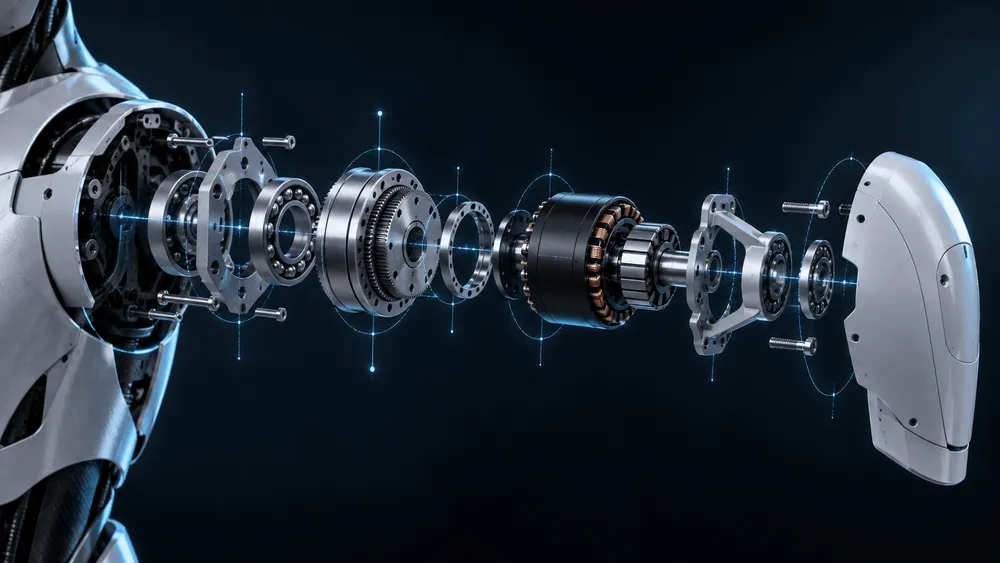
It was reported on August 31, 2026, that Goldman Sachs had revised its forecast for the 2035 humanoid robot market to $138 billion and 6.48 million units. That figure had only just been raised to $38 billion and 1.4 million units in February 2024. Meanwhile, the parts-cost estimate published by the Bank of America Institute in April 2025 puts the bill of materials (BOM) per unit at $35,000 by the end of 2025, falling to only $13,000–$17,000 by 2030–2035 even as mass production advances. While the dollar forecast moved 3.6x in two and a half years, the cost assumption only calls for less than half over five years. Closing this gap in speed is not happening on the market-forecast side; it depends entirely on how far the unit price of the 30 actuators packed into each robot can fall.
Sixfold, then another 3.6x in two and a half years
Goldman Sachs Research's report "Humanoid Robots: Sooner Than You Might Think," published on November 15, 2022, contained no dollar figure for market size. What it did contain was the line "in the history of humanoid robot development, no robot has yet succeeded commercially," along with a projection that economic viability could emerge for factory use in 2025–2028 and for consumer use in 2030–2035. It also noted that recovering an investment within two years would require cutting production costs by 15–20% annually.
Fifteen months later, the firm put a number on it. In its February 27, 2024 revision, it set the 2035 TAM (total addressable market) at $38 billion — more than six times the $6 billion it cited as its own prior forecast. Shipment volume was set at 1.4 million units, four times the earlier figure. The analyst was Jacqueline Du, who heads China Industrial Technology research. The reason given for the revision was a single line: "AI progress has surprised us the most." There was no mention of actual deployment results.
Costs had moved too. The same report noted that per-unit manufacturing cost had fallen from the prior year's $50,000–$250,000 range (from low-cost to state-of-the-art) to $30,000–$150,000. Against the firm's own assumption of a 15–20% annual decline, the actual figure came in at 40%. And the reason Goldman itself gave was not design philosophy but sourcing: cheaper components had become available and the number of suppliers had grown.
Then, at the end of August 2026, the same firm reportedly rewrote the same 2035 forecast once more. Market size: $138 billion. Shipment volume: 6.48 million units (apparently annual shipments, though Goldman's own classification was not made explicit in the reporting). The 2030 figure is said to have been raised from 256,000 to 890,000 units, and the 2026 figure from 51,000 to 75,000 units.
For the same 2035 market, Goldman Sachs has now raised its outlook twice — from $6 billion to $38 billion to $138 billion. Its shipment forecast has also grown 4.6x, from 1.4 million to 6.48 million units. The scale of these revisions far exceeds any realistic decline in actual BOM cost. Notably, the August 2026 figures have not been confirmed on Goldman's official pages, and reporting does not clarify whether the 6.48 million units refers to annual 2035 shipments or a cumulative total. Even the original $6 billion figure was itself something the February 2024 report retroactively cited as its "previous" estimate.
The reason forecasts can swing by such large factors lies in how the TAM is constructed. These are top-down estimates — the total labor market multiplied by a penetration rate — and moving that multiplier by just one percentage point can shift the result by hundreds of billions of dollars. CleanTechnica's Michael Barnard has offered a conditional calculation: against a global labor market of $20 trillion, a 1% penetration rate yields $200 billion, while 5% yields $1 trillion (he is not forecasting the penetration rate itself at 1–5%). If one percentage point of assumption equals $200 billion, revising the forecast is not a difficult task.
Cost estimates, by contrast, are built bottom-up. The Bank of America Institute's "Humanoid robots 101" (April 29, 2025) assumes Chinese-made components and sets the end-2025 BOM at $35,000, expecting it to fall to $13,000–$17,000 by 2030–2035 — an implied annual decline of roughly 14%. Extending that 14% rate directly, it would take about 5.6 years — landing around 2031 — for $35,000 to reach the $15,000 midpoint. Over the same span in which the dollar forecast moved 3.6x, cost, even if it proceeds exactly as assumed, would fall by less than 30%.
The job of turning a $930 joint into a $240 one
According to the industry analysis site GrabaRobot, the parts cost of Tesla's Optimus Gen-2, excluding software, is estimated at $50,000–$60,000 per unit. Per that report, the largest cost item is actuators at roughly 56%, followed by hands at 17.2% ($9,500), then hip and pelvis at 14.2%, thighs at 13.2%, shins at 13.2%, and feet at 12.2%. This breakdown is attributed to Morgan Stanley, but it cannot be directly confirmed against a primary source and should be treated as a secondhand figure.
The ratio itself varies by source. Estimates range from TechTimes' 35–40%, to Morgan Stanley's roughly 56% figure for Optimus Gen-2, to independent estimates of 40–55% — too scattered to pin down with a single number. What is certain is only that actuators sit somewhere within a 40–60% band, depending on the estimate.
On the count of actuators, the Bank of America Institute's model is specific: 16 rotary actuators and 14 linear actuators per unit, totaling 30, with the dexterous hand set at 6 degrees of freedom. The institute states that a 6-degree-of-freedom hand design can cover 60–70% of the functionality of a human hand (which has 27 degrees of freedom), and its cost estimate is built on a hand at that level.
Applying the ratio and the count together yields a per-unit dollar figure. If actuators account for 56% of the BOM across 30 units per robot, the parts cost per joint comes to $930–$1,120. To bring the total BOM down to $13,000–$17,000 while keeping the same ratio and count, each joint would need to fall to $240–$320 — a roughly 73% reduction. The math is simple: $50,000 × 0.56 ÷ 30 = $933; $60,000 × 0.56 ÷ 30 = $1,120. On the target side: $13,000 × 0.56 ÷ 30 = $243; $17,000 × 0.56 ÷ 30 = $317. Comparing the midpoints yields the required 73% decline.
This estimate comes with caveats. The total BOM and the ratio are Morgan Stanley's estimate for a single model, Optimus Gen-2, not an industry average; the count of 30 is from a Bank of America Institute model, issued by a different institution in a different year. The target range itself is a 2025-vintage forecast, not a realized price. There is also no guarantee the actuator share will remain at 56% going forward — if other cost items fall first, the share could rise instead. Even so, the order of magnitude — roughly $700 per joint that must be shaved off — does not change.
So where does that $700 come from? Here, the contrast with semiconductors matters. With semiconductors, each new process generation packs more transistors into the same area, so the cost per unit of function drops in step-like fashion.
Precision reducers are the opposite: the process of grinding, measuring, and assembling gear teeth does not shrink. Whether it's a strain wave gear or a planetary roller screw, unit price is set by the precision of the machining equipment and the number of process steps, and neither of those automatically compresses just because volume rises. What does fall is yield, changeover time, the intermediate margin removed by in-house production, and material sourcing terms. In other words, this is a learning curve, not an exponential curve.
Looking at current unit prices shows how far away that target still is. According to the same GrabaRobot article, the planetary roller screws used in leg linear joints cost $1,350–$2,700 each, with roughly 12 units in a full-size robot (neither the count nor the price, including the source, has been confirmed against a primary source). A single screw accounts for roughly a tenth of the entire target BOM. Hands are similar: if a 6-degree-of-freedom hand assembly costs $9,500, that alone exceeds half of the $13,000–$17,000 target. The closer a robot's hand gets to a human hand, the further the target moves away.
A $13,500 machine, and machines with no listed price
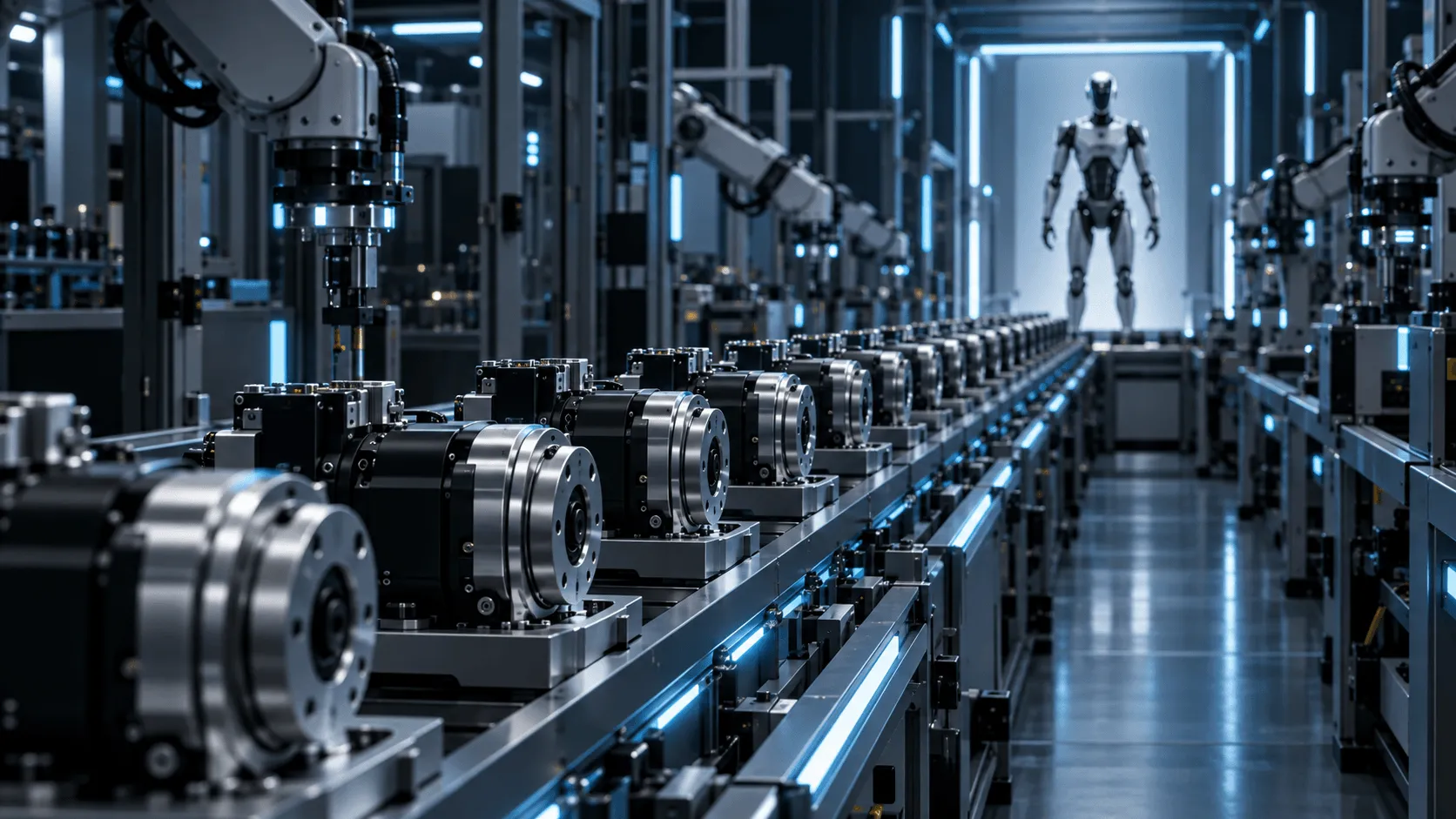
Unitree's official store sells the G1 for $13,500 (tax and shipping excluded). Full height: 1,320mm; mass: about 35kg; 23 degrees of freedom; roughly two hours of operating time. Looking at this single unit alone, it appears the $13,000–$17,000 mass-production BOM target has already been hit.
Western commercial machines, by contrast, don't even list a price. Neither Boston Dynamics' electric Atlas nor Figure 02 has a published official price, and the estimates circulating publicly don't agree with each other. Agility Robotics' Digit is offered mainly as RaaS (robot-as-a-service); the company's June 2026 investor materials cite an assumed price of roughly $8,500 per unit per month, or about $100,000 annually. The often-cited "$30 per hour" figure does not refer to the Digit usage fee — it's the fully burdened human labor cost (about $30.50/hour) used as a point of comparison.
On the consumer side, 1X Technologies' NEO is priced at either a $20,000 lump sum or $499/month (with a $200 reservation fee), with shipments to U.S. households set to begin in 2026. Tesla's Optimus target of $20,000–$30,000 is Elon Musk's stated long-term mass-production price goal; as of mid-2026 there are no orders, no official price, and no shipments to paying customers. Target prices, quoted prices, and market prices are all being discussed side by side using the same unit — dollars.
When the average selling price falls, there are two distinct paths behind it. One is that the cost of producing the same configuration of machine falls. The other is that cheaper products sell more and the mix shifts.
Unitree's average selling price for humanoid robots fell from RMB 593,000 in 2023 to RMB 168,000 in the January–September 2025 period. The company makes its own motors, reducers, joint modules, and servo drivers, so it certainly has the first factor at play. At the same time, the expansion of its price range — from the roughly $4,900 R1 to the $43,900–$73,900 EDU developer edition — means the second effect is mixed in too. Looking at the average alone and reading it as "hardware got cheaper" risks conflating the two.
A breakdown by use case helps separate them. According to a Counterpoint Research report dated August 19, 2026, global shipments in the first half of 2026 exceeded 22,000 units, up roughly 300% year-over-year, with full-year shipments expected to exceed 50,000 units (up 210%). Market share: AgiBot 43%, Unitree 31%. But broken down by use case, entertainment and demonstrations plus data generation and research together account for over 60%, while intelligent manufacturing is just 13% and warehouse logistics only 5%. A sharp rise in shipment volume is indeed occurring — but most of it is not machines working in factories or warehouses.
In other words, what China's mass production has solved is how to build machines cheaply for research and demonstration purposes. Shipping a 23-degree-of-freedom robot with two hours of runtime at $13,500 is not the same problem as shipping a finished machine that runs eight hours a day in a factory with ten years of guaranteed spare-parts support, at the same price. Even when IDTechEx forecasts the global average selling price falling roughly 68%, from $114,700 in 2024 to $37,000 by 2030, the base year is 2024, and the average shifts substantially depending on whether Chinese mass-produced units are included in the population.
84 finished machines, versus an 80% share in joints
A forecast published by Yano Research Institute on April 24, 2026 (based on manufacturer shipment units) puts the global market at 16,580 units in 2025, 81,690 units in 2026 (up 492.7% year-over-year), and 7.18 million units in 2035. The 2025–2035 CAGR (compound annual growth rate) works out to 83.5%. In the same tally, Japan's domestic market stands at just 84 units in 2025 — under 1% of the global share. Judging strictly by finished-machine volume, Japan is barely a participant in this market.
Shift the focus to components, and the picture reverses. Harmonic Drive Systems maintains an 80–90% global share in the small precision reducer (strain wave gear) market, and moved its listing to the Tokyo Stock Exchange Prime market on February 27, 2026. For the fiscal year ending March 2026, it posted revenue of ¥59.557 billion (up 7.0% year-over-year) and operating profit of ¥2.567 billion. Operating profit the prior year had been just ¥6 million — meaning it recovered by nearly four orders of magnitude in a single year. President Akira Maruyama has said, "It's rare for a component to remain in use this long after its basic patent has expired."
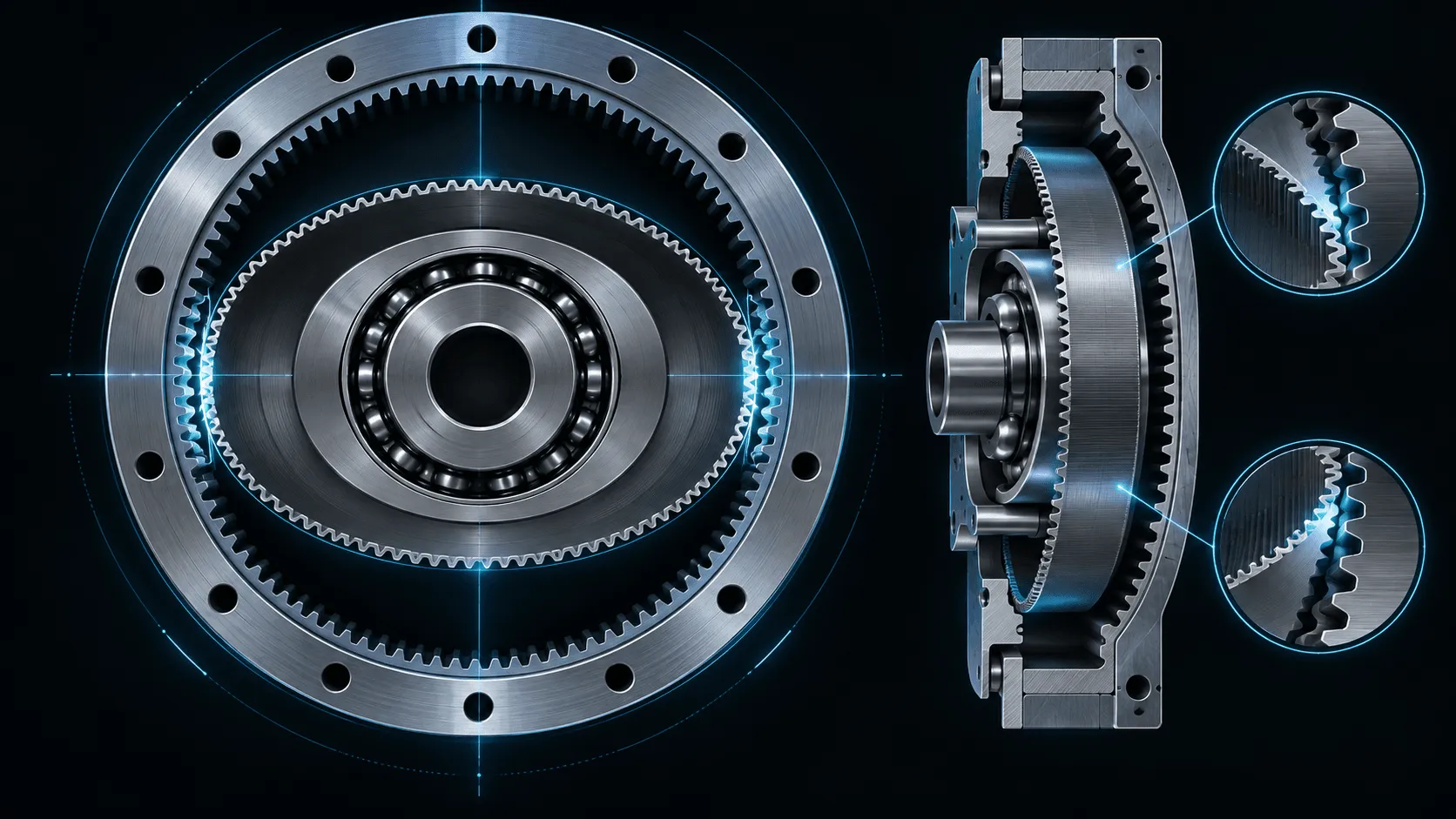
The reason strain wave gears have held onto their place in robot joints comes down to structure. A thin metal cup is pressed into an elliptical shape, and the meshing point with an outer rigid ring shifts by one position with each rotation, producing reduction. Unlike gear-train designs, this method produces almost no backlash, achieves a high single-stage reduction ratio of roughly 100:1, and remains lightweight. For a robot that needs to precisely control joint angles, a component that satisfies all three of these properties at once is hard to replace.
And humanoids need many joints. According to the company, the number of reducers per unit runs roughly 6–10 times higher than in a conventional industrial robot. This is a business where what matters is not whether one finished machine sells, but how many reducers go into that one machine.
Japan's other major player, Nabtesco, has long held the mid-to-large industrial robot joint market with its RV reducers. The two companies dissolved their partnership in 2021; Nabtesco decided in November 2022 to sell its Harmonic Drive shares, and by June 2023 had completed the sale of its entire stake for a total of ¥37.515 billion. Japan's two reducer makers are now approaching the new demand from humanoids separately.
In a December 9, 2025 analysis, TrendForce classified Japan as pursuing a strategy of raising barriers to entry through core components — actuators, sensors, and control systems — while the U.S. and China push finished products aggressively into the market. That doesn't mean Japan has no finished machines. Kawasaki Heavy Industries' Kaleido 9 stands 190cm, weighs 99kg, and has 30 degrees of freedom across its body; at iREX 2025 in December 2025 it demonstrated moving a 30kg shelf. But it isn't competing on volume.
On the finished-machine side, Japan's involvement so far has appeared mainly as a buyer. Agility Robotics and Toyota Motor Manufacturing Canada announced a RaaS agreement on February 19, 2026. Following a one-year pilot with three units, the initial rollout is seven units, deployed at plants in Cambridge and Woodstock, Ontario, to handle loading and unloading totes onto automated guided vehicles.
Tim Hollander, president of Toyota Motor Manufacturing Canada, said that after evaluating many robots, they chose Digit, and expressed pleasure that it could improve working conditions for employees while further increasing operational efficiency. Goldman's 2026 revision reportedly also included an estimate that Toyota could produce 190,000–540,000 units by 2035, a 3–8% global share. Japan as a buyer is beginning to be counted, in the same breath, as part of the production-country outlook as well.
One caveat here: Harmonic Drive's 80–90% figure refers to the specific strain wave gear product market, not the reducer market as a whole, and certainly not the robot-components market as a whole. It is also widely acknowledged within the industry that Chinese manufacturers are catching up fast, using price as their weapon. The reading that Japan monopolizes robot joint components does not follow from these figures.
The "Year One" that arrived three times
The label Chinese media attaches to this industry has moved up every year. 2024 was the year of prototype releases; 2025 was the "Year One of Mass Production"; and 2026 is the "Year One of Commercialization." Xinhuanet's January 8, 2026 article frames 2026 as the year of commercialization, citing estimates from the GGII (High-Tech Robot Industry Research Institute) that shipments will grow from 18,000 units in 2025 to 62,500 units in 2026.
Lining up the deployments actually confirmed under contract in this "Year of Commercialization" tells a different story. Agility Robotics and Toyota Motor Manufacturing Canada: 7 units. BMW's February 27, 2026 release describes its Figure 02 project at Spartanburg as a pilot project involving a single unit. That one unit supported a production process that built over 30,000 X3 vehicles over ten months in 2025, moving parts roughly 90,000 times over 1,250 hours of operation — but Figure announced the retirement of Figure 02 on November 19, 2025. Boston Dynamics unveiled its production-version Atlas at CES 2026, but its 2026 production capacity is reportedly fully allocated to Hyundai's Robotics Metaplant Application Center and Google DeepMind, with shipments to outside customers not starting until early 2027.
The gap between production and actual operation is wider still. According to Interact Analysis, over 20,000 humanoid robots were produced globally in 2025 (up tenfold from under 2,000 in 2024), but only about 10% — roughly 2,000 units — were actually put into operational use. The rest, according to the firm, went largely to research, data collection, and entertainment purposes. Interact Analysis sees the inflection point for large-scale commercialization coming after 2032, forecasting annual shipments of over 700,000 units and market revenue of about $15 billion by 2035.
When comparing figures, what needs aligning first is not units but definitions. The 2035 volume forecasts line up as follows: Goldman Sachs at 6.48 million, Yano Research Institute at 7.18 million, Morgan Stanley at 13 million — but Yano's figure counts manufacturer shipments, Morgan Stanley's counts operational units in service, and it isn't even clear from reporting whether Goldman's 6.48 million refers to annual shipments or a cumulative total, so treating it as annual shipments remains provisional. Numbers that look close are often not counting the same thing at all.
Shipments represent units that left the factory that year — a flow — while operational units are a stock built up from past shipments; assuming a five-year service life, the stock figure in the same market could be several times the flow figure. Morgan Stanley's 13 million is reported as an operational-unit forecast, and the figure the firm expresses with more confidence is its longer-term picture: a roughly $5 trillion market and about 1 billion operational units by 2050. The same kind of mismatch shows up in dollar figures too. Goldman's $138 billion is a total TAM, while Interact Analysis's roughly $15 billion is annual shipment-based market revenue — a ninefold gap that looks meaningful but is comparing different things entirely.
Examples of forecasters tracking their own accuracy are, in this field, the exception rather than the rule. In a January 1, 2026 self-assessment, Rodney Brooks graded his own 2018 predictions about dexterous hands and household robots as unmet, and added new predictions: usable dexterity will likely remain inferior to the human hand well past 2036, and unless new mechanisms emerge, walking humanoid robots will remain too dangerous to operate right next to humans for the foreseeable future.
Toward $240 a joint: who is going to cut the cost?
At this point, three paths could plausibly deliver a 73% price cut. The first is bringing component production in-house. Behind Unitree cutting its average selling price to under a third in two years lies in-house drivetrain manufacturing, and the same shift is now starting on the finished-robot maker side as well.
Figure AI's own factory, BotQ, had reached a production rate of one unit per hour as of April 29, 2026 — a 24x increase achieved in under 120 days. In the process of manufacturing over 350 Figure 03 units, the facility produced more than 9,000 actuators across more than 10 part types, reportedly achieving an end-of-line first-pass yield above 80%. When a finished-robot maker operates its own actuator factory, the intermediate margin per joint disappears.
The second path is production volume itself. The variable a learning curve tracks isn't time — it's cumulative production. Because cost falls by a fixed percentage each time cumulative volume doubles, the Bank of America Institute's "14% annually" figure is really a volume-based function translated into a yearly rate. TrendForce forecasts global shipments of over 50,000 units in 2026, while Goldman puts the figure at 75,000; at this scale, doubling cumulative volume won't take long. But turning a $930 joint into a $240 one requires multiplying cumulative volume many times over, and the number of years that takes is governed more by absolute unit count than by the growth rate of shipments.
The third path, semiconductors, has limited leverage. Goldman's 2026 report is reported to estimate per-unit semiconductor cost at over $3,000–$6,000 — roughly 10–20% of a $35,000 BOM. Even if semiconductor cost were halved, that would only cut $1,500–$3,000 from total cost, bringing $35,000 down to just $32,000–$33,500. Cheaper compute makes a robot smarter, but it doesn't make its joints cheaper.
Into this picture, a regulatory line has now been drawn. On July 28, 2026, the FCC added "foreign-produced advanced robotic devices" — mobile machines including autonomous mobile robots, humanoids, and quadrupeds — to its Covered List via public notice DA 26-786. Covered devices include units over 4.4 pounds (roughly 2kg) with connectivity of 200kbps or more; new models will no longer be able to obtain the equipment authorization required for import and sale in the United States.
Existing certifications are not revoked retroactively — already-certified machines can still be sold and used — but any hardware change requires an individual waiver. This is not a blanket ban; it's a measure that closes the entry point for new machines going forward.
Where exactly that line falls becomes clear from a look at Nvidia's own announcement. At GTC Taipei on June 1, 2026, the company unveiled its Isaac GR00T reference humanoid robot. Its body is Unitree's H2 Plus chassis (roughly 183cm, 68kg, 31 degrees of freedom), paired with a Sharpa Wave five-finger hand (22 degrees of freedom) and a Jetson AGX Thor T5000, for 75 degrees of freedom overall. It is set to be supplied by Unitree in the latter half of 2026, with adopters reportedly including four institutions such as Ai2 and the Stanford Robotics Center. The body American researchers are set to use as a reference platform is built by a manufacturer whose products the U.S. itself added to an import restriction list in July.
Which brings us back to the central question of how fast prices actually fall. A learning curve depends on how many units of the same design were built in the same factory. If the supply chain splits in two along regulatory lines, each side loses a substantial portion of its share of the cumulative-volume denominator, and reaching $240 per joint gets delayed. Even if the Bank of America Institute's 14% annual rate holds, $35,000 wouldn't reach the $15,000-range midpoint until around 2031 — and it would take further time still before that filters through to actual retail prices.
So the numbers worth watching next aren't Goldman's revision size or its TAM figure. They're how far Counterpoint's use-case breakdown of 13% intelligent manufacturing and 5% warehouse logistics climbs; where Unitree's average selling price stops falling; and how much Harmonic Drive Systems' humanoid-related shipments add up to in terms of actual reducer units. If a joint reaches $240, humanoids stop being capital equipment requiring individual sign-off for each purchase and become a tool whose count you simply add to match your process needs. But as Melonee Wise pointed out in an interview with IEEE Spectrum, no one has yet found a use case that requires thousands of units at a single site. Whether demand is waiting once prices drop remains a separate question from the cost math itself.