

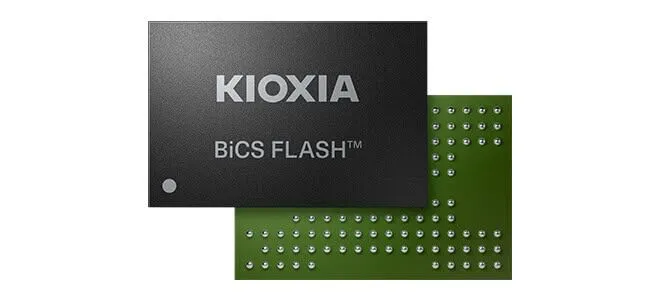
Kioxia has stepped into a product lineup that no longer treats NAND flash generation numbers as a simple old-to-new hierarchy. On July 30, 2026, the company announced, in quick succession, sample shipments of a 1Tb TLC product using 230-layer 9th-generation BiCS FLASH and the "KIOXIA CM10 series" enterprise SSD equipped with 332-layer 10th-generation BiCS FLASH. The former targets mainly AI PCs and smartphones, while the latter aims at AI inference and enterprise systems.
Both products reach a NAND interface speed of 4.8Gb/s. What differs is the design approach and where investment is placed to get there. The 9th generation leverages existing memory cell technology to hold down capital expenditure, while the 10th generation increases both the number of layers and planar density to achieve larger capacity. With this same-day announcement, the "dual-axis strategy" that Kioxia has been advocating has begun moving on both the NAND device and SSD fronts.
230 Layers and 332 Layers Both Aim for the Same 4.8Gb/s
The 9th-generation 1Tb TLC combines 230-layer memory cells based on the 8th generation with the latest CMOS circuitry. TLC is a method that records 3 bits per cell. Here, 1Tb indicates the density of the NAND device in bits, and does not mean a 1TB SSD capacity usable by end users.
Kioxia uses CMOS directly Bonded to Array (CBA) technology, fabricating the memory cell array and CMOS circuitry on separate wafers and then bonding them together after manufacturing. On Pitch Select Gate Drain (OPS) technology reduces unused memory holes, shortening bit lines while also lowering word line capacitance. Both technologies have been used since the 8th generation, making the 9th generation a product that builds performance on top of existing processes.
| 9th-Gen 1Tb TLC | 10th-Gen 1Tb TLC | |
|---|---|---|
| Number of layers | 230 layers | 332 layers |
| NAND interface | 4.8Gb/s, 33% improvement over 8th gen | 4.8Gb/s, 33% improvement over 8th gen |
| Primary target | High performance and investment efficiency in low-to-mid capacity range | Large capacity, high performance, enterprise/data center SSDs |
| Stage confirmed this time | Sample shipment announced July 30, 2026 | Sample shipment announced July 3, 2026 |
What the table shows is that the 10th generation is not always faster than the 9th generation. Through 332-layer stacking and increased planar density, the 10th generation raised bit density by 59% compared to the 8th generation. Power efficiency during writing is said to have improved by 18%, and by 30% during reading. Meanwhile, the 9th generation achieves the same 4.8Gb/s as the 10th generation while keeping the layer count at 230. The role of each generation is determined by a combination of speed, capacity range, and manufacturing investment.
However, the 4.8Gb/s figure and power efficiency improvement rates are NAND-side values measured under Kioxia's specific conditions. An SSD's actual performance is also affected by the controller, firmware, error correction, and thermal design. Evaluation samples may differ in specification from mass-produced products, and the mass production timing for the 9th-generation 1Tb product has not been disclosed.
CM10 Brings 10th-Gen BiCS to PCIe 6.0
The concrete implementation of 10th-generation BiCS FLASH appears in the E3.S and E1.S models of the KIOXIA CM10 series. These two form factors are Kioxia's first PCIe 6.0-compatible enterprise SSDs, supporting NVMe 2.1 and NVMe Flexible Data Placement (FDP). Compared with the previous-generation CM9, sequential read performance is said to have improved by up to approximately 92%, and random read by up to approximately 85%. However, the announcement materials do not disclose absolute performance figures or comparison conditions.
CM10 offers a read-intensive 1 DWPD variant and a mixed-use 3 DWPD variant, where DWPD, or drive writes per day, indicates how many times the full drive capacity can be rewritten per day during the warranty period. The read-intensive E3.S model reaches up to 61.44TB, while the mixed-use model reaches up to 51.2TB. The E1.S ranges from 3.84TB to 15.36TB for the read-intensive variant.
Looking only at the product name and assuming "all CM10 models are PCIe 6.0 with 10th-generation BiCS" would be a mistake. It is the E3.S and E1.S that adopt PCIe 6.0 and 10th-generation BiCS. The 2.5-inch version uses PCIe 5.0 and 8th-generation BiCS FLASH. Its capacity is also limited to a maximum of 30.72TB for read-intensive and 25.6TB for mixed-use variants. Kioxia has not explained why only the 2.5-inch version has different specifications, and adopters must check by form factor rather than by series name.
There are also caveats regarding "compliance" with the OCP Datacenter NVMe SSD Specification v2.7. Kioxia itself notes that it does not meet all requirements of that specification. On the security side, the company touts SPDM v1.4 and quantum-resistant cryptography aligned with CNSA 2.0, while FIPS 140-3-compliant models remain at the planning stage. Rather than simply listing standard names, adopters need to verify the scope of compliance with individual requirements.
Doubling Bandwidth Turns Cooling into a Design Challenge
PCI Express 6.0 raises the per-lane rate to 64.0GT/s, aiming for twice the transfer rate of PCIe 5.0. PCI-SIG moved from binary NRZ signaling to four-level PAM4 signaling, and introduced low-latency forward error correction (FEC) along with 256-byte Flits. The 256GT/s figure that Kioxia presents for the CM10 E3.S and E1.S is the combined transfer rate of four bundled PCIe 6.0 lanes, and does not mean the SSD can read 256GB per second.
The CM10, in the E3.S and 9.5mm-thick E1.S form factors, supports direct liquid cooling, in which a cold plate is applied directly to the SSD. The 15mm version of the E1.S is air-cooled only, and all form factors can also be used with conventional air cooling. Kioxia explains that direct liquid cooling can make AI infrastructure cooling systems more efficient, but power consumption, temperature, and sustained performance under liquid cooling have not been disclosed. The effects remain to be verified through customer evaluation.
NVIDIA CMX, which the CM10 claims to support, offers concrete material for envisioning its intended use case. CMX uses BlueField-4 to manage NVMe SSDs, placing a context layer shared on a per-pod basis outside of GPU memory. This is a configuration for storing and sharing the KV cache generated by long inputs and multi-turn conversations. However, the effect of incorporating the CM10 has not been shown, nor has it been announced that PCIe 6.0 is a requirement for CMX.
Beyond Sample Shipment Lie Mass Production and Real-World Measurement
The CM10 is still at the stage of sample shipment to limited customers, and has not yet reached mass production or general availability. It is scheduled to be exhibited at FMS, held in Santa Clara, California, from August 4 to 6, 2026. Pricing and mass production timing remain undisclosed. Power consumption and sustained performance under liquid cooling also remain unclear.
In the competition for PCIe 6.0 enterprise SSDs, Samsung Electronics had already announced the start of mass production of the PM1763 on July 8. Therefore, CM10's claim of being "first" refers to Kioxia's own internal product generations, not an industry first. While Samsung moved forward to mass production, Kioxia shipped samples of the 10th-generation 1Tb TLC on July 3, and the 9th-generation 1Tb TLC and CM10 on July 30, advancing to the evaluation stage in parallel while separating NAND designs by use case.
The next decision-making factor is not the layer count or standard names. It is how much read performance the CM10 can sustain under the same capacity, endurance, and cooling conditions, and how far power consumption per unit can be reduced. Only when mass production start dates and customer adoption are added to that picture will it become possible to gauge whether the dual-axis strategy has delivered results in both manufacturing investment and AI storage.