

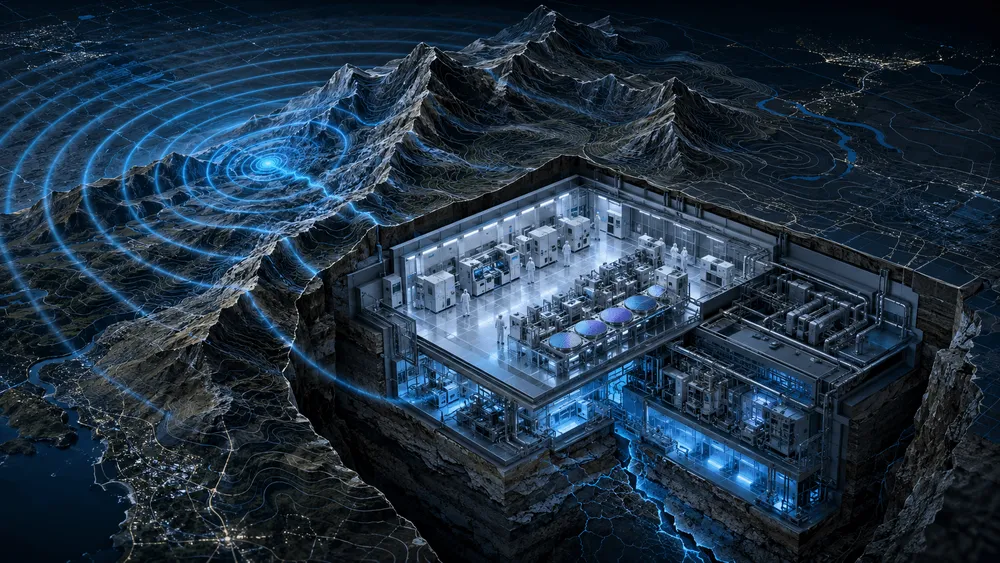
Whenever news breaks about semiconductor shortages, readers have first asked, "Is TSMC okay?" But the M7.1 "Reiwa 8 Kumamoto Earthquake," which struck the Kumamoto region of Kumamoto Prefecture at 4:27 PM on July 28, 2026, showed that this question itself was missing the point. TSMC's subsidiary JASM (Kikuyo Town, seismic intensity 5 lower) confirmed no damage to its buildings and resumed operations in stages. Meanwhile, Tokyo Electron Kyushu (Koshi City at intensity 5 upper, Ozu Town at intensity 6 lower)—which holds a 91% global share of coater/developer equipment (machines that apply and develop photoresist)—suspended operations entirely for the day on July 29. TSMC Kumamoto's production capacity is said to be under 3% of the company's total. Yet in the equipment supply chain, it is Tokyo Electron Kyushu, supporting that small site, that holds the larger stake.
The Two Companies' Initial Responses on July 28, When Intensity 7 Struck the Semiconductor Hub
The Japan Meteorological Agency (JMA) announced that an earthquake centered in the Kumamoto region of Kumamoto Prefecture occurred at around 4:27 PM on July 28, 2026. The epicenter was roughly 10 km deep, with a preliminary magnitude of M7.1, and the maximum seismic intensity of 7 was recorded in Uki City and Hikawa Town. The JMA named the quake the "Reiwa 8 Kumamoto Earthquake," issued tsunami advisories for the coasts of the Ariake Sea and Yatsushiro Sea, and warned residents to remain alert for aftershocks of up to intensity 7 over the following week, especially in the first two to three days. Intensity readings varied by site: 5 lower in Kubota, Kikuyo Town; 6 lower in Ozu, Ozu Town; and 5 upper in Takeba, Koshi City.
The full scope of human casualties remained fluid as of July 29, 2026. At a press conference at 8:30 AM on July 29, Prime Minister Takaichi cited a death toll of 13 while stating that "confirmation of both human and material damage is still ongoing." Kumamoto Prefecture, in an announcement at 9:30 AM the same day, reported 3 deaths from building collapses and 5 people in cardiopulmonary arrest. Cardiopulmonary arrest does not constitute a medically confirmed death, so these figures are likely to continue changing.
TSMC's subsidiary JASM (Kikuyo Town) evacuated all employees per its evacuation protocols and confirmed their safety through roll call. In a statement, TSMC said, "All personnel evacuated according to evacuation standards, and the safety of everyone on the premises has been confirmed. Structural inspections found no damage affecting the safety of the buildings." After completing structural inspections, Fab 1 resumed operations in stages. While no direct earthquake impact has been confirmed at the Fab 2 construction site either, some work there has been suspended out of caution regarding aftershocks.
Tokyo Electron Kyushu (which operates two sites, in Koshi and Ozu), by contrast, stated in an official release: "At this time, no significant damage to buildings or equipment has been confirmed. Tomorrow, prioritizing safety above all, we will halt operations at both sites and conduct safety inspections." The company chose to suspend operations entirely for the day on July 29. While both companies share the fact that no building damage was confirmed, their decisions were diametrically opposed. Understanding where this difference came from is the next focus.
Intensity 5 Lower vs. 6 Lower: Why the Same Earthquake Produced Opposite Outcomes
On the JMA's seismic intensity scale, the shift from 5 lower to 6 lower is continuous in terms of perceived shaking and the movement of objects—but for precision equipment, its significance is not continuous at all. Semiconductor fab cleanrooms are lined with equipment such as lithography systems and coater/developers (machines that apply and develop photoresist on circuit substrates), all of which depend on nanometer-scale alignment. Even a shift of just a few millimeters from the foundation can necessitate recalibration of such equipment, meaning that even without structural damage to the building itself, a separate round of equipment-level inspection and recalibration becomes necessary. Misalignment in a coater/developer degrades the overlay accuracy of pattern formation performed later by lithography equipment, directly leading to yield losses such as circuit breaks or shorts—which is why inspection cannot be skipped even when no visible abnormality is apparent.
When Tokyo Electron Kyushu stated in its release that it was "prioritizing safety above all," this can be read as referring to this kind of equipment-level inspection. The Ozu site, which recorded intensity 6 lower, experienced stronger shaking than JASM in Kikuyo Town at intensity 5 lower, meaning a correspondingly larger volume of work is required to individually check for misalignment or calibration drift in each piece of equipment. Even though both companies agreed on the criterion of "no building damage" in terms of structural seismic resistance, when judged by the criterion of recalibrating each individual machine, a one-step difference in intensity translated into the difference between resuming operations and a full day's suspension. Because fabs with more equipment have more units to inspect, differences in seismic intensity tend to show up directly as differences in inspection time required.
The fact that semiconductor fabs take a more cautious initial approach than typical factories also reflects design philosophies specific to this industry. Many cutting-edge fabs not only incorporate base-isolation or vibration-damping structures into the buildings themselves, but also mount key equipment such as lithography systems and coater/developers on individual active vibration-isolation platforms, designed to cancel out micro-vibrations independent of the building's own shaking. However, strong lateral shaking on the order of intensity 6 lower can exceed the tolerance range these isolation mechanisms are designed for. The three-tiered defense of building, floor, and equipment can each guarantee that things won't break, but none of them can guarantee that equipment precision will be preserved. Tokyo Electron Kyushu's decision to opt for a full day's suspension immediately after confirming its buildings were undamaged appears to reflect an awareness of this gap between the two standards.
Why Tokyo Electron Kyushu's 91% Mattered More Than TSMC's 3%
Most major news reports emphasized that TSMC Kumamoto's production capacity accounts for under 3% of the company's total, framing the earthquake's coverage around the narrative that "the impact on TSMC itself is limited." This figure itself is not wrong. However, what that 3% figure measures is "the share of Kumamoto within TSMC's total production volume"—and whether it's appropriate to draw the boundary of impact there is a separate question entirely.
Tokyo Electron Kyushu is said to hold a 91% global share of coater/developer equipment, with Kumamoto serving as effectively its sole production site. What that 91% figure measures is not "the share of Kumamoto within TSMC's production volume," but rather "the share of Kumamoto-made units within all coater/developer equipment used by semiconductor fabs worldwide." These two figures have different denominators, so it would be an oversimplification to line them up and conclude "3% is small, 91% is large"—but in terms of the scope of impact, the 91% figure covers far more ground. If TSMC Kumamoto goes down, only TSMC suffers. If Tokyo Electron Kyushu goes down, semiconductor manufacturers worldwide—not just TSMC—are affected.
JASM is a joint venture in which TSMC holds a majority stake, with Sony Semiconductor Solutions and Denso (with Toyota also planning future investment) as minority shareholders. Its focus is mainly mature process nodes such as 28/22nm and 16/12nm, with the bulk of TSMC's leading-edge 2nm/3nm processes remaining in Taiwan. Even at this scale, Kumamoto is merely one small piece from the standpoint of TSMC's own production diversification strategy—meaning the true single point of failure lay on the equipment side.
The mature-process work handled by JASM is centered on demand from the automotive and industrial equipment sectors. The presence of Denso as a minority shareholder, along with Toyota's planned future investment, underscores that this fab is strongly oriented toward supporting the parts-procurement network of Japan's domestic automotive industry. The fact that Toyota's major plants, having resumed operations after this earthquake, were forced to halt again due to aftershocks confirms that the industries this fab supports and the industries disrupted by the earthquake overlap in the same region.
While TSMC has diversified its production sites beyond Taiwan to the U.S. and Japan, Tokyo Electron has long maintained a structure concentrating everything from development to mass production at its single Kumamoto site. Because mass production of semiconductor equipment involves extraordinarily precise processes, adding more sites multiplies the costs of duplicating engineers and capital investment, which makes site consolidation economically rational for equipment makers. This earthquake exposed the risk lurking behind that rationale.
2016: A 10-Day Recovery, and the First Real Test for a ¥2.1 Trillion Site
This is not the first time Kumamoto Prefecture has been struck by a major earthquake. In April 2016, a foreshock (M6.5, April 14) and mainshock (M7.3, April 16) struck in quick succession, killing 211 people. In that 2016 earthquake, Tokyo Electron Kyushu managed to resume production in stages roughly 10 days later, on April 25, but Sony Kumamoto (now Sony Semiconductor Solutions) took about three months to fully recover, and the resulting disruption in supply of image sensors for digital cameras rippled out to camera manufacturers.
TSMC announced the establishment of JASM in 2021, aiming to diversify away from its concentration in Taiwan, with an investment of roughly $13.9 billion (about ¥2.1 trillion). The Japanese government has subsidized this project with up to ¥732 billion. Fab 1 began mass production in December 2024, meaning this earthquake struck barely a year and a half after operations began. For JASM, a site of national strategic importance, this marks its first experience with a major earthquake.
As of July 29, 2026, the timing of Tokyo Electron Kyushu's resumption of operations remains undetermined, so it is not yet possible to make a simple comparison with the 2016 track record of "10 days." That said, the speed of its initial response—voluntarily opting for a full day's suspension and safety inspections even before building damage had been confirmed—can be seen as a response informed by the lessons of 2016. Sony Semiconductor Solutions has also halted production at both its Kikuyo and Koshi sites, meaning the same scenario from 2016 is once again being put to the test.
Tokyo Electron Shares Drop 6.5%, Ripple Effects Spread to Automotive and Cameras
Markets treated Tokyo Electron Kyushu's shutdown as more serious than the damage to TSMC. TSMC's stock closed down 2.98% on the Taiwan market, and its U.S. ADRs (American Depositary Receipts) fell as much as 2.64% in premarket trading. Tokyo Electron's stock, by contrast, fell 6.50% from the previous day to ¥52,280 on July 29, single-handedly dragging the Nikkei average down by roughly 559 points. The fact that the two companies, hit by the same earthquake, saw their stock market reactions reverse in magnitude shows that investors are beginning to recognize the concentration risk in the equipment supply chain.
The impact spread beyond the two semiconductor companies. Sony Semiconductor Solutions (Kikuyo Town and Koshi City), Renesas Electronics (both its Kawashiri and Nishiki plants), and Mitsubishi Electric (two plants in Koshi City and Kikuchi City) also halted production. At Renesas's Nishiki plant, ceiling panels fell and wall cracks were confirmed, though air conditioning and power supply were reportedly functioning normally. Toppan (Tamana City) and Fujifilm Kyushu (Kikuyo Town) also suspended operations, resulting in a situation where the supply chain within Kumamoto Prefecture ground to a halt across the board.
The ripple effects have also spread to the automotive industry. After reopening some plants, Toyota was forced to shut down three plants in Fukuoka Prefecture again due to aftershocks, and Honda has continued to suspend operations, including at its motorcycle plants. For Japanese readers, the most immediate, tangible impact shows up first in the form of Tokyo Electron's stock price and those of related domestic semiconductor names. If the supply of smartphones and cameras equipped with Sony-made image sensors thins out, the impact will extend there as well. The question of whether the Japanese government's ¥732 billion national strategic investment was worthwhile will be tested not by peacetime press conferences, but precisely by this kind of emergency initial response.
From the standpoint of what feels tangible to individual investors, Tokyo Electron's 6.50% decline exceeds TSMC's stock declines (2.98% on the Taiwan market, 2.64% for U.S. ADRs). From the perspective of the Japanese stock market, the fact that the shutdown of a single equipment maker moved the entire index this time exposed a concentration risk in equipment supply that is rarely on people's minds in ordinary times. If Tokyo Electron discloses the financial impact of this shutdown in its earnings, that will give the market even more material to price in.
This development is also not irrelevant for readers holding Nikkei-linked investment trusts through NISA or iDeCo accounts. The Nikkei average is an index heavily influenced by high-priced stocks, and Tokyo Electron ranks among its most prominent examples. The fact that a sharp drop in a single stock dragged the entire index down by roughly 559 points shows that equipment concentration risk can also ripple through individual asset management.
Conditions for Supply Chain Normalization: Tokyo Electron Kyushu's Next Move
As of July 29, 2026, the timing of Tokyo Electron Kyushu's resumption remains undetermined. Two conditions need to be met for anxiety over the supply chain to subside: Tokyo Electron Kyushu must complete safety inspections at both sites and announce a resumption date, and the aftershock activity the JMA is warning about must actually subside. Whether construction work at JASM's Fab 2 lifts its aftershock precautions and resumes in earnest will also serve as an indicator of the delay risk facing the ¥2.1 trillion project. The pace at which surrounding companies such as Sony Semiconductor Solutions and Mitsubishi Electric resume production will likewise indicate how quickly Kumamoto's supply chain can recover as a whole.
The pace of Sony Semiconductor Solutions' recovery is also worth watching closely. In 2016, full recovery took three months, during which supply of digital camera sensors was disrupted. Whether the company requires a similarly long period this time, or whether the business continuity plan (BCP) investments it has since built up will shorten that timeline, will become clear through its next production announcements or earnings reports.
The 2016 earthquake occurred at a time when TSMC did not yet have a foothold in Japan. This time, TSMC's own diversification strategy functioned as intended, and the damage to JASM itself remained minor. But the equipment supply chain that is supposed to underpin that diversification still carries a concentration level of 91%. On the day Tokyo Electron Kyushu formally announces its resumption of operations, the seismic resilience of that deeper layer—the equipment quietly supporting the national strategic site of JASM—will finally be tested and quantified.