

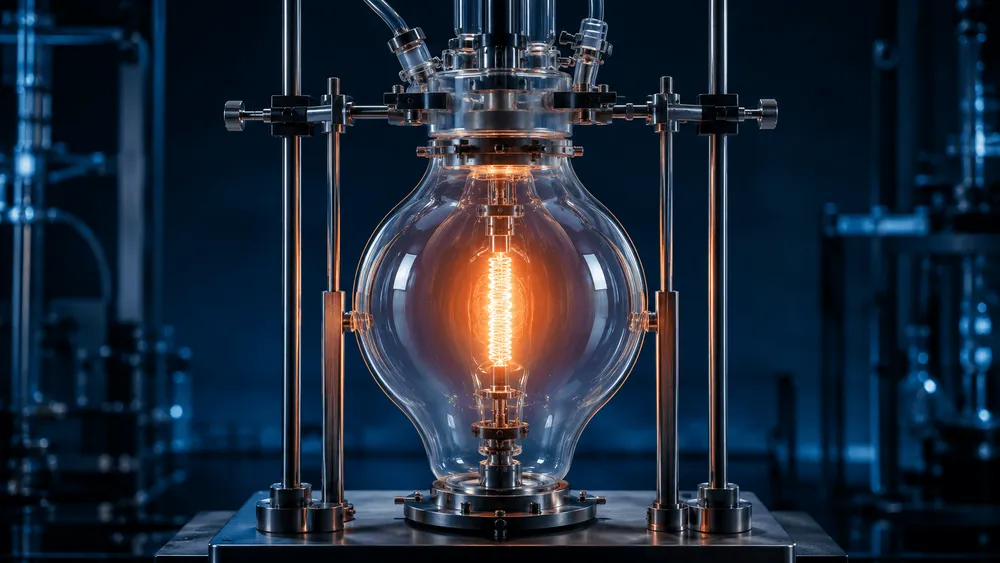
On July 28, National University of Singapore (NUS) published a collection of research applying an electrically heated chemical reactor reminiscent of an incandescent light bulb to three reactions related to decarbonization. Electric current is passed through a thin metal filament, heating not the entire reactor but a narrow region to over 1,200°C. Because the surrounding temperature can be kept relatively low, reactants can be activated at high temperature while products are handled under separate conditions at lower temperature.
What is new here is not that the figures obtained for ammonia, polyolefins, and methane have been combined into one. Rather, it is that while the filament, catalyst, and temperature are tailored to each reaction, the design—which avoids forcing both activation and selectivity control into the same temperature range—is presented as a common platform. That said, NUS states that scale-up and industrial application are still under consideration. This is not an announcement of a commercial reactor.
A Design That Does Not Spread Heat Across the Whole Reactor
The electrically heated filament concentrates the heat needed for the reaction into a small region. According to NUS, even when the thin metal filament reaches high temperatures, most of the reactor can be kept at a lower temperature. This differs in how heat is placed compared with methods that heat the entire reactor to the same temperature.
In high-temperature reactions, sufficiently activating the reactants can cause the products themselves to keep reacting. The three studies addressed this problem by localizing the heat source and, where needed, shifting the reaction to a lower-temperature region. Compactness and electrification are benefits expected from this configuration, but individual performance figures belong to the experimental conditions of each reaction.
For example, in the ammonia decomposition study, current was passed through a tungsten wire, raising the local temperature to as high as 1,800K. The paper's abstract reports a conversion rate of up to 99.995%, and the study reports an experimental energy efficiency of up to 60%. This is the result of decomposing ammonia into hydrogen and nitrogen; it does not indicate that the upstream ammonia is green or that the entire hydrogen supply chain is zero-emission.
Handling Methane Across Two Temperature Zones
The methane conversion study is the clearest example of the temperature-separation design. A Joule-heated molybdenum filament is used at 1,000–1,457°C to activate methane. A palladium-based catalyst on the inner wall is placed at 154–350°C, controlling product selectivity downstream.
Non-oxidative methane conversion does not produce CO2 during the reaction stage and targets ethylene and BTX (benzene, toluene, xylene). However, the high temperature needed to react methane also tends to invite overreaction of the products. The paper aims to decouple this conversion-selectivity trade-off through its non-isothermal configuration.
The reported combined yield of ethylene and BTX was 39.4%, and hydrogen yield was 62%. Under conditions of 1,457°C/350°C, the combined selectivity for ethylene and BTX in the products exceeded 60%. Coke deposited mainly on the filament, with little on the Pd catalyst layer. The study reports that the filament was regenerated with CO2.
However, these are laboratory results. Being able to separate the location of coke formation suggests a possibility for protecting the catalyst layer, but it does not prove that the system can withstand long-term industrial operation. Nor does it mean that methane itself becomes carbon-neutral.
Performance Measured with Ammonia and Plastics
The ammonia study aims for high local reaction rates with lower power input than heating the entire reactor volume, achieved through a steep radial temperature gradient. The paper also presents a design with 1,700 tubes and 3L capacity intended to produce 100kg of hydrogen per day. However, this is a proposal based on simulation, not an operating plant. The comparison suggesting it could be made two to three orders of magnitude smaller than current state-of-the-art reactors also applies to the proposed design.
In the polyolefin decomposition study, a high-temperature transition-metal filament serves as both a localized Joule-heating source and an in-situ catalyst. Filament temperature reached up to 2,300°C, and olefin monomer selectivity reached up to 65%. For a sample mixing polyethylene (PE) and polypropylene (PP) at a 1:1 ratio, total selectivity was 58%, and with stainless steel, ethylene selectivity reached up to 63%.
In this reaction, rapid heating and moving products to a lower-temperature region suppress secondary reactions that tend to occur in conventional slow pyrolysis. However, the target is PE- and PP-type polyolefins, and this does not mean that mixed general waste plastics as a whole can be recycled at commercial throughput. The paper cites impurities, additives, and moisture in the feedstock as challenges. Filament breakage, coke, and product separation also need to be worked out toward practical application.
Verification Needed for Industrialization
Under the conditions set in the analysis, the techno-economic analysis and life cycle analysis in the methane study showed the possibility of cost-competitive, net-zero production. This is not a life cycle result measured with commercial equipment. Conclusions would change if the energy source, feedstock carbon intensity, or system boundaries were different.
The three papers also do not present a single specification for the same reactor. The tungsten, transition-metal, and molybdenum filaments, along with the catalyst and temperature conditions, differ for each reaction. Therefore, the next stage requires confirming whether the benefits of localized heating can be maintained when continuous throughput is increased, rather than focusing on individual yield or selectivity figures.
For electrified high-temperature reactors to move closer to industrial equipment, filament lifetime and regeneration, resistance to impurities in the feedstock, and product separation must be demonstrated under continuous operation. Whether the design shared across the three reactions can continue to separate reaction activation from product control under those conditions—that is what will determine the judgment on industrial application.