


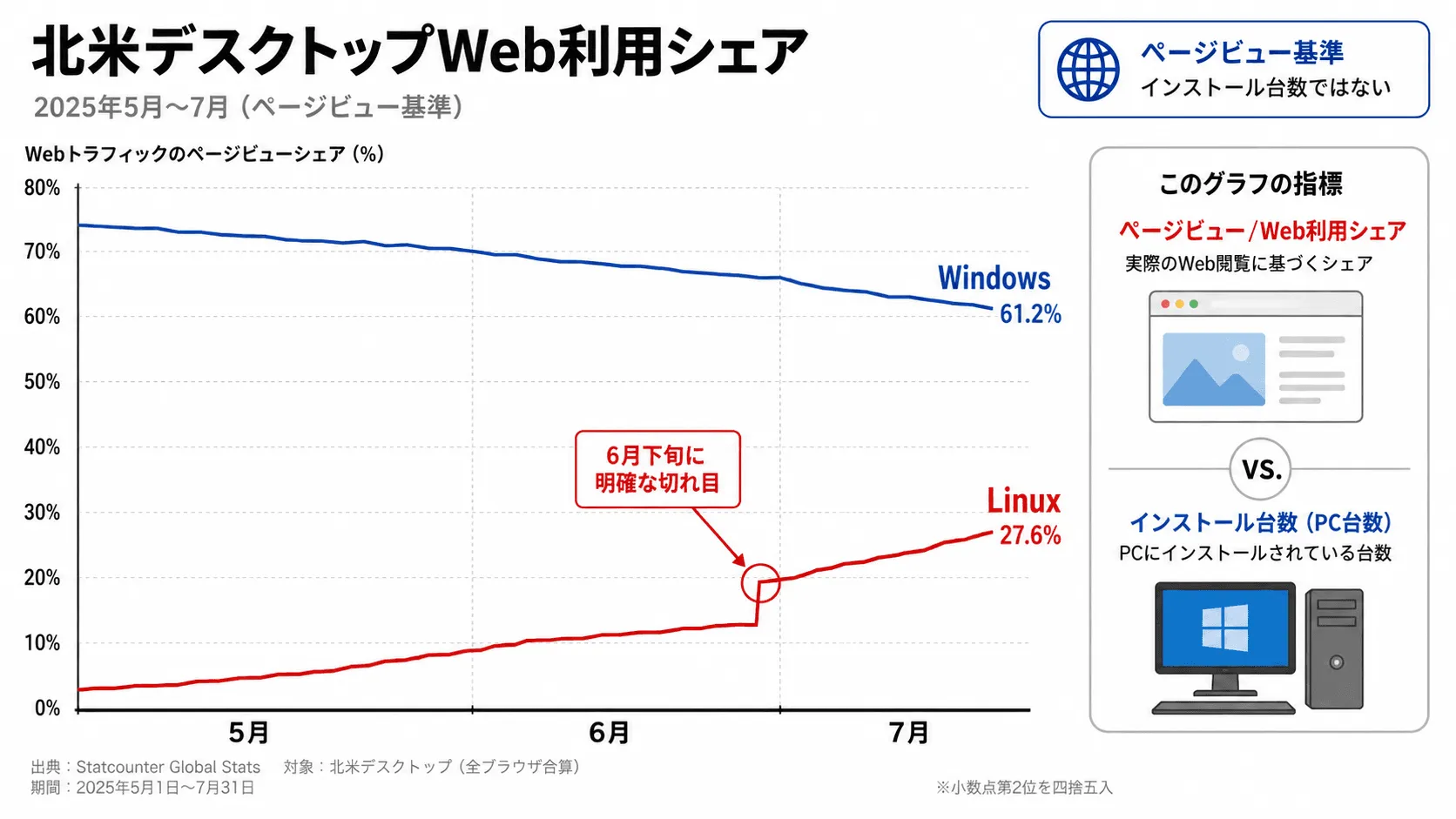
According to StatCounter's July 2026 data, desktop Linux in North America surpassed 10% for the first time. As of August 4, the aggregate chart page shows 10.65%, a striking figure for desktop Linux. However, this is not a share of the number of PCs in North America. What StatCounter measures is the composition ratio of web page views from desktops and laptops among the pages covered by its tracking network. Moreover, the monthly CSV available from the same official page lists July at 10.61%. It's necessary to separate what the numbers actually show from the user migration that the numbers alone cannot confirm.
10.65% Is Not a Ratio of Installed Units
StatCounter aggregates over 3 billion monthly page views through tracking code installed on more than 1 million websites worldwide. Each time a page is opened, it determines the OS and device category from the browser's user agent and other data, and presents that browsing volume as market share. Laptops are included under "desktop." If one person views the same site repeatedly, page views increase accordingly—so this differs in nature from surveys that count devices or number of users.
The aggregation also involves no artificial weighting by population or by the number of internet users per country. StatCounter states that it excludes bot activity, but what's published are the post-aggregation ratios; neither the actual number of instances per OS nor the breakdown between human and automated access is disclosed. The ratio can shift when a particular large-scale site joins the tracking network, when the composition of visitors changes, or when OS detection logic is updated.
Treatment as a preliminary figure also matters. StatCounter states that it can correct errors or omissions for 45 days after initial publication. As of August 4, the North American bar chart shows 10.65%, while the monthly CSV from the same site shows 10.61%—a difference of 0.04 points. While the broad picture of surpassing 10% is consistent, the figures are not fixed down to the decimal point.
The Discontinuity That Occurred on June 24
According to the monthly CSV, North American Linux rose from 3.56% in May to 6.14% in June and 10.61% in July. That's an increase of 7.05 points over two months, roughly a 2.98-fold rise. Windows fell from 64.66% to 57.63% over the same period, a drop of 7.03 points. The two movements are nearly mirror images of each other, but this alone doesn't mean that Windows-equipped PCs were replaced by Linux. In a composition ratio that sums to 100%, if one category rises, another must necessarily fall.
Looking at the daily data, the change is even more abrupt. Linux jumped from 4.77% on June 23 to 10.19% the next day, June 24. By June 28, it rose to 17.05%. July also swung widely, from 5.54% to 17.94%, ending the month at 9.16% on July 31. The monthly figure of 10.61% is a ratio compiled from page views across the entire month—it is neither the value at month-end nor a simple average of the daily ratios.
It's difficult to explain a change of more than double overnight solely through OS replacement. Whether human Linux browsing actually increased, or whether the visitor composition or access frequency of the tracked sites changed, cannot be determined. The ratios published by StatCounter don't allow these contributions to be separated. What can be confirmed, therefore, is only that from late June onward, the proportion of desktop web browsing in North America that StatCounter's observations classified as Linux surged sharply.
A Divide: 11.87% in the U.S., 3.83% in Canada
Broken down by country, the North American figure surpassing 10% is not a uniform movement. The U.S. Linux ratio climbed from 3.71% in May to 6.33% in June and 11.87% in July. Mexico also rose, from 2.58% to 6.08%. Canada, however, fell from 5.59% in June to 3.83% in July. This is a difference that the regional label alone doesn't reveal.
StatCounter aggregates page views as measured, without weighting by each country's population. The U.S. figure of 11.87% is close to the North American overall figure of 10.61%, while Canada's 3.83% is far removed from it. However, since country-level page view counts aren't included in the monthly tables, it's impossible to calculate exactly how many points the U.S. contributed to pushing up the North American figure. Even 11.87% is not a ratio of installed Linux PCs—it is the ratio of desktop web browsing classified as occurring within the U.S.
The rise during this period isn't confined to North America either. Global Linux share rose from 3.81% in May to 5.59% in June and 7.51% in July, and Asia rose from 3.88% to 7.17%. Meanwhile, Europe stayed flat at 5.49% in both June and July. While the observed values trended upward across multiple regions, that alone doesn't confirm either a broad expansion in usage or a North America–specific mass migration.
What Steam's 4.01% and the End of Windows 10 Support Reveal—and Their Limits
Looking at a different population lets us separate the direction of the rise from its magnitude. In Valve's July 2026 Steam Hardware & Software Survey, Linux stood at 4.01%, up 0.32 points from the previous month. This is a voluntary, anonymous monthly survey targeting Steam users, differing from StatCounter's web page views in both methodology and regional scope. We can confirm that the Linux ratio rose within the Steam survey, but this doesn't corroborate the 10.61% figure for North American web browsing.
On the Windows side, there are circumstances encouraging migration. Microsoft ended mainstream support for Windows 10 on October 14, 2025, halting technical assistance, feature updates, and regular security updates—with an exception for users of the Extended Security Updates program. For owners of PCs that cannot upgrade to Windows 11, Linux can become a viable option. However, the sudden doubling of StatCounter's ratio on June 24—more than eight months after the end of support—cannot be explained by this date alone.
Within the scope of StatCounter's measurement, surpassing 10% is a fact, and not a change that can be dismissed. For it to be confirmed as a milestone in adoption, the July figure needs to hold even after the 45-day revision window closes, and elevated ratios centered on the U.S. need to continue in August and September. If surveys drawing on different populations, like Steam's, also point in the same direction, only then can the conclusion advance from a sudden shift in web browsing to an actual expansion in usage.