

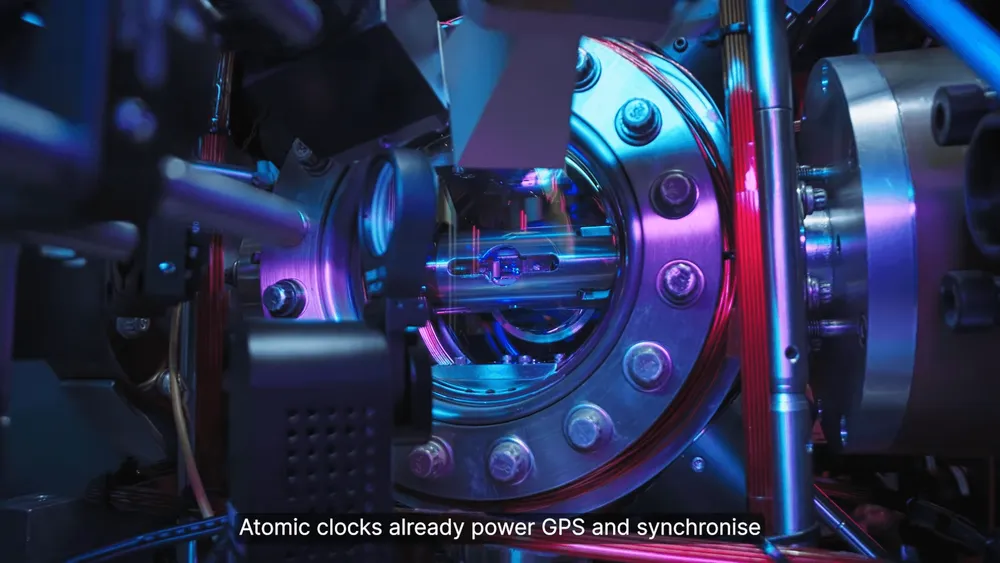
The Centre for Quantum Technologies at the National University of Singapore has published results in Nature on the performance of two optical atomic clocks built using lutetium ions. The estimated relative frequency systematic uncertainties for the two clocks came to 1.2×10⁻¹⁹ and 1.3×10⁻¹⁹ respectively—the smallest values yet reported for any optical atomic clock. The research team compared the two independently built clocks over a combined 200 hours and confirmed that their frequencies agreed with each other.
However, the "roughly 10⁻¹⁹" figure quoted for each individual clock is not the same thing as the actual resolution with which the frequency difference between the two clocks could be distinguished in the comparison experiment. Understanding this distinction clarifies what the new record actually means—and what remains before the second can be redefined.
What "world's highest precision" actually refers to
The new clock's reference is an 848-nanometer optical transition absorbed by singly ionized lutetium-176. The team trapped single ions in two separate, independent traps. The laser frequency is tuned to match the atomic transition, while the surrounding heat, magnetic fields, and ion motion—all sources of deviation—are measured and corrected for. The values 1.2×10⁻¹⁹ and 1.3×10⁻¹⁹ reported in the Nature paper represent the systematic uncertainty estimated to remain after these corrections are applied.
Comparing this to previous records requires looking at the same metric. A calcium-40 ion clock reported in Physical Review Letters in February 2026 achieved a systematic uncertainty of 4.4×10⁻¹⁹ by cooling with liquid nitrogen. The smaller of the two new lutetium clock values, 1.2×10⁻¹⁹, is roughly a quarter of that figure. The "world's highest precision" the team claims refers specifically to achieving the smallest-ever estimated systematic uncertainty in frequency—not to how long the clock has been operated, nor to how stably it has served as an international time standard.
Relative frequency uncertainty is a measure of how tightly the residual deviation in a clock's ticking frequency has been narrowed down. The smaller this number, the more rigorously the reference frequency of the atomic clock can be pinned down. But it's important to note that systematic uncertainty is a value estimated after known sources of deviation have been measured and corrected for—it is not a direct measurement of the timing error that accumulates from actually running the clock over a long period.
Why lutetium resists error even at room temperature
Lutetium's strength lies in a transition that is relatively insensitive to environmental influences. At room temperature, atoms are subject to thermal radiation from their surroundings and exposed to external magnetic fields. Both effects slightly shift the energy difference between electron states, distorting the clock's frequency. According to the paper, the transition used here has particularly low sensitivity to blackbody radiation and magnetic fields among the leading candidates used in optical clocks. The apparatus operates at room temperature and does not use magnetic shielding.
That said, low environmental sensitivity doesn't mean corrections become unnecessary. The team averaged over multiple hyperfine transitions to suppress magnetic-field-induced shifts. They then evaluated the second-order Zeeman shift, which scales with the square of the magnetic field strength and remains even after this averaging. In terms of the magnitude of the correction itself, this is the largest single term.
By contrast, the factor that most affects the uncertainty of each individual clock is how precisely the blackbody radiation shift can be estimated, accounting for roughly 1×10⁻¹⁹ in each clock. "The term requiring the largest correction" and "the term contributing the largest remaining uncertainty after correction" are not the same thing.
This distinction also matters for understanding the progress made since the same research group's 2023 experiment. That earlier study also compared two lutetium clocks, but the stability of the comparison was limited by factors such as heating of the trapped ions. As a result, the authors at the time refrained from concluding that extremely high precision had been achieved for the individual clocks.
This time, the team improved the trap design and re-examined effects such as ion motion and collisions with background gas. They also re-measured the coefficient for the second-order Zeeman shift and revised their evaluation of the largest correction term accordingly.
What "agreement to the 19th decimal place" actually verified
In the comparison experiment described in the paper, the team used "correlation spectroscopy" to track the frequency difference between the two ions while canceling out noise originating from the shared laser. Combining 11 independent measurement runs, the total measurement time reached 200 hours. The resulting relative frequency difference was [−0.1±5.7(statistical)±1.0(systematic)]×10⁻¹⁹, a result consistent with zero.
The "200 hours" here does not mean the clocks were run continuously for 200 hours. The measurements were spread across a 12.4-day period, during which the operational duty cycle was 67%, and the longest single continuous measurement lasted 37 hours. If optical clocks are to serve as continuously operating international time standards, not only peak achievable precision but also the ability to run stably over extended periods matters.
| Measured/evaluated quantity | Value | What the number means |
|---|---|---|
| Lutetium clock 1 | 1.2×10⁻¹⁹ | Estimated systematic uncertainty |
| Lutetium clock 2 | 1.3×10⁻¹⁹ | Estimated systematic uncertainty |
| Frequency difference between the two clocks | −0.1×10⁻¹⁹ | Central value of the measured difference |
| Statistical uncertainty of the two-clock comparison | 5.7×10⁻¹⁹ | Statistical uncertainty associated with the comparison measurement |
In this study, the systematic uncertainties estimated for the individual clocks—1.2×10⁻¹⁹ and 1.3×10⁻¹⁹—and the statistical uncertainty of 5.7×10⁻¹⁹ obtained from comparing the two clocks are distinct metrics. In addition, the evaluation of the frequency difference includes a separate systematic uncertainty of 1.0×10⁻¹⁹, on top of the statistical uncertainty shown in the table above.
Given the statistical uncertainty of 5.7×10⁻¹⁹ and the systematic uncertainty of 1.0×10⁻¹⁹, the frequency difference between the two clocks does not deviate significantly from zero. However, this comparison experiment did not directly confirm, at the same fine resolution, the roughly 1×10⁻¹⁹ precision claimed for each individual clock.
Correlation spectroscopy is effective because it cancels out phase noise from the laser shared by both clocks. The team primarily set the free evolution time for the ion superposition state in the Ramsey measurement to 5 seconds, with some measurements also conducted at 7.5 and 10 seconds. This allows the difference between the two atomic transitions to be compared with greater precision, unconstrained by the stability of the laser itself.
On the other hand, comparing clocks using the same element within the same laboratory may not reveal unknown systematic shifts common to both clocks. The paper itself lists comparison with a clock at a different institution as a task for future work.
What the "5-millimeter equivalent" sensitivity means
Converted into a height difference, the precision of the two-clock comparison corresponds to being able to distinguish the gravity-induced frequency shift caused by a roughly 5-millimeter difference in elevation on the same experimental table. According to general relativity, a clock placed at a higher elevation runs very slightly faster. The team separately measured the height difference between the ions trapped in the two clocks to sub-millimeter precision, ensuring this effect did not limit the comparison's precision.
However, what was actually measured here was the frequency difference between two clocks located in the same laboratory. This does not mean that height changes caused by, say, ground movement were measured on-site to millimeter-level precision.
Comparing clocks at the same precision across distant locations would require, in addition to high-precision technology for transmitting clock frequency information, sufficiently precise knowledge of the gravitational potential at both sites. The paper notes that in remote comparisons, uncertainty in the gravitational potential difference between sites could interfere with evaluating the clock's own precision. Miniaturizing the clock into a portable form—a goal the team is pursuing—also remains a future challenge.
What remains before the second can be redefined
The current SI second is defined based on a microwave transition in cesium-133 atoms. The BIPM has published a roadmap toward redefining the second using optical clocks, with 2030 cited as one possible target date for the redefinition.
The roadmap cited in the Nature paper sets a benchmark of keeping the systematic uncertainty of individual clocks at roughly 2×10⁻¹⁸ or below, and confirming agreement between clocks at different institutions with a combined uncertainty of roughly 5×10⁻¹⁸ or below. The new lutetium clocks fall well below the former threshold for individual-clock uncertainty, and the comparison between the two clocks within the same laboratory showed a high degree of agreement. However, this does not constitute an achieved comparison across different institutions.
Redefining the second requires confirming a record achieved in one laboratory at another location as well, demonstrating that it can be stably connected to a time standard. Making the lutetium clock portable and comparing it with optical clocks at other institutions would help further narrow down unknown errors common to a particular apparatus or environment.
The next important milestone is not simply announcing an even smaller uncertainty—it is demonstrating that this level of performance can be reproduced outside the laboratory and verified through comparison with independent clocks elsewhere.