

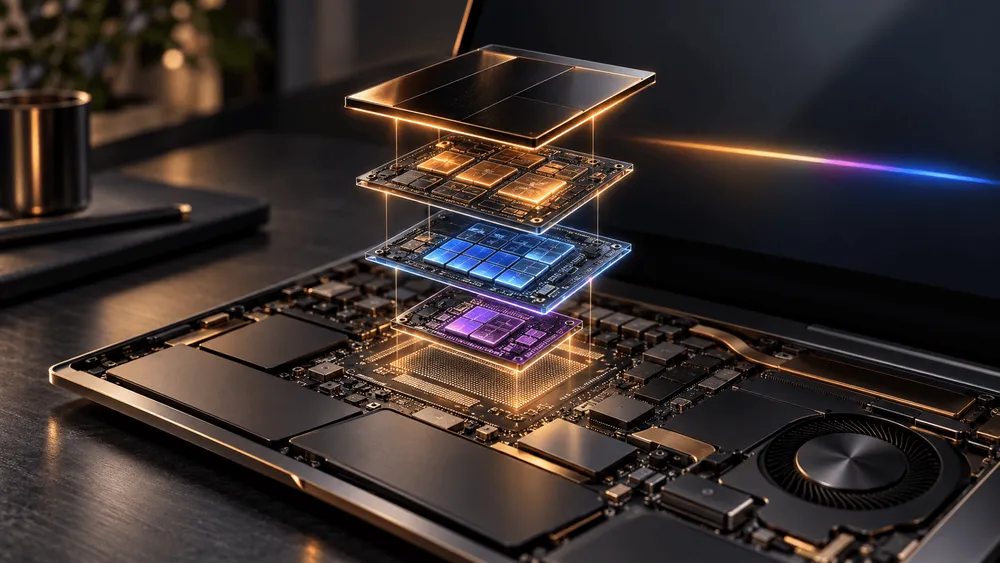
MediaTek has unveiled the Dimensity CX C10 Max, a system-on-chip built for Google's new premium PC category, Googlebook. It's the first entry in MediaTek's new PC-focused brand, Dimensity Compute Experiences (CX), and is built on a 3nm process with an NPU rated at up to 55 TOPS, designed to support thin, fanless laptop designs.
According to 9to5Google, MediaTek confirmed via email that the chip will power an upcoming Lenovo Googlebook device. However, comparing the chip's published specifications with last year's Chromebook-focused Kompanio Ultra 910 reveals something more nuanced: rather than a ground-up redesign, the C10 Max largely carries over the existing architecture with select enhancements.
That doesn't diminish the value of the C10 Max. Googlebook is launching as a platform that blends Android's app ecosystem with Chrome's underlying technology, and it supports processors from three different companies—Intel, Qualcomm, and MediaTek. For MediaTek, what matters isn't whether it introduced an entirely new CPU core, but how effectively it can bring the Arm-based expertise it built through smartphones and Chromebooks into the premium PC market.
Even as a new flagship SoC, the core architecture inherits from Kompanio Ultra 910
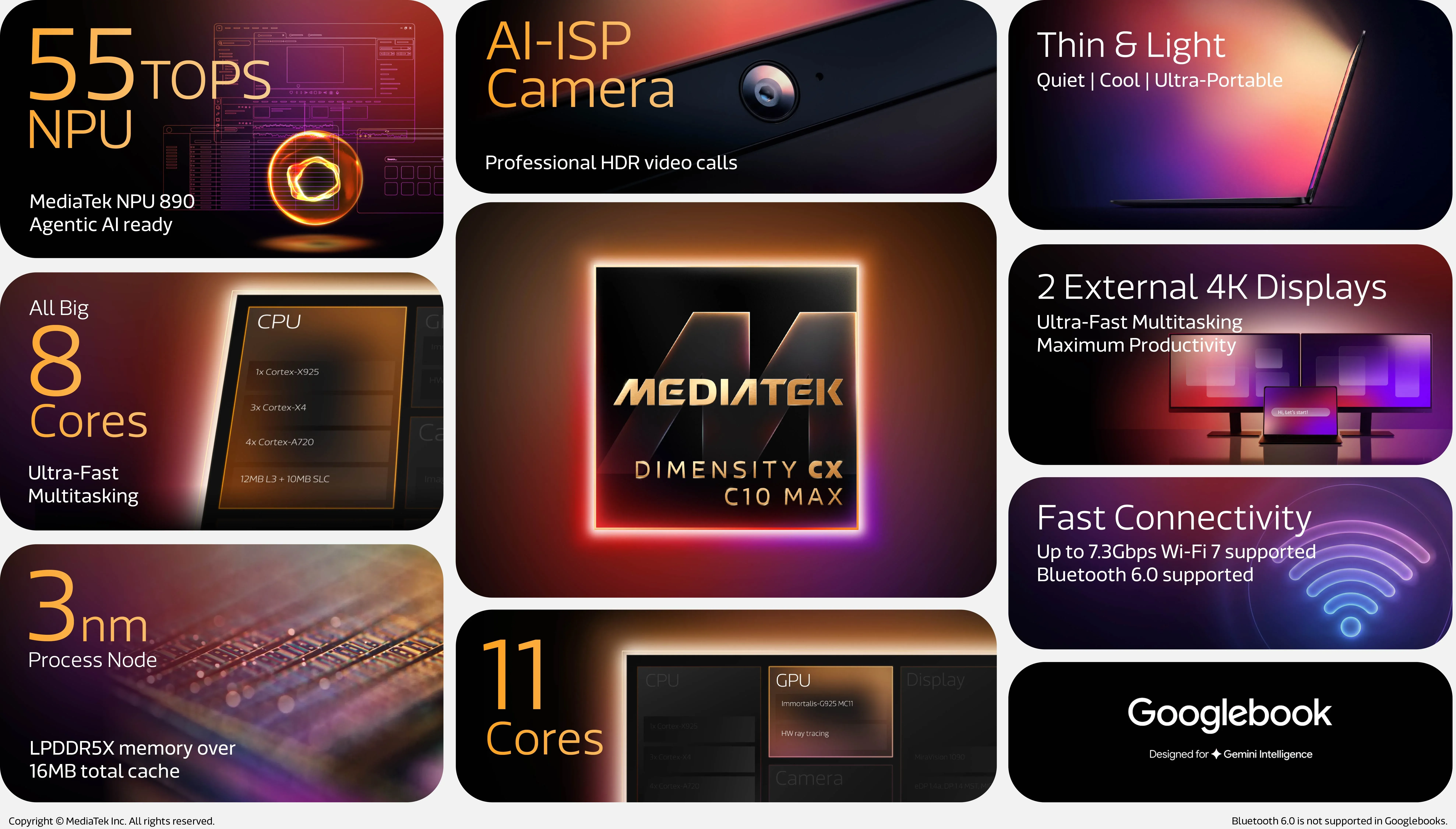
The CPUs in both the C10 Max and Kompanio Ultra 910 consist of one Cortex-X925 core, three Cortex-X4 cores, and four Cortex-A720 cores. Both chips share a 12MB L3 cache and a 10MB system-level cache (SLC). The GPU is identical too—an Arm Immortalis-G925 MC11—as is the UFS 4.0 storage standard, and both use the same NPU 890 for AI processing.
| Official Spec | Dimensity CX C10 Max | Kompanio Ultra 910 | Difference |
|---|---|---|---|
| Cortex-X925 max clock | 3.73GHz | 3.62GHz | ~3.0% increase |
| LPDDR5X max data rate | 9600Mbps | 8533Mbps | ~12.5% increase |
| Rated NPU performance | 55 TOPS (dense) | 50 TOPS | 10% increase |
| CPU configuration | 1x X925, 3x X4, 4x A720 | Same | Identical |
| GPU | Immortalis-G925 MC11 | Same | Identical |
| Cache | 12MB L3, 10MB SLC | Same | Identical |
| Storage | UFS 4.0 | Same | Identical |
Comparing MediaTek's official specifications item by item, the C10 Max shares its CPU configuration, GPU, cache capacity, and storage standard with the Kompanio Ultra 910.
Meanwhile, the maximum CPU clock speed rose from 3.62GHz in the Kompanio Ultra 910 to 3.73GHz in the C10 Max—roughly a 3% increase. The corresponding maximum memory data rate climbed from 8533Mbps to 9600Mbps, about a 12.5% increase, and the rated NPU performance rose from 50 TOPS to 55 TOPS, a 10% increase.
These percentage increases were calculated by taking the maximum values listed on MediaTek's official pages as of September 22, 2026, and dividing the difference between the new and old values by the old value.
On the camera processing side, a new "Imagiq 1090 ISP" is explicitly listed, supporting cameras up to 32MP, HDR video, electronic image stabilization, and auto-zoom.
However, these spec figures merely indicate generational differences and don't necessarily translate into real-world device performance. There's no guarantee that the maximum CPU clock speed, maximum memory speed, and NPU TOPS rating can all be sustained simultaneously in Lenovo's actual product.
MediaTek also hasn't disclosed whether the C10 Max and Kompanio Ultra 910 use the same die. As a result, it's neither accurate to call this a "completely new design" nor merely a "rebrand." What can be confirmed at this point is that the chip inherits much of its foundational architecture while enhancing select performance metrics and features.
"All Big Core" doesn't mean all eight cores are identical
MediaTek refers to this CPU configuration as "All Big Core," meaning the design forgoes power-efficient cores entirely in favor of eight high-performance-oriented CPU cores. However, this doesn't mean all eight cores are the same type.
The C10 Max pairs a single Cortex-X925 running at up to 3.73GHz with three Cortex-X4 cores below it, plus four Cortex-A720 cores. All belong to Arm's high-performance core lineage, but they're divided into three tiers based on their balance of performance and power consumption.
This configuration also reflects MediaTek's broader design philosophy of integrating not just the CPU but also the GPU, NPU, memory controller, and camera/video processing into a single SoC.
The C10 Max supports LPDDR5X-9600 and UFS 4.0, and can drive an internal 4K60 display alongside up to two external 4K displays. On the video processing front, it supports 4K60, 10-bit decoding for AV1, HEVC, AVC, and VP9. It's essentially an extension of the highly integrated SoC design MediaTek honed for smartphones and tablets, now scaled up for laptops' larger screens and peripherals.
MediaTek states that TSMC's second-generation 3nm process and power management technology enable the design of thin, fanless PCs capable of all-day use.
However, the battery life figures cited are based on estimates using a Google PLT reference device with a 60Wh battery—not actual measurements from an upcoming Lenovo Googlebook.
Actual battery life will vary depending on chassis thickness, cooling design, battery capacity, and the SoC's power configuration. As such, claims about fanless design and long battery life can't be confirmed until real products become available.
Compatibility with Googlebook matters more than the 55 TOPS figure
Googlebook isn't simply a rebranding of Chromebook.
In May 2026, Google unveiled Googlebook as a new PC category built around a combination of Android's app foundation and browser technology honed through ChromeOS, with Gemini Intelligence and integration with Android devices at its core. It supports Google Play apps and lets users access files and apps on their smartphones directly from the PC.
That same May, MediaTek explained that because Googlebook builds on a common Android-derived foundation, the company could more readily leverage the technology it has developed for Android devices. The C10 Max represents that strategy taking concrete form as an actual product SoC.
Windows on Arm has often struggled with compatibility issues involving existing x86 apps and peripherals. Googlebook, by contrast, can build on the software foundation of Android devices and Chromebooks—markets where MediaTek has long supplied chips.
This likely makes Googlebook an easier market for MediaTek to enter, but it doesn't guarantee that every app on Googlebook will run with equal performance or compatibility.
The NPU 890's "55 TOPS" figure deserves similarly careful scrutiny.
The C10 Max supports not just INT8 but also INT16, FP16, and BF16 computation. Google, too, has emphasized on-device Gemini features as central to the Googlebook experience.
However, the "over 45 TOPS" benchmark Google has cited for initial Googlebook devices, and the NPU performance figures published by Intel, Qualcomm, and others, don't necessarily align in terms of computational precision, how dense versus sparse operations are handled, power consumption, or the actual proportion of that performance accessible to software.
So the 55 TOPS figure alone isn't sufficient grounds to conclude that the C10 Max outperforms Intel's or Qualcomm's offerings.
The official page for the previous Kompanio Ultra 910 includes a note stating that agentic AI, Bluetooth 6.0, and ray tracing aren't available on ChromeOS.
While the C10 Max newly lists support for INT16, FP16, and BF16, along with the Imagiq 1090 ISP, it remains unclear how much of these capabilities Googlebook's OS will actually expose to apps. The features built into the SoC itself and the features actually available to end users need to be considered separately.
Intel and Qualcomm lead the initial lineup
Google began accepting preorders on September 21 for five initial Googlebook models, manufactured by Acer, ASUS, Dell, HP, and Lenovo. These run on either Intel Core Ultra Series 3 or Qualcomm Snapdragon X Elite processors, with US pricing starting at $899. Retail availability is set for October 4 in the US and October 5 in six other countries including Canada and the UK.
Qualcomm also announced the same day that Dell and HP Googlebooks powered by the Snapdragon X Elite are now available for preorder.
A product page has also gone live for the Lenovo Googlebook 15, part of the initial lineup, featuring an Intel Core Ultra 5, 16GB of RAM, 512GB of storage, and a large OLED display, priced at $1,099.
In other words, for Intel and Qualcomm, actual purchasable products—along with pricing and core specifications—have already been revealed.
MediaTek-powered devices haven't reached that stage yet.
MediaTek's official announcement only states that the C10 Max will be used in an upcoming "premium, ultra-thin Googlebook," without naming the manufacturer.
The Lenovo connection came to light through an email MediaTek sent to 9to5Google. 9to5Google has also speculated about a possible link to an unannounced tablet-style device, but neither MediaTek nor Lenovo has confirmed that product's form factor. There's currently no basis for concluding it will be a tablet.
The fact that Google is working with three companies—Intel, Qualcomm, and MediaTek—demonstrates that the Googlebook platform is designed not to depend on any single chip vendor.
Having multiple processor suppliers could potentially widen the range of price points and chassis designs available. However, since pricing for Googlebooks running the C10 Max hasn't been announced yet, it's premature to say that MediaTek will enable cheaper Googlebooks than those powered by Intel or Qualcomm.
The C10 Max's real performance will be determined by actual Lenovo hardware
The C10 Max carries over a great deal from the Kompanio Ultra 910. Even so, boosting memory speed, expanding NPU data format support, and enhancing ISP capabilities specifically for Googlebook are meaningful improvements.
Furthermore, the C10 Max is set to appear in an upcoming Lenovo Googlebook. For MediaTek, this means entering the new PC market by leveraging existing design and software development experience, without needing to wait for an entirely new CPU architecture.
Whether this translates into a real benefit for consumers, though, won't be clear until actual products are available.
How much RAM and storage will Lenovo include? How will the chassis be cooled, and what battery capacity will it carry? Under identical conditions—the same apps, the same screen brightness—how does its battery life compare to Intel- and Qualcomm-powered devices?
It will also matter how much CPU, GPU, and NPU performance shifts between plugged-in and battery-powered use. Other key questions include how extensively on-device Gemini features utilize the NPU 890, and whether Android apps and Linux development environments can run stably over extended periods.
Whether MediaTek can carve out a meaningful presence in the premium PC market can't be judged from the new "CX" brand name alone.
Only once the upcoming Lenovo device delivers on its thin, fanless design goals—and proves competitive on price, battery life, and sustained performance against the Intel and Qualcomm models already available for preorder—will it be possible to properly evaluate how successful the C10 Max has actually been as a Googlebook SoC.