

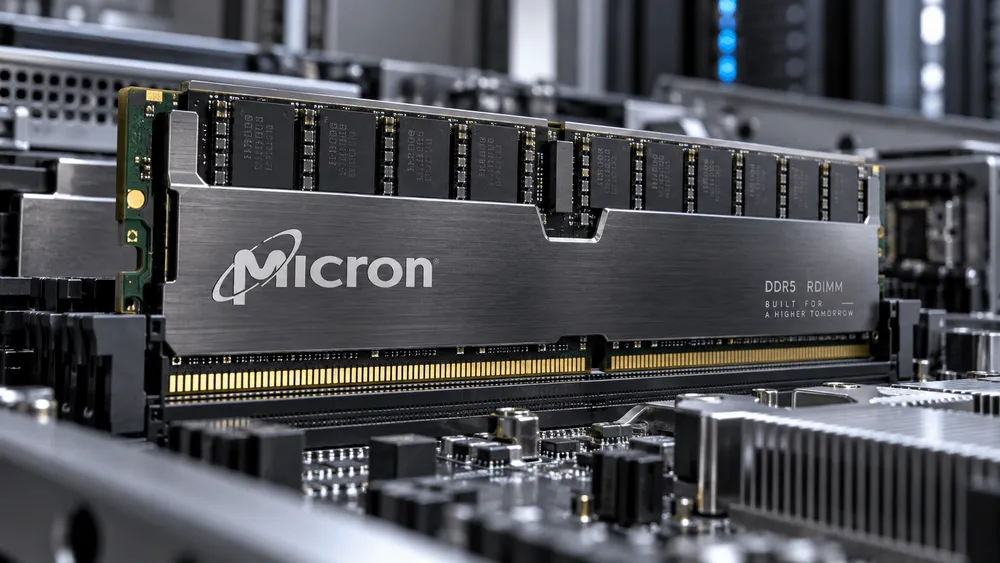
Micron Technology (hereafter "Micron") announced on September 15, 2026, that it has successfully demonstrated the operation of the world's first 512GB DDR5 RDIMM (Registered DIMM) module across multiple server platforms. The module packs a massive 512GB of high-density DRAM into a single memory stick while achieving data transfer speeds of up to 9,200 MT/s. When deployed across a 24-slot dual-socket server, this enables an unprecedented 12TB of main memory in a single rack-mounted chassis.
As large language model (LLM) inference, agentic AI, and real-time analytics continue to spread, the main memory capacity and bandwidth demanded by compute infrastructure are expanding exponentially. However, limited physical slot counts and per-rack power envelopes have consistently posed severe constraints for data center architects. Compared to configuring the same total capacity using four conventional 128GB modules, Micron's new 512GB module reduces operating power by more than 60%. The question now is how this cutting-edge packaging technology aims to break through the capacity and thermal density limits facing host-side memory hierarchies in AI clusters.
512GB in a Single Module at 9,200 MT/s: Micron Opens a New Frontier in Ultra-High-Density DDR5
The 512GB DDR5 RDIMM that Micron has demonstrated represents a major milestone that advances the memory roadmap for enterprise and cloud data center servers. While 128GB and 256GB modules have previously been the standard for high-capacity RDIMMs, achieving a single-module capacity of 512GB is an industry first. Even more notable is that Micron achieved this capacity maximization while simultaneously reaching an extremely high transfer rate of up to 9,200 MT/s.
Current enterprise DDR5 platforms typically operate at standard transfer rates, and even MRDIMMs (Multiplexed Rank DIMMs), which incorporate specialized buffer circuitry, remain limited to their first-generation speeds. The module Micron has now demonstrated achieves a high-speed transfer rate of 9,200 MT/s while maintaining the standard RDIMM framework. This higher clock speed substantially expands memory bus bandwidth, enabling sufficient data throughput to be delivered to each core of the latest high-core-count server processors.
The system-level benefits are equally significant. Standard dual-socket servers typically feature 12 memory channels per processor, with a mainstream configuration using one module per channel (1DPC, or 1 DIMM Per Channel) for a total of 24 DIMM slots. Populating all 24 slots with 512GB modules makes up to 12TB of DDR5 main memory available within a single server system. Whereas conventional modules limited total capacity even when all slots were filled, this new module dramatically expands memory space without any change to the chassis footprint.
Extreme Density Without Sacrificing Slot Efficiency: Vertically Stacking 32Gb Dies with TSV
To pack 512GB of DRAM capacity onto a single board, Micron introduced what it calls "advanced vertical interconnect packaging" technology. At its core is Through-Silicon Via (TSV) technology, which stacks DRAM dies vertically and connects them directly through electrodes that pass vertically through the silicon substrate.
Conventional memory modules have typically increased capacity by arranging numerous DRAM packages flatly across both sides of a printed circuit board (PCB). However, module physical dimensions are strictly constrained by JEDEC standards. Additionally, as wiring patterns on the board lengthen, parasitic capacitance and wiring inductance increase, causing high-frequency signals to attenuate and distort—making it impossible to sustain ultra-high-speed transfer rates like 9,200 MT/s.
To overcome this challenge, Micron selected a cutting-edge 32Gb (gigabit) monolithic DRAM die as its foundation. While a single 32Gb die already offers substantial capacity on its own, vertically stacking multiple layers using TSV technology (3DS, or 3D Stacking technology) dramatically increases the capacity per package. Vertical TSV wiring can shorten wire length to the micrometer scale compared to the diagonal wiring used in conventional wire bonding. This minimizes signal delay variation (skew) and reflection noise, successfully maintaining a clean eye pattern even at the high-frequency range required for 9,200 MT/s operation.
Furthermore, by adopting TSV vertically stacked packaging, Micron keeps the number of packages arranged on the module board within an appropriate range, significantly reducing the electrical loading seen by the memory controller. The ability to achieve this ultra-high density within the existing server form factor—without modifying physical slots or motherboard wiring layouts—is a decisive advantage for data center deployment.
16.0W vs. 44.2W: How a 60%+ Power Reduction Transforms Rack Density
Alongside memory capacity, power consumption and heat suppression are equally decisive factors in server densification. In modern data centers, the power supply capacity per rack and the heat dissipation capability of cooling infrastructure have reached physical limits—no matter how high-performing the hardware, actual deployment is impossible if it exceeds the power envelope.
A particularly notable figure in the official data Micron has disclosed concerns module operating power comparisons. Comparing the power consumption of a single 512GB DDR5 RDIMM module (16.0W) against four 128GB DDR5 RDIMMs configured to provide the same total capacity (44.2W combined), consolidating into a single module reduces operating power by more than 60% (63.8%). This 28.2W power difference achieved by consolidating into a single 512GB module fundamentally transforms the thermal design of an entire 24-slot server.
| Configuration Item | 128GB RDIMM × 4 (Conventional) | 512GB RDIMM × 1 (New) | Reduction / Difference |
|---|---|---|---|
| Memory Capacity Provided | 512GB | 512GB | Same capacity |
| Operating Power Consumption | 44.2W | 16.0W | 28.2W reduction (63.8% reduction) |
| Slots Occupied | 4 slots | 1 slot | 3 slots saved (freed for expansion) |
| Maximum Capacity at 24 Slots | Based on 128GB modules | 12TB (512GB × 24) | Capacity expansion |
This improvement in power efficiency brings about a dramatic transformation in overall server operational design. With conventional 128GB modules filling all slots, there is a ceiling on achievable capacity, and forcing the same large capacity using older modules would consume enormous amounts of power on memory alone. With 512GB modules, however, 12TB of main memory can be completed within a single chassis while maintaining extremely efficient power levels.
The benefit of reduced slot occupancy should not be overlooked either. Because only a single slot is consumed to achieve the same 512GB capacity, the remaining slots can be preserved for future memory expansion, or the freed space can be used to improve airflow and reduce the load on cooling fans. As a result, this directly contributes to improved data center Power Usage Effectiveness (PUE) and reduced capital investment in cooling infrastructure, leading to substantial reductions in Total Cost of Ownership (TCO).
1.4x Faster Spark Analytics: Resolving In-Memory Database Bottlenecks
At the intersection of increased capacity, higher speed, and reduced power consumption, key enterprise workloads show concrete performance gains. In workload performance comparisons for Spark SVM (Support Vector Machines) data analysis, the 512GB RDIMM configuration achieves up to 1.4x performance improvement compared to a 256GB DDR5 configuration. In-memory databases such as RocksDB and Redis also see substantial improvements in throughput and concurrency.
In analytics processing and machine learning training and inference, when a dataset exceeds main memory (DRAM) capacity, the system is forced to offload data to slower secondary storage such as NVMe SSDs (paging/swapping). Because there is an overwhelming gap in access latency and bandwidth between DRAM and storage, the processor's computational pipeline stalls waiting for data the moment storage I/O occurs. By keeping terabyte-scale datasets resident entirely in main memory using 512GB RDIMMs, slow storage access can be eliminated entirely, allowing CPU computational capacity to be fully utilized.
Similar benefits are prominently apparent in infrastructure handling caching and real-time transactions, such as the distributed key-value store RocksDB and the in-memory database Redis. The dramatic expansion of main memory capacity makes it easier to improve cache hit rates, expand the number of concurrent queries (concurrency), and maintain throughput as datasets grow. Darrin Alves, CIO of Infrastructure Platforms at JPMorganChase, commented: "As data center workloads continue to grow, we're focused on optimizing the balance of compute, memory, and efficiency across the stack. High-capacity memory technologies like Micron's 512GB RDIMM help enterprises support larger in-memory workloads, improve resource utilization, and gain the flexibility to scale modern computing environments."
Furthermore, the importance of host memory in AI workloads is also growing. Even in GPU-centric accelerator clusters, terabyte-scale CPU main memory is indispensable as an offload destination for KV (Key-Value) caches used by LLMs processing long contexts, and as storage for the vast knowledge graphs referenced by agentic AI. The wide-bandwidth 9,200 MT/s 512GB module also plays a role in easing data transfer bottlenecks between GPUs and host memory.
Ecosystem readiness for broader adoption is also progressing. Processor giants AMD and Intel are already jointly conducting real-world validation testing of Micron's 512GB DDR5 RDIMM on their respective next-generation server platforms. Amit Goel, Corporate Vice President of Compute & Enterprise AI Platforms Solutions Engineering at AMD, and Karin Eibschitz Segal, General Manager of Platform & System Engineering in Intel's Data Center Group, have both expressed close collaboration toward next-generation data center infrastructure. The technology's full value is expected to be realized when paired with next-generation server CPUs arriving around 2027.
Regarding mass production timing, Micron plans to align with customer demand for a launch in late 2027. Because the process involves advanced packaging steps such as multi-layer TSV stacking, validation challenges remain toward commercialization, including securing manufacturing yield in the initial phase, controlling module unit costs, and standardizing high-frequency signal design for 9,200 MT/s operation. Nevertheless, this achievement—delivering 512GB and 9,200 MT/s in a single module while cutting operating power by more than 60%—stands as a clear solution to the physical limits facing data centers in the AI era.