

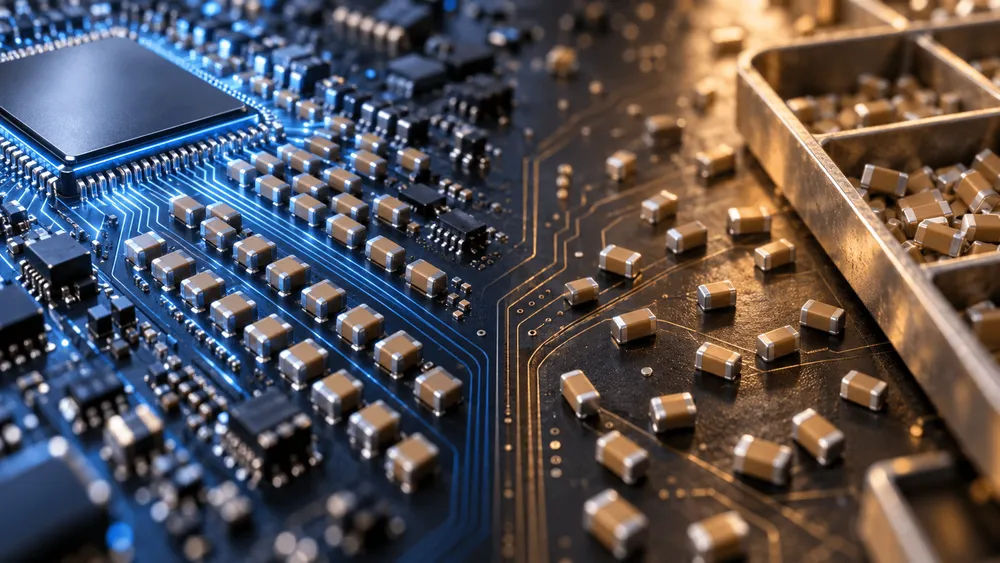
Two different trends are unfolding in China's MLCC (multilayer ceramic capacitor) market. According to market reporting compiled by TrendForce on September 21, a representative generic product traded in Shenzhen's Huaqiangbei market has fallen to roughly one-third of its late-June peak price. Meanwhile, for AI-grade high-performance MLCCs made by Chinese manufacturers, some orders are already booked through Q2 2027, with customers placing orders earlier than they used to.
The fact that price declines and supply tightness are occurring simultaneously—despite both being called "MLCC"—stems from differences in product specifications, distribution channels, and manufacturing processes.
The price drop applies to generic consumer-grade products
What has fallen in price is the spot price of a generic consumer-device product known as "0603-104," traded in Huaqiangbei.
In the local market example cited by TrendForce, the price was about 5 yuan per 1,000 units in Q2 2026, rose to roughly 30 yuan by the end of June, and has since fallen to about 10 yuan. The decline from the peak works out to roughly 66.7%, calculated as (30−10)÷30.
Even though the generic 0603-104 in Huaqiangbei has fallen about 66.7% from its peak, this does not mean that supply capacity for AI-grade high-capacity products has recovered. Product specifications, pricing mechanisms, and manufacturing processes all differ.
| Observed metric | Q2 2026 | Late-June peak | As of Sept. 21 report | Scope of interpretation |
|---|---|---|---|---|
| Huaqiangbei 0603-104 spot price | ~5 yuan/1,000 units | ~30 yuan/1,000 units | ~10 yuan/1,000 units | Inventory pricing at a single distribution hub for a single part number |
| Order timing for AI-grade high-performance products | Previously 1–2 months before delivery | — | Reportedly 3–6 months before delivery | Applies to some Chinese suppliers |
| Backlog for AI-grade high-performance products | — | — | Some booked through Q2 2027 | Not the total contract backlog for the entire market |
Source: TrendForce's September 21 article. The prices reflect store-level transaction examples in Huaqiangbei, not manufacturers' official list prices or long-term contract prices.
While 10 yuan is lower than the late-June peak, it is still double the 5 yuan level seen in Q2.
Moreover, spot market prices can swing significantly depending on distributors' and trading companies' inventory levels, panic buying, and the timing of inventory releases. As of May, TrendForce had already noted that while actual demand from ODMs was weakening, distributors were building up inventory out of concern over shortages.
The sharp spike at the end of June and the subsequent pullback indicate that price movements were not driven solely by end-product demand.
Here, it's important not to lump together long-term contracts between manufacturers and major clients, direct sales to OEMs/ODMs, distributor sales, and store-based spot trading as if they were a single market.
Just because the storefront price of 0603-104 has fallen does not mean that contract prices for high-capacity, high-reliability products certified for AI servers have also declined. Pricing by product category for AI-grade products is not publicly disclosed.
For AI-grade products, manufacturing process load matters more than unit count
AI servers use a large number of MLCCs.
In a March 2025 briefing for individual investors, Murata Manufacturing estimated that a standard server uses 1,800 to 2,500 MLCCs, while an AI server equipped with a baseboard and eight AI accelerators uses 10,000 to 20,000 units.
This figure represents the total number of MLCCs required for the entire server, not an indication that only Murata's products are used.
However, what determines supply capacity is not simply the increase in the number of units used.
In its earnings briefing for Q2 FY2025, Murata indicated that with next-generation GPUs, rather than a dramatic increase in the number of MLCCs mounted, the capacity per unit is increasing within limited board space, shifting the product mix toward higher-priced products.
High-capacity MLCCs require stacking more layers of dielectric material and electrodes, which increases the number of processing steps. As a result, greater strain is placed on front-end processes such as lamination and molding.
Even when producing the same 100 million units, the time occupied by equipment differs between generic products and high-capacity products. Even if there is slack in back-end processes like inspection and taping, if lamination and molding processes hit their capacity limits, the supply of finished products cannot be increased.
Murata indicated that its MLCC equipment utilization rate was 90–95% in Q2 FY2025, with plans to raise it to nearly 95% in the second half.
At the time, server-related sales were approaching just under 10% of total MLCC sales, but the company was clearly aware that higher capacitance requirements could shift how production capacity is allocated.
The performance requirements also differ from generic products.
Around AI accelerators, power supply voltage must remain stable while responding to rapid current changes. Performance at high temperatures, capacitance degradation under applied DC voltage, and reliability during long-duration operation are all also important.
Even if MLCCs with the same external dimensions are in surplus for consumer devices, they cannot simply be used as substitutes unless they meet the design requirements and customer certifications required for AI servers.
Chinese manufacturers are shifting expansion toward high-performance products
Chinese manufacturers are also expanding production capacity, but the focus of investment is shifting from simply increasing unit output toward high-performance products.
According to Guangdong Fenghua Advanced Technology's (Fenghua Hi-Tech) 2026 half-year report, the company has been advancing higher capacitance, higher voltage, and higher reliability in MLCCs for AI computing and automotive applications, and has begun mass production of several high-performance products. High-precision products are also included among its development targets.
On the other hand, the same report also notes that the company has halted investment in Phase 2 of the Xianghe Industrial Park project, which had been planned to expand production capacity primarily for small MLCCs, and has repurposed the already-completed building for the production of other products.
The company cited future strategy and optimal allocation of management resources as the reasons.
In other words, just because Chinese manufacturers are increasing production capacity does not mean that supply of small MLCCs for consumer devices will uniformly increase. What matters is which products the new equipment is being allocated to.
Fenghua Hi-Tech's revenue for the first half of 2026 was 3.5 billion yuan, up 26.28% year-over-year, and net profit attributable to shareholders of the parent company was 290 million yuan, up 74.01%.
However, the company also handles resistors, inductors, supercapacitors, and other products besides MLCCs. This revenue and profit growth cannot be attributed solely to growth in AI-grade MLCCs.
What can be confirmed is that the company is directing management resources toward high-performance products both in terms of product development and capital investment.
Japanese and Korean manufacturers are moving in the same direction.
In its full-year earnings briefing in May 2026, TDK indicated it would accelerate material development for low-voltage, high-capacitance MLCCs for data centers through a joint venture, with plans to expand sales of passive components related to AI data centers to roughly 10 times current levels in the future.
However, this is a future target, not an already-achieved sales figure.
On September 1, Samsung Electro-Mechanics announced a contract worth a total of 1.0722 trillion won to supply AI server MLCCs to major global customers throughout 2027.
The company stated that it has signed long-term supply agreements with more than 10 global customers, but did not disclose customer names, target part numbers, or per-unit pricing.
The scale of the contract serves as evidence of strong AI-related demand, but it is not information that can be directly compared with Huaqiangbei spot prices.
Three indicators to watch for signs of normalization
To judge whether the polarization in the MLCC market is heading toward resolution, at least three indicators need to be tracked separately.
The first is the lead time and order timing for AI-grade high-capacity products.
If the currently reported order lead time of 3–6 months returns to the previous 1–2 months, it may indicate that preemptive ordering driven by fear of supply shortages has eased.
The second is distribution inventory and spot prices for consumer-device MLCCs.
Whether the current price of about 10 yuan returns to around 5 yuan—the Q2 level—or rises again after inventory adjustments will make it easier to judge the actual supply-demand situation for generic products.
The third is which products manufacturers direct their lamination and molding process capacity toward.
Looking only at total factory-wide unit output cannot reveal the supply capacity for AI-grade MLCCs. Only once the yield rates for high-capacity products, product mix, and progress on customer certifications become clear can actual supply slack be properly assessed.
A stabilization in spot prices for consumer-device MLCCs could be good news for PC and home appliance manufacturers.
However, as long as efforts continue to secure supply allocations for AI-grade products through 2027, it cannot yet be said that supply and demand across the entire MLCC market have normalized.
Only when all three conditions are met—shortened delivery times for AI-grade products, eased capacity constraints on production concentrated on high-capacity products, and a return of consumer-grade distribution inventory to normal levels—can it be concluded that the two currently diverging markets are moving toward normalization together.