

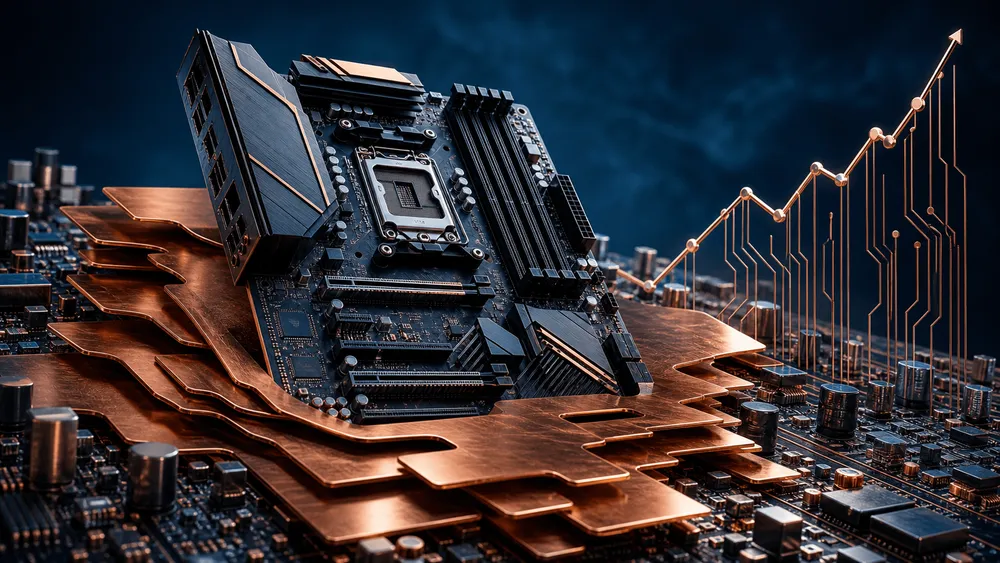
Chinese industry site Board Channels (博板堂) has reported that ASUS, GIGABYTE, and MSI are planning to raise motherboard distribution prices in the third quarter of 2026. The move comes amid rising costs for PCBs (printed circuit boards) and copper used in consumer motherboards. Costs for surface-mount capacitors, power components, and control ICs have also increased, according to the report. Notably, the figure "at least 50% increase in 2026" stands out. However, this refers to the outlook for PCB prices, not the retail price of finished motherboards. The actual burden on PC buyers will depend on how much of the cost increase manufacturers absorb and when distribution inventory turns over.
Q3 Distribution Price Adjustments with Unspecified Increases
According to Board Channels, the plan involves all three companies adjusting distribution prices sometime during the third quarter—July through September—to restore profit margins for both manufacturers and sales channels. As of August 4, the quarter has already begun. This suggests that not all products will see a simultaneous price change on the same day; rather, changes to purchasing terms may reach distribution channels gradually.
Board Channels' report does not specify concrete markup percentages for finished products, which models are affected, or which regions will see the changes. No unified pricing table shared across the three companies has been attached, and what has been disclosed so far is merely an outlook for distribution price adjustments. There is no indication that high-end and budget tiers, or Intel-compatible and AMD-compatible boards, would see the same rate of increase.
Still, the price hike outlook is drawing attention because rising material costs and declining sales volumes are happening simultaneously. Board Channels reports that DIY PC demand remains weak, and manufacturers have been unable to fully pass on increased costs to customers. When sales volumes fail to grow, development and logistics costs must be recovered across fewer units, making it harder for manufacturers to absorb rising costs internally.
The "50%" Figure Refers to PCBs, Not Finished Products
The "at least 50%" figure refers to the projected rise in PCB prices for consumer motherboards throughout 2026. The PCB houses the CPU socket and memory slots, and connects the power circuitry with various controllers. However, it doesn't account for the entirety of a finished product's cost. Even if PCB costs rise by 50%, this doesn't mean retail prices will automatically rise by the same amount.
On the other hand, price increases aren't limited to PCBs alone. Board Channels reports that, in addition to copper, surface-mount capacitors have also risen in price. Control ICs responsible for power components and peripheral functions have seen cost increases as well. When multiple components rise in cost simultaneously, it becomes harder to offset expenses through non-PCB costs. Since the baseline PCB price, specifications, and the region used to calculate the 50% figure haven't been disclosed, this number should be read as an indicator of how challenging the procurement environment has become—not as an advance price notice for finished products.
From China's 30.5% Copper Price Increase to 2oz Copper Layers
According to statistics released by China's Ministry of Industry and Information Technology on May 22 for Q1 2026, average copper prices in the Chinese market rose 30.5% year-over-year. Tin rose 48.6%, gold rose 62.7%, and silver rose 167.0%. While these figures don't reflect individual manufacturers' procurement costs, official statistics confirm that material prices surrounding China's PCB and electronic component industries have trended higher than the previous year.
The path by which copper prices affect motherboards is clear. MSI's annual report states that its Intel 800 series and AMD AM5 series motherboards use server-grade PCBs with 2oz-thick copper layers. GIGABYTE has also disclosed its Ultra Durable 3 design, which uses 2oz copper for both power and ground layers. According to the company's materials, a 1oz copper layer corresponds to 35 micrometers, while 2oz corresponds to 70 micrometers.
Thicker copper layers reduce electrical resistance and heat generation, supporting the stability of power circuits handling high current loads. For products featuring CPUs with high power demands, reducing copper content doesn't necessarily allow manufacturers to maintain the same design targets. Rather than thinning out materials to recoup costs, manufacturers are left with the option of maintaining their designs while passing costs on through pricing. That said, a direct line cannot be drawn from China's 30.5% average copper price increase to a 50% rise in PCB costs. Resin, glass fiber, processing costs, and yield rates also factor into PCB pricing.
Inventory Levels Will Determine the Timing of Price Pass-Through
Even when distribution prices change, retail listings don't shift immediately. If retailers still hold inventory purchased under old terms, they can maintain current prices until that stock runs out. Conversely, models with thin inventory, or regions that transition more quickly to new purchasing contracts, are likely to see price changes appear sooner. Rather than a globally unified MSRP, regional wholesale pricing and inventory turnover will create price disparities in the near term.
If demand remains weak, price increases could drive buyers further away. However, if sales volumes continue to decline while material costs rise, manufacturers will need to either shift their product lineup toward higher price tiers or adjust distribution prices to protect profit margins. Board Channels suggests that manufacturers and distributors are unable to fully pass on costs, squeezing profit margins on both sides.
While the construction of AI data centers is one factor driving demand for copper and electronic components, it would not be accurate to attribute the current cost increases to AI alone. Metal market prices and component supply are pushing costs upward, compounded by logistics expenses and inventory conditions specific to each product. What buyers should verify isn't the headline "50%" figure, but whether actual selling prices for candidate models have changed with new inventory shipments. Whether the three companies disclose target products and specific price adjustments—or whether distribution prices move first—by September 30, when Q3 ends, will serve as the benchmark for measuring how accurate these reports turn out to be.