

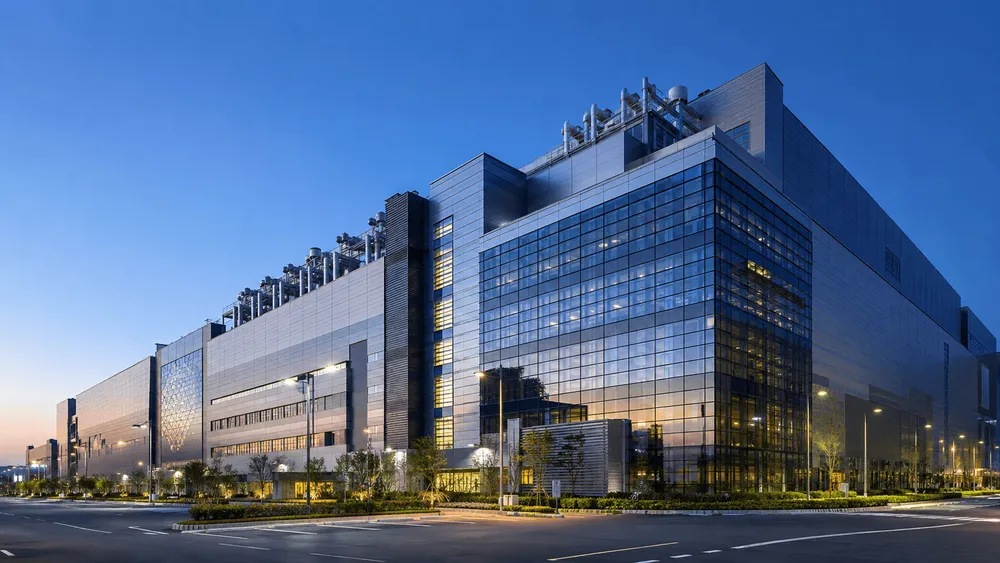
On August 5, Nanya Technology's board of directors approved a budget of up to NT$346.6 billion for capital expenditure on its new plant, "Fab 5A." This upper limit includes spending for 2026 and is to be executed in phases over up to four years, targeting a monthly wafer input capacity of 35,900 wafers. This is not an announcement of a brand-new factory plan starting from scratch. Rather, it is a resolution that concretizes which portion of the existing Fab 5A plan will receive funding and what level of input capacity is being targeted.
On the same day, the company also raised its 2026 capital expenditure budget from a maximum of NT$52 billion to a maximum of NT$69.7 billion. The increase of NT$17.7 billion is intended to accelerate the ramp-up of Fab 5A's capacity through advance payments for certain equipment. An upper budget limit does not necessarily represent the actual amount to be spent. Additionally, the funding sources disclosed—internal funds, bank borrowings, and other financing methods—do not constitute an announcement that financing has been completed.
According to materials presented in July, net cash at the end of the second quarter stood at NT$198.4 billion. The NT$346.6 billion budget ceiling for Fab 5A, the quarter-end net cash figure, and the disclosed funding sources are each separate pieces of information. The company lists internal funds, bank borrowings, and other financing methods as funding sources. While this is not a statement of insufficient funds, it serves as a standard for not conflating the approved amount with cash on hand when interpreting the scale of the investment.
What the Fab 5A budget indicates: 35,900 WSPM
The NT$346.6 billion figure represents the upper budget limit for a scope aimed at achieving 35,900 WSPM at the new Fab 5A. WSPM stands for wafer starts per month, referring to the number of wafers input into the manufacturing process per month. This figure does not directly represent DRAM bit production volume, finished chip shipment volume, or revenue.
This point needs to be read separately from another figure presented in the July 10 investor briefing materials. That presentation outlined a first-phase plan to ramp up to 30,000 WSPM by 2028, and separately presented an overall capital expenditure plan—including construction costs—targeting 45,000 WSPM with a total investment of $16 billion. The August 5 resolution is not the same amount or scope as this broader overall plan. It defines the budget for Fab 5A targeting 35,900 WSPM and the funds required for 2026.
At the groundbreaking ceremony in June 2022, the company had announced plans to expand Fab 5A in three phases to approximately 45,000 WSPM, with a total investment of about NT$300 billion. The plan called for a dedicated EUV building and covered 10nm-class generations from 1A to 1D, with construction originally scheduled for completion in 2025. Today's resolution does not newly establish this old plan; rather, it updates the previously disclosed concept in terms of budget and input capacity units.
From NT$52 billion to NT$69.7 billion: securing equipment through advance payments
The 2026 capital expenditure budget increased from NT$52 billion to NT$69.7 billion, but this NT$69.7 billion figure cannot be regarded as the total cost for all of Fab 5A. The advance payments apply to a subset of equipment, and the company cited the goal of accelerating capacity building. The NT$346.6 billion Fab 5A budget, the NT$69.7 billion annual budget for 2026, and the $16 billion overall plan for 45,000 WSPM each cover different scopes.
There are also boundaries between what was disclosed in 2022 and in 2026 regarding the plant's progress. The 2022 materials had construction scheduled for completion in 2025. The Q1 2026 earnings announcement schedules equipment installation for Q1 2027. The company has not explained the reason for this schedule change in these materials.
Therefore, one cannot derive from the August budget resolution the month of first production or the calendar date for reaching 35,900 WSPM. While the resolution defines phased execution within four years, it does not disclose the timing of input starts by process stage or capacity allocation by product. The 30,000 WSPM target for 2028 is the first-phase goal presented in the investor materials, not the timing for achieving 35,900 WSPM itself.
EUV is a development plan, not a declaration of mass production start
In its July materials, Nanya Technology stated that development of 1C, 1D, and 1E is progressing as planned. EUV is included among the development targets. The Q1 earnings announcement likewise stated that development of 1C, 1D, and EUV is proceeding according to the original plan. What is indicated here is development progress, not the start of mass production. Yield rates, customer qualification, and commercial shipments cannot be confirmed.
EUV is a lithography method that uses 13.5nm light to draw circuit patterns onto wafers. However, including EUV in the development plan does not indicate equipment model numbers, unit counts, delivery dates, or which generation will adopt it. Nanya Technology's "10nm-class" notation should also not be equated with the same physical meaning as logic semiconductor foundry generations.
Conditions remain that must connect the development process to the factory ramp-up before one can judge whether the investment will translate into mass production capacity. The scheduled equipment installation in Q1 2027, the actual start of wafer input, and the schedule for product mix and customer qualification have not been clarified in this official announcement.
Building capacity in phases to meet AI demand
In its July materials, the company stated that AI infrastructure and server-related products account for more than 20% of revenue. It also indicated that supply tightness is expected to continue for the next several quarters, noting that AI and general-purpose servers are pushing up demand for HBM and RDIMM, constraining supply for smartphones, PCs, automotive, and consumer applications. Multi-year LTAs are explained as a means of aligning supply-demand expectations.
However, this revenue composition does not provide grounds to conclude that Fab 5A will produce only AI-related memory or HBM. The official materials do not disclose the product mix or customers for each phase. Combining the 30,000 WSPM target for 2028 from the July briefing materials with the 35,900 WSPM phased execution within four years from the August resolution, this can be read as a plan to build up capacity in stages.
Whether Fab 5A can build up capacity as planned cannot be determined solely by the size of the approved budget. The first checkpoint will be whether the company can proceed from equipment installation in Q1 2027 to the 30,000 WSPM ramp-up in 2028. Next is which products the 1C, 1D, and 1E generations currently under development will be tied to for mass production. The stage of EUV adoption is another checkpoint to watch.