

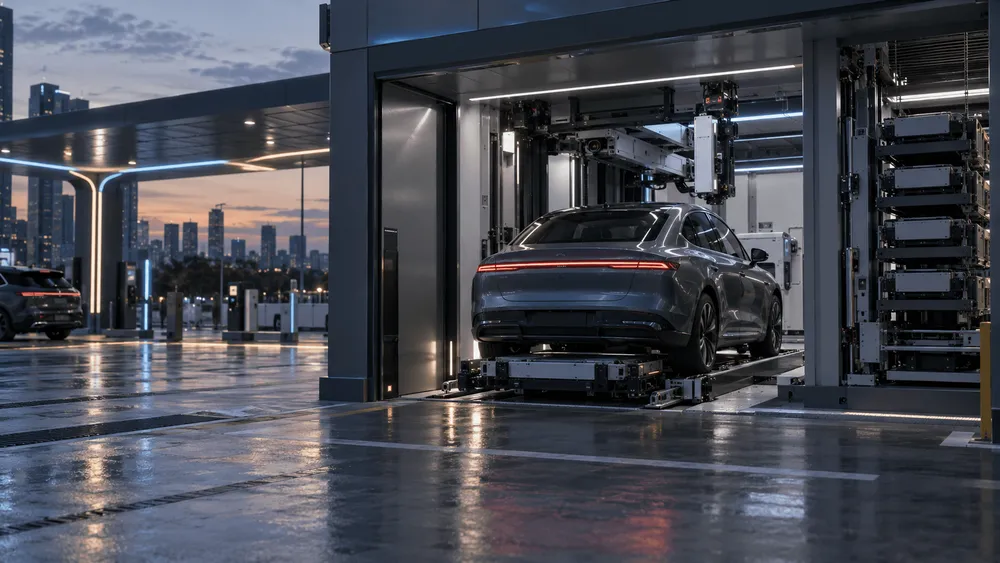
Chinese EV maker NIO announced on September 27, 2026, that it has signed a formal agreement under which a subsidiary of Zhejiang Geely Holding Group Co., Ltd. ("Geely Holding") will acquire a 30% stake in NIO Power.
On its side, Geely will contribute cash along with all shares of Yiyi Internet Technology (Chongqing) Co., Ltd., a company that operates battery-swap services for commercial vehicles, to NIO Power. The cash portion of the investment is RMB 640 million.
Once the deal closes, the standardization cooperation on battery-swap specifications that began three years ago will advance to a new stage: Geely's swap business will be folded into NIO Power, and the two companies will hold equity stakes in each other.
However, the 30% stake Geely is acquiring is not fixed—it could be reduced to as low as 20% depending on post-merger performance. To properly assess this deal, which values NIO Power at a post-money valuation of roughly RMB 16 billion, one needs to look not only at the cash but also at the value of the business being contributed, together with this equity-adjustment clause.
Geely's 30% Stake Is Not Fixed
Upon completion of the transaction, a Geely Holding subsidiary will hold 30.0% of NIO Power, NIO China (NIO's Chinese subsidiary) will hold 63.6%, and existing investor Wuhan Guangchuang will hold 6.4%.
Since NIO China will retain a majority stake, NIO Power will remain consolidated under NIO.
That said, the deal is subject to customary closing conditions, including regulatory approval, and has not yet been finalized as of the announcement.
A notable feature of this transaction is that Geely's equity ratio could still change after closing.
According to NIO's announcement, if NIO Power falls short of certain business targets, Geely's stake could be reduced to a minimum of 20%.
However, it has not been disclosed which metrics will be used as business targets, over what period performance will be evaluated, or how the magnitude of the reduction from 30% to 20% will be determined.
This is likely a mechanism to adjust the value of Yiyi Internet Technology's business based on its performance after integration into NIO Power, but the current disclosures do not clarify which party bears how much of the risk if targets are missed.
On the other hand, there is also a provision allowing Geely to increase its stake.
Geely can invest an additional RMB 640 million by either two years after the deal closes, or the date NIO Power signs a binding agreement for its next round of financing—whichever comes first.
Assuming no equity adjustment takes place after closing, this additional investment would increase Geely's stake to 34.0%, while NIO China's stake would fall to 60.0%.
In other words, Geely's stake could range from 20% to 34% depending on the conditions, meaning the 30% figure at closing alone is not enough to determine the final economic interest.
Non-Cash Consideration Works Out to Roughly RMB 4.16 Billion
NIO has disclosed a post-money valuation of roughly RMB 16 billion for NIO Power.
Multiplying this valuation by Geely's planned 30% stake yields a simple calculation of approximately RMB 4.8 billion for the total consideration. Subtracting the RMB 640 million in cash leaves roughly RMB 4.16 billion, which corresponds to the value assigned to the full equity of Yiyi Internet Technology being contributed by Geely.
Expressed as a formula:
RMB 16 billion × 30% − RMB 640 million = approximately RMB 4.16 billion
Of the roughly RMB 4.8 billion total consideration, cash accounts for about 13.3%, with the remaining approximately 86.7% consisting of consideration in the form of business equity.
However, this RMB 4.16 billion figure cannot be treated as a confirmed fair value for Yiyi Internet Technology.
The RMB 16 billion valuation for NIO Power itself is an approximation, and NIO has not disclosed an independent valuation report for Yiyi Internet Technology. Figures such as revenue, profit, and the number of battery-swap stations have also not been disclosed.
Furthermore, if post-merger performance falls short of certain targets, Geely's stake could be reduced to 20%.
Even with the same contribution of Yiyi Internet Technology's full equity and RMB 640 million in cash, if the final stake drops from 30% to 20%, the roughly RMB 4.16 billion valuation calculated backward from the 30% assumption cannot simply be maintained.
The very existence of this equity-adjustment clause indicates that the two companies have not fixed the value of Yiyi Internet Technology unconditionally.
There is also a past transaction for comparison.
In May 2024, Wuhan Guangchuang signed an agreement to invest RMB 1 billion in NIO Power in exchange for a 10% stake. A simple calculation based on these terms implies a post-money valuation of RMB 10 billion at that time.
The roughly RMB 16 billion figure disclosed this time is 60% higher than that.
However, this cannot simply be interpreted as meaning "NIO Power's valuation rose 60% over two years."
This is because the comparison conditions are not aligned—it's unclear under what final terms the 2024 investment closed, whether there were subsequent additional investments or dilution, what scope of Yiyi Internet Technology's business is being brought into NIO Power this time, and how the equity-adjustment clause factors in.
There are also unexplained aspects of the capital structure.
If Wuhan Guangchuang's reported 10% stake from 2024 had simply been diluted by the 30% new share issuance to Geely this time, the resulting stake would work out to 7.0%.
However, the disclosed stake for Wuhan Guangchuang this time is 6.4%.
NIO's latest announcement does not explain what transactions or equity adjustments occurred to bring the stake from 10% down to 6.4%.
From a Technology Partnership Three Years Ago to Integration of the Swap Business Itself
This is not the first time NIO and Geely Holding have cooperated on battery swapping.
In November 2023, the two companies announced they would jointly develop two battery-swap specifications—one for passenger vehicles and one for commercial vehicles—and cooperate on operating swap networks, developing compatible vehicles, and managing battery assets.
Geely's Yiyi Internet Technology has built up experience primarily in battery swapping for commercial vehicles, while NIO has focused on passenger vehicles.
The 2023 announcement set goals such as jointly operating swap networks and developing vehicles compatible with both systems, but did not determine which company would consolidate the assets or how the investment burden would be split.
This new agreement adds an equity relationship on top of that.
Yiyi Internet Technology's business will be folded into NIO Power, and Geely will share in the results of the battery-swap business as a minority shareholder in NIO Power.
In other words, the relationship is moving from jointly developing a common specification to jointly investing capital in the same battery-swap business and sharing in its enterprise value.
Meanwhile, in the charging business, investment is flowing in the opposite direction.
NIO China will subscribe for new shares in cash to acquire a 10.0% stake in Zhejiang Haohan Energy Technology Co., Ltd., a charging business operated under Geely Holding.
Haohan Energy plans to use the funds raised to acquire some of NIO's charging assets.
In short, in the battery-swap business, Geely is investing in NIO Power, while in the charging business, NIO is investing in a Geely-affiliated company.
However, NIO has not disclosed the amount it will pay to acquire the 10% stake in Haohan Energy, nor the specific scope or price of the charging assets to be transferred.
While this takes the form of mutual investment, that does not mean both transactions are of equal scale.
For the battery-swap business, a valuation figure of RMB 16 billion was given for NIO Power, but no comparable valuation or investment amount has been disclosed for the charging business.
Will Geely Vehicles Be Able to Use the 4,000-Station Swap Network?
In August 2026, NIO brought its 4,000th battery-swap station online.
Regarding its first fifth-generation swap station, the company stated it has improved compatibility across all models of its three in-house brands—NIO, ONVO, and FIREFLY.
If this swap network is to be extended to Geely-affiliated vehicles as well, which vehicle models can actually use the existing 4,000 stations will be a key factor in the efficiency of this infrastructure investment.
NIO has disclosed that, as of January 2026, it had invested a cumulative RMB 18 billion in charging and battery-swap infrastructure.
It reports a combined total of 8,541 charging and swap locations within China, with cumulative battery swaps exceeding 96 million. The company has also set a goal of expanding both charging and swap locations to over 10,000 sites each by 2030.
However, the figure of 8,541 locations does not count battery-swap stations alone—it includes charging facilities as well.
Also, the cumulative investment of RMB 18 billion is not a figure that directly indicates NIO Power's current enterprise value or the profitability of the business.
This integration could potentially add commercial vehicle usage to this large-scale, fixed infrastructure.
For vehicles with long operating hours, such as ride-hailing cars and taxis, the benefit of being able to swap the battery itself in a short time—rather than waiting to charge—tends to be greater. This could also increase the utilization rate of the same swap stations.
However, NIO has not disclosed current figures for Yiyi Internet Technology, such as the number of swaps performed, the cities it serves, or its revenue.
As a result, it is not currently possible to determine how much this integration will increase station utilization or how much it will improve NIO Power's profitability.
Plans for mass-market Geely vehicles to use NIO Power's swap network are also still in the process of being worked out.
While the two companies have an initial plan to develop vehicles adopting battery-swap technology with NIO Power providing the swap service, it has not been decided which brands under Geely will participate.
Specific vehicle models, battery dimensions, launch timing, and which swap stations will be usable have also not been disclosed.
The fact that NIO already has a network of 4,000 swap stations is a separate matter from whether Geely vehicles will actually be able to swap batteries there.
Making this a reality will require aligning specifications and mechanisms on both the vehicle side and the swap-station side.
What to Watch Going Forward Is Not the "30%" Figure, But the Conditions Behind It
What matters most in assessing this deal is not the headline figure of Geely acquiring 30% of NIO Power, but the conditions that could cause that stake to change.
First, will the specific business targets that could reduce Geely's stake from 30% to as low as 20% be disclosed in concrete terms going forward?
Second, will figures such as the number of swap locations, usage volume, revenue, and profit be disclosed for Yiyi Internet Technology once it is integrated into NIO Power?
For the charging business as well, the amount NIO pays to acquire its 10% stake in Haohan Energy, and the price and scope of the charging assets transferred to that company, will be needed.
NIO Power's standalone revenue, profit, and operating cash flow also remain undisclosed at this time.
NIO has so far highlighted the scale of its swap network and cumulative usage figures, but the value of an infrastructure business cannot be determined by station count alone.
Only once figures such as usage per station, the number of compatible vehicle models, and construction and maintenance costs are known can one properly assess how much return the invested capital is generating.
If, going forward, no equity reduction occurs due to performance conditions, Geely increases its stake to 34% through additional investment, and specific Geely vehicle models begin using NIO's swap network, then the standardization concept that began in 2023 can be said to have developed into a genuine joint infrastructure business.
On the other hand, if the details of the performance conditions and the compatible vehicle models remain undisclosed, then the RMB 16 billion valuation presented this time should be viewed simply as the valuation set at the starting point of this business integration.
The contract terms disclosed going forward, along with which vehicle models actually become compatible with battery swapping, will serve as the key evidence for determining whether this partnership remains a mere equity stake or develops into a full-fledged joint infrastructure venture.