

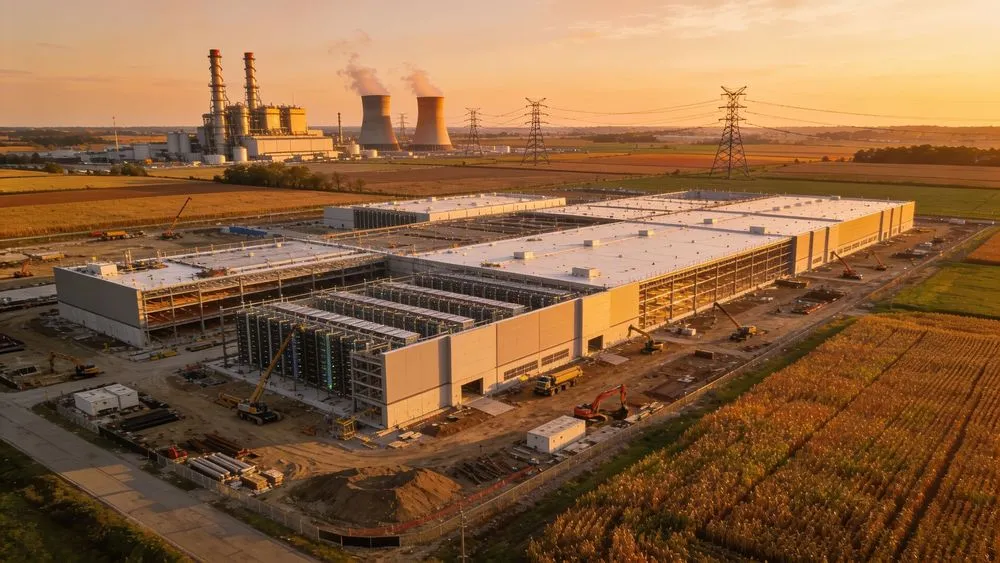
** **In Pike County in southern Ohio lies 3,777 acres (about 15.3 square kilometers) of cleared land. It is the site of the Portsmouth Gaseous Diffusion Plant (PORTS), selected by the U.S. Atomic Energy Commission in 1952 and brought online in 1956. During the Cold War, this facility produced highly enriched uranium for nuclear weapons, underpinning America's nuclear deterrent. Since the last enrichment cell shut down in 2012, the land has lain quietly, awaiting environmental remediation.
In 2026, this land is set to transform once again—this time into a national-scale, energy-intensive facility. The "PORTS Technology Campus" project, a joint effort between SoftBank's SB Energy and the U.S. Department of Energy (DOE), calls for building up to 10 gigawatts (GW) of data centers powered by a 9.2GW natural gas plant. According to CNBC's analysis, 10GW is equivalent to the annual electricity consumption of about 8 million U.S. households—more than ten times the size of xAI's Colossus (Memphis, roughly 946MW), currently the world's largest operating AI data center.
OpenAI has stepped forward as a tenant for this massive project. And it was NVIDIA that was supposed to provide the financial guarantee that would make it possible for OpenAI to lease the facility.
Why a $250 Billion Guarantee Shrank to Under $120 Billion
In late July 2026, the Wall Street Journal reported that NVIDIA was negotiating a financial guarantee of approximately $250 billion for OpenAI. Under this arrangement, confirmed by CNBC the following day, NVIDIA would use its own creditworthiness to guarantee OpenAI's lease obligations and construction-related debt, enabling large-scale borrowing even without OpenAI holding an investment-grade credit rating.
About two weeks later, on August 14, the same newspaper reported that NVIDIA had reduced this guarantee amount to less than $120 billion. Reuters said it could not independently verify this report but cited multiple sources familiar with the matter. The reason for the reduction: investors had expressed concern about NVIDIA's expanding risk exposure.
Crucially, this guarantee is not a direct investment from NVIDIA. Rather than contributing cash, NVIDIA acts as a "co-guarantor" for debt that OpenAI borrows from third parties. If OpenAI or SB Energy fails to meet its debt obligations, NVIDIA would be liable to pay.
Separately from this guarantee, NVIDIA is also pursuing negotiations to supply up to $350 billion worth of AI chips to this facility. The chip payments and the construction/lease debt have different financial structures and are being treated as independent negotiations.
| Item | Initial Concept (Late July) | Revised (Mid-August Reports) |
|---|---|---|
| NVIDIA's financial guarantee amount | ~$250B | Under $120B |
| Guarantee scope | Entire project (10GW) | Entire project (10GW) *only the guarantee amount reduced |
| Chip supply (separate deal) | Up to $350B | Up to $350B (unchanged) |
| Total project value (including chips) | Over $500B | Over $500B (unchanged) |
| Negotiation status | Early stage | Reportedly nearing agreement (unsigned) |
According to source material reported by Interesting Engineering, the revised guarantee still covers lease payments and construction-related debt for the entire 10GW facility. The scope of the guarantee has not narrowed—rather, the amount NVIDIA is willing to underwrite for the same scope has been cut by more than half. Who will cover this gap—at least $130 billion—and how, remains unanswered at this point.
The Structural Problem of 'Circular Financing'
Behind the reduction in the guarantee amount lies growing distrust across the AI industry regarding circular financial flows. The pattern works like this: NVIDIA invests in OpenAI. OpenAI uses that money to buy NVIDIA's chips. NVIDIA's revenue grows, and that growth becomes the basis for further investment and guarantees. Investors are increasingly questioning whether this cycle is artificially inflating demand.
On August 11, CNBC reported that NVIDIA is trying to quell criticism of "circular financing," but Wall Street remains skeptical. Business Insider reported in late July that NVIDIA's credit default swap (CDS) prices recorded their largest increase since the swaps began trading in November 2025. A sharp rise in the insurance premium against NVIDIA's default indicates that the market has begun assessing the company's financial risk more seriously than before.
In response to these concerns, NVIDIA CEO Jensen Huang announced on August 11 that major financial institutions, including BlackRock and Goldman Sachs, had lined up more than $500 billion for AI infrastructure construction. By structuring the arrangement so that each institution independently evaluates individual deals, with NVIDIA's involvement limited to only some of them, the company sought to dispel the impression that "NVIDIA is guaranteeing everything."
However, the fact that the guarantee reduction was reported just three days after this announcement suggests that market anxiety has not been fully resolved.
OpenAI's Financial Condition Undermines the Premise of the Guarantee
For whoever underwrites a guarantee, the counterparty's ability to repay is the paramount concern. OpenAI's financial condition hardly matches its $852 billion ($852B) valuation.
According to leaked audited financial statements from June 2026 (reported by Ars Technica and the Financial Times), OpenAI's 2025 revenue was $13.07 billion ($13.07B), a 3.5-fold increase from $3.7 billion ($3.7B) in 2024. Meanwhile, operating losses expanded from $8.78 billion ($8.78B) in 2024 to $20.92 billion ($20.92B) in 2025. R&D spending alone reached $19.18 billion ($19.18B), far exceeding revenue. Sacra estimates that cash burn will reach about $27 billion ($27B) in 2026 and about $63 billion ($63B) in 2027, with positive cash flow not expected until 2030.
Providing a guarantee exceeding $120 billion to a company without an investment-grade rating and with no clear path to profitability until 2030—this structural tension lies at the heart of what is unsettling NVIDIA's investors.
What the Reduced Guarantee Changes—and What It Doesn't
Even with the guarantee amount cut in half, the physical scale of the PORTS Technology Campus remains unchanged. According to a DOE fact sheet, the first phase of 800MW will break ground in 2026, targeting operation by 2028. SB Energy is building $4.2 billion ($4.2B) worth of transmission lines through AEP Ohio, and $33.3 billion ($33.3B) in Japanese funding will be allocated to natural gas power generation as part of the Japan-U.S. Strategic Trade and Investment Agreement. The DOE estimates that more than 10,000 jobs will be created during the construction period.
For NVIDIA, the reduced guarantee represents an adjustment in risk management, not a severing of ties. The company announced a strategic partnership with OpenAI in September 2025, expressing intent to invest up to $100 billion ($100B) in stages in line with the deployment of more than 10GW of NVIDIA systems. When OpenAI completed a $122 billion ($122B) funding round in March 2026, NVIDIA also contributed $30 billion ($30B).
By capping the guarantee at under $120 billion, NVIDIA has chosen a path that maintains its involvement in the project while controlling the scale of contingent liabilities on its own balance sheet. However, as long as the scope remains the entire 10GW project, a guarantee gap of more than $130 billion emerges relative to the original plan. Whether other financial institutions will fill this void, or whether the entire project's financing plan will be revised, remains unclear as of mid-August. The WSJ reports that NVIDIA and OpenAI are nearing an agreement, with a signing possible as early as August. However, as of mid-August 2026, no formal contract has been signed.
Two Bottlenecks: Power and Capital
A scale of 10GW is unprecedented in the history of data center construction. According to an analysis by IEEE Spectrum, as of 2014, the entire U.S. data center industry consumed an average of about 8GW of power. A single campus would consume more power than the entire industry did a decade ago.
Even Meta's planned 5GW data center "Hyperion" in Louisiana, initially estimated to cost $10 billion, has seen its total cost balloon to more than $50 billion ($50B). The figure of over $500 billion for the total PORTS project is an estimate that includes chip costs, and it remains unclear how much construction costs and energy infrastructure alone could ultimately swell to.
Securing power is also a challenge. While the DOE plans to build 9.2GW of new natural gas generation, grid reinforcement, environmental impact assessments, and effects on local residents all take time. In its permit application to the Ohio Environmental Protection Agency (EPA), SB Energy has presented two layout options concerning impacts on wetlands and rivers, and the final layout remains undetermined.
The fact that NVIDIA has reduced its guarantee once again demonstrates that building AI infrastructure is not just a technological challenge but also a challenge of financial structuring. No matter how much chip performance improves, if funding for the buildings that house them cannot be secured, the GPUs will sit idle in warehouses. Land once used to enrich uranium during the Cold War is now reflecting the distortions of capital-intensive structures in the AI era.