

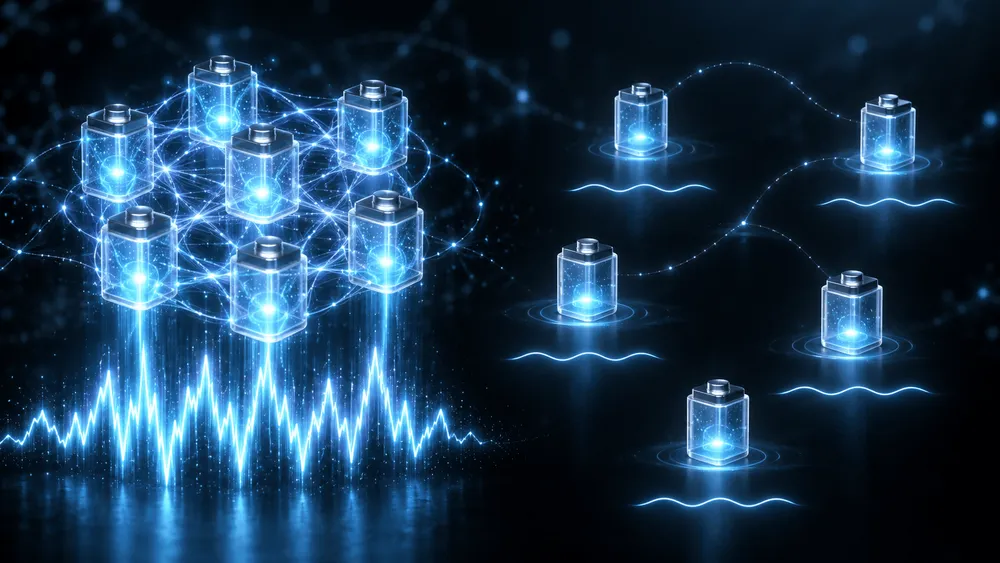
A four-member research team led by Brij Mohan, a postdoctoral researcher at the University of Oulu in Finland, has shown theoretically that when the cells of a quantum battery are made to interact and are charged together, charging power (the energy stored per unit time) increases, but so do the fluctuations in that power. The findings were published in PRX Quantum on September 15, 2026.
In quantum battery theory, a 2013 study pointed out that using entanglement could allow more work to be extracted than independent operations could. Since 2017, research has advanced on "collective charging," in which multiple cells interact together, as a way to raise charging power.
The new paper derives a limit resembling an uncertainty relation: the extractable work and the fluctuations in power cannot both be reduced as far as one likes at the same time. Using a model in which cells interact in groups of k, the authors also show mathematically that charging more cells together raises power but reduces its stability.
However, the theory assumes a closed quantum system with no external noise or energy dissipation. Neither the paper nor the university's announcement says how much this limit would matter in actual quantum batteries.
Why work and power fluctuations cannot both be made small
The reliability measure used in the paper is the noise-to-signal ratio (NSR). For both work and power, it is the variance of the value divided by the square of its mean. A larger value means more scatter in outcomes and lower reliability.
Mohan and colleagues showed that the NSRs of work and power each have a lower bound, and that no charging method can drive both toward zero simultaneously.
In a closed quantum battery, work and power are represented as mutually non-commuting operators. That means pinning one down precisely leaves uncertainty in the other. The structure resembles the position-momentum uncertainty relation: suppressing variation in power leaves variation in work, and vice versa.
The lower bound on each NSR is determined by how quickly the quantum state changes over time. The paper defines this speed using classical Fisher information, which expresses how much the probability distribution of measurement outcomes changes with time.
The authors then derived the NSR lower bounds using the Bhattacharyya bound, a statistical inequality that limits estimation precision.
If the initial state is an eigenstate of the observable, meaning a state for which a measurement gives a single definite value, the correlation term in the bound vanishes. The average work coincides with ergotropy, the maximum energy extractable by unitary operations, and the fluctuations in work were calculated using full counting statistics, which treats the entire probability distribution of extracted work.
This general theory assumes a closed quantum system with no external noise or dissipation, in which the battery is charged and discharged by unitary operations. The initial state can be a general state described by a density matrix ρ₀, so the theory is not limited to pure states.
The paper states explicitly, though, that work and power can be treated as such operators only because the system is closed, and that the results cannot be applied as they are to open systems that interact with an environment.
In the University of Oulu's announcement, Mohan explained that quantum batteries need not only fast, high-power charging and discharging but also stable operation, and that quantum mechanics itself imposes a fundamental limit on that reliability.
The paper is titled "Fundamental Limitations on the Reliabilities of Power and Work in Quantum Batteries." It was first posted on arXiv as arXiv:2601.05315 on January 8, 2026, submitted on March 11, revised on June 30, and accepted on July 23.
Comparing speed and stability across parallel, hybrid, and collective charging
The paper compares three types of charging.
These are "parallel charging," in which each cell is charged independently; "collective charging," in which all cells interact together; and "hybrid charging," in which cells interact in groups of k.
The more widely cells interact, the higher the charging power, but the larger the variation in that power.
An explainer by APS Physics, the publisher, describes the difference in terms of the number of cells, N.
In parallel charging, power scales in proportion to N, and the product of the work and power NSRs falls in inverse proportion to N². In collective charging, power rises to scale with N², but the NSR product is at its maximum.
APS Physics says that restricting the range of interaction to some extent, rather than making all cells interact at once, makes it easier to balance power and stability.
The mathematical comparison uses a simplified model the paper calls the "k-body toy model."
N = kq qubits are divided into q groups of k, and the qubits interact within each group. With k = 1, this is the parallel scheme in which each cell is charged independently; with k = N, it is the collective scheme in which all cells interact at once; values in between correspond to the hybrid scheme.
Starting from the discharged state |0⟩^⊗N, in which every cell is in its ground state, and when N is divisible by k, Eq. (9) in the published version gives the product of the work and power NSRs as k²/N², independent of time.
For parallel charging (k = 1) it is 1/N², and for collective charging (k = N) it is 1. When N/k is not an integer, a different formula that accounts for leftover cells (Eq. E12 in Appendix E) is needed, and the simple k²/N² does not apply directly.
| Scheme | Range of interaction | Power | Product of work and power NSRs | Power stability |
|---|---|---|---|---|
| Parallel charging | None (k=1) | Proportional to N | 1/N² | High |
| Hybrid charging | Groups of k (1<k<N) | Increases with k | k²/N² | Between parallel and collective |
| Collective charging | All cells (k=N) | Proportional to N² | 1 (maximum) | Low |
How power scales is based on the APS Physics explainer; the NSR product is based on Eq. (9) of the published paper.
Note that the NSR product equals k²/N² only when the k-body model is used, the initial state is |0⟩^⊗N, and N/k is an integer. All of these are theoretical values for closed systems without noise or dissipation, not experimental results.
In the same model, the average power oscillates over time, and the amplitude of the oscillation grows in proportion to k.
In the limit where the number of groups N/k is much larger than the dimensionless quantity Ω₀t, the power NSR is proportional to (k/N)³, while the work NSR is proportional to N/k. In other words, increasing k increases the variation in power but reduces the variation in work.
Multiplying the two gives
(k/N)³ × (N/k) = k²/N²
which matches Eq. (9).
The authors point out that, once these power fluctuations are taken into account, the seemingly large "quantum advantage" from collective charging does not necessarily translate into a practical advantage.
A similar trend was confirmed in another model, which also starts charging from |0⟩^⊗N.
In a transverse-field Ising-type model with N = 10, increasing the number s of qubits interacting at once from 2 to 4 raised power but also worsened the power NSR. The work NSR improved, and the product of the two increased as s grew.
The direction the paper points to is using a hybrid scheme with 1 < k < N, between parallel and collective charging, to balance power and stability. It does not, however, give a specific optimal value of k.
Co-author Tanmoy Pandit of VTT said in the university's announcement that charging schemes in which only a limited range of cells interact could be a compromise between high output and stable operation.
What is new in quantum battery research since 2013
The paper cites the 2013 work by Alicki and Fannes as one of the starting points of quantum battery research. That study showed that operating on multiple batteries in a quantumly correlated way could allow more work to be extracted than operating on each independently.
| Year | Type | Study | Main content |
|---|---|---|---|
| 2013 | Theory | Alicki & Fannes (PRE 87, 042123) | Showed that operations correlating multiple batteries quantumly could extract more work than independent operations |
| 2017 | Theory | Campaioli et al. (PRL 118, 150601) | Showed that collective quantum effects can raise the work stored per unit time, i.e., charging power |
| 2018 | Theory | Ferraro et al. (PRL 120, 117702) | Showed a power enhancement from collective charging in the Dicke model, where many two-level systems couple to a single light mode |
| 2020 | Theory | García-Pintos et al. (PRL 125, 040601) | Showed that fluctuations of the free-energy operator set an upper limit on charging power |
| 2020 | Theory | Julià-Farré, Bera, Lewenstein et al. (PRR 2, 023113) | Discussed upper limits on quantum battery capacity and charging power |
| 2022 | Experiment | Quach et al. (Science Advances 8, eabk3160) | Observed superabsorption in an organic microcavity |
| 2022 | Experiment | Joshi & Mahesh (PRA 106, 042601) | In an NMR nuclear-spin system, measured the energy that could be transferred to a load after waiting up to 2 minutes following storage |
| 2022 | Theory | Gyhm, Šafránek, Rosa (PRL 128, 140501) | Showed that without global operations across all cells, the quantum charging advantage does not grow in proportion to the number of cells |
| 2025 | Theory | Rinaldi et al. (PRA 112, 012205) | Evaluated quantum advantage while accounting for energy fluctuations |
| 2026 | Experiment | Hymas et al. (Light: Science & Applications 15, 168) | Demonstrated a proof of concept covering a full cycle of charging, storage, and discharge in an organic microcavity |
| 2026 | Theory | Mohan et al. (PRX Quantum 7, 033057) | Showed that the work and power NSRs have lower bounds and that fluctuations in both cannot be made small at once |
Viewed chronologically, studies up to around 2017–2018 largely focused on raising power through collective charging. In the 2020s, more studies began to evaluate fluctuations and the conditions under which global interactions are required, not just power.
The present work advances that trend, and can be positioned as showing that, in closed quantum systems, there are fundamental limits on the reliability of both work and power.
This is not the first study to bring fluctuations into the evaluation of quantum batteries.
García-Pintos and colleagues showed in 2020 that energy fluctuations are related to the upper limit of charging power. In 2025, Rinaldi and colleagues discussed a "reliable quantum advantage" that accounts for energy fluctuations, using a Jaynes-Cummings-type model combining an optical cavity with "flying qubits" that carry quantum information as they travel.
What sets Mohan and colleagues' work apart is that it gives limits on the reliability of two quantities, work and power, simultaneously, and makes explicit in a simplified model the differences among three charging schemes: parallel, hybrid, and collective.
Co-authors Bera and Lewenstein also took part in the 2020 study on the capacity and power limits of quantum batteries.
A review organizing quantum battery research as a whole is the Colloquium by Campaioli, Gherardini, Quach, Polini, and Andolina (Rev. Mod. Phys. 96, 031001, July 2024).
Japanese research institutions are also producing results in this field.
In December 2023, Yuanbo Chen, Yoshihiko Hasegawa, and colleagues at the University of Tokyo proposed a charging method using "indefinite causal order," in which the order of operations is itself placed in quantum superposition, and verified it in an optical experiment (PRL 131, 240401).
In May 2025, Cheng Shang and colleagues at RIKEN developed a theory of topological quantum batteries, showing that dissipation, normally considered a factor that degrades performance, can in some cases temporarily boost charging power (PRL 134, 180401).
Among studies suggesting possible uses, there is also a collaboration involving the Okinawa Institute of Science and Technology (OIST). In Physical Review X on January 26, 2026, a team from OIST, CSIRO, and the University of Queensland published a theoretical estimate that incorporating quantum batteries could quadruple the qubit capacity of a quantum computer, outlining an idea of using them as power sources inside quantum computers.
Storage time: the next challenge, according to CSIRO
On March 18, 2026, Australia's CSIRO, together with RMIT and the University of Melbourne, announced a proof of concept for a quantum battery that goes through a full cycle of charging, storage, and discharge.
The battery charges a multilayer organic microcavity with laser light and operates at room temperature. CSIRO describes it as the "first proof of concept of a fully functioning quantum battery."
According to the original paper (Hymas et al., Light: Science & Applications 15, 168, published March 13), the signal indicating the excited state persisted for tens of nanoseconds in this device. That is about a million times the time required for charging.
The energy is transferred to a metastable triplet state of copper phthalocyanine (CuPc), meaning a state that does not return to the ground state immediately after excitation. The typical lifetime of this state was 10 to 50 nanoseconds.
These are values specific to this device, obtained by transient reflection spectroscopy, which measures changes in reflectivity over time after light is applied.
When the physical system of a quantum battery changes, so does the way of evaluating how long it can hold energy.
The tens of nanoseconds for the organic microcavity is the time over which a signal indicating the excited state was observed. By contrast, Joshi & Mahesh in 2022 used a star-shaped NMR system in which a central battery spin is charged by surrounding charger spins, set storage times of up to 2 minutes, and then measured how much energy could be transferred to a load spin.
This "2 minutes" is the upper limit of the storage times tested in that experiment. Because the physical systems and measurement methods differ, it cannot simply be compared with the tens of nanoseconds of the organic microcavity to judge which is better.
Experimental examples cited in the present paper include NMR systems, organic microcavities, and a study by Tibben et al. (PRX Energy 4, 023012, 2025) that extended the time to self-discharge using molecular triplet states.
The paper by Mohan and colleagues itself, however, does not directly address how long a quantum battery can retain energy.
CSIRO's James Quach said the next major challenge is to extend storage time further, and that overcoming it would bring commercialization closer.
CSIRO also explains that practical quantum batteries have not yet been commercialized. Neither the paper nor the university's announcement says how much the limits on power and work fluctuations shown by Mohan and colleagues matter in current organic-microcavity or NMR quantum batteries.
Toward realistic quantum batteries with noise and dissipation
The paper lists as future work extending the theory to photon-based quantum batteries and to charging in open quantum systems with dissipation.
The university's announcement likewise names, as next steps, treating the dynamics of open systems with noise and dissipation and testing the theory on real experimental platforms.
Manabendra Nath Bera of IISER Mohali said in the university's announcement that the reliability limits shown here directly link quantum fluctuations and many-body quantum physics, and could provide clues for exploring charging methods with practical use in mind.
Maciej Lewenstein of ICFO also said that understanding such fluctuations is essential to developing quantum batteries into technology that can actually be used.
As for the practical charging methods Bera mentions, the paper goes only as far as pointing to a range between k = 1, where all cells are charged independently, and k = N, where all cells interact at once, that is, 1 < k < N.
It does not give a specific optimal value of k.
It is also not yet known whether the limit derived here, using operators specific to closed quantum systems, holds in the same form in open systems with noise and energy dissipation.
Confirming that will be the next challenge in linking the theoretical limits shown here to quantum batteries that are actually built.