

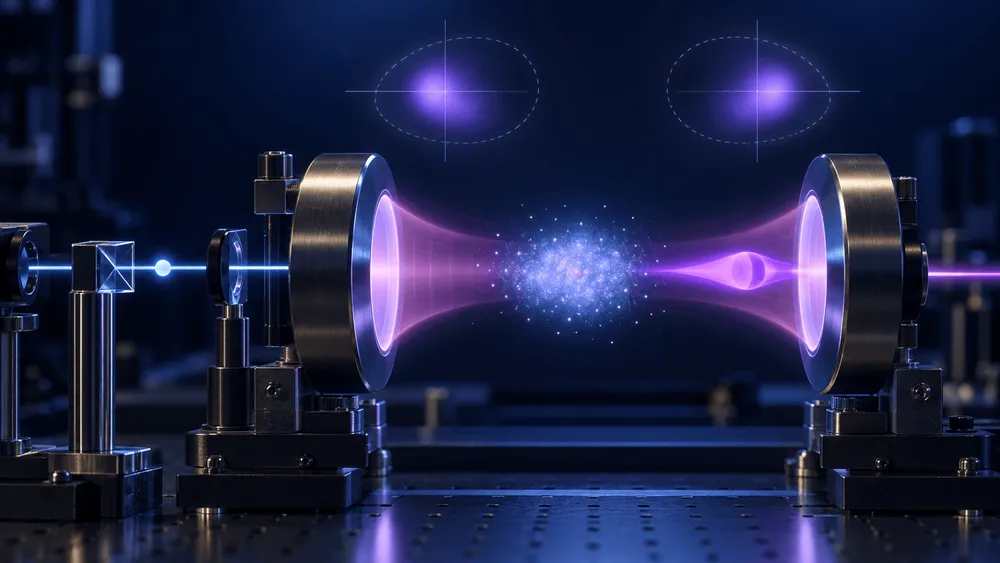
Hendrik Hegels and colleagues at the Max Planck Institute of Quantum Optics have reported an experiment that uses Rydberg excitations to make an optical "Schrödinger's cat" larger than before. The state is a superposition of light entangled with the polarization of another photon. The metric for the size of the cat state reached 2.4 after correcting for detection loss, up from the previous 1.4.
The result appeared as a non-peer-reviewed preprint published on September 23, 2026. The team presents it as a "world record," but it applies only to a specific kind of "hybrid entangled state" in which an optical cat state is entangled with another qubit.
To understand the record, it helps to separate two questions: what exactly is being measured as the "size of the cat," and how the researchers confirmed that quantum properties survived after enlarging it.
What is the "world record" for?
The team created a hybrid entangled state that combines a "cat state," a superposition of different states of light, with a polarization qubit carried by a separate photon.
The former uses a continuous variable, the amplitude of light, while the latter uses discrete states such as horizontal and vertical polarization. Because it combines two systems that represent quantum information in different ways, it is called "hybrid."
The "alive" and "dead" of Schrödinger's cat correspond to two optical states with different phases.
The researchers quantum-mechanically superpose two distinct "coherent states," an idealized description of laser light. They define the size of the cat state by how far apart these two states are. The easier they are to tell apart, the "larger" the cat.
This is not a record for the number of atoms or the mass of an object.
In the paper's definition, half the difference in amplitude between the two optical states is called α, and its square serves as the size metric. For an ideal, symmetric cat state, this value corresponds to the mean photon number in each component.
However, this "size" is not a distance the light physically travels through space. It indicates how far apart the two states are within the space used to describe the quantum state of light.
Nor does the 2.4 mean the largest of all optical cat states.
In the prior work that Hegels and colleagues summarize in the paper's introduction, a size metric of 3.1 has already been reported for a standalone optical cat state that is not entangled with another qubit.
For hybrid states like this one, in which an optical cat state is entangled with another qubit, the previous maximum was 1.4, from an experiment using a single atom and an optical cavity.
The 2.4 counts as a record because it compares states that satisfy two conditions at once: creating a large optical superposition and maintaining entanglement with another qubit.
Such hybrid states are also studied as a resource for linking optical quantum computing and quantum communication that handle quantum information in different ways. The aim of this research is to maintain quantum connections while expanding the two optical states to a size where they can be adequately distinguished.
Storing one photon in atoms and shifting the phase of a later light pulse
The experiment uses an ensemble of cold atoms placed in a cavity, along with two kinds of light that play different roles.
First comes the "control photon," followed by the "target light" used to create the cat state. The cavity is a device that makes light bounce back and forth many times inside so that it interacts strongly with the atoms.
The control photon is split into two paths according to its polarization.
One component passes through the cavity and is temporarily stored as a "Rydberg excitation" of the atomic ensemble. The other travels through an optical fiber, bypassing the cavity.
If the control photon is prepared in a superposition of polarizations, the states "excitation stored in the atomic ensemble" and "not stored" are themselves placed in a quantum superposition.
A Rydberg state is one in which an atom's electron has been excited to a very high energy level.
An atom in a Rydberg state interacts strongly with surrounding atoms, making it hard for another Rydberg excitation to occur nearby. This phenomenon is called "Rydberg blockade."
The team combined this effect with "electromagnetically induced transparency," which uses an auxiliary light field to control the interaction between atoms and light.
As a result, the atoms' response to the target light that arrives afterward changes depending on whether the control photon is stored in the ensemble.
When the target light is reflected from the cavity, its phase changes depending on the presence or absence of the stored control photon.
The control photon stored in the atomic ensemble is then retrieved as light and recombined with the component that bypassed the cavity. This creates entanglement between the different states of the target light and the polarization of the control photon.
Furthermore, by measuring the control photon's polarization in a particular way and selecting only the data corresponding to that result, the team can also obtain a cat state consisting of the target light alone.
Reconstructing the light's state to confirm quantumness and entanglement
The team ran the experiment with six different input amplitudes of the target light and reconstructed the quantum state of the light from the measurement data.
This method of estimating a whole quantum state from many measurement results is called "quantum state tomography."
To measure the target light, they used homodyne detection, which examines the amplitude and phase of light by overlapping it with a reference laser beam. For the control photon's polarization, they prepared six measurement settings and sorted the data according to each result.
For each size and polarization setting, they typically collected about 40,000 measurements.
State reconstruction also faces the problem that detectors cannot capture all the light.
According to the paper, the effective optical loss of the entire detection system was 21%. The maximum value of 2.4 was calculated after correcting for this detection loss.
The figure "size 2.4" should therefore be read not as a value computed directly from the data that actually reached the detectors, but as a result corrected for the light lost in detection.
The quantum nature itself, on the other hand, was confirmed even from measurement data without loss correction.
The Wigner functions of the six reconstructed "odd cat states" all showed regions taking negative values.
The Wigner function is one way to represent a quantum state, and unlike a classical probability distribution, it can take negative values for states with distinctly quantum features.
This negative region is an important indicator that "nonclassicality," which cannot be explained by a mere classical mixture of light, remains.
The researchers also examined whether entanglement remained between the target light and the control photon.
At the maximum size of 2.4, the Bell-state fidelity after correcting for detection loss was 51.2±0.4%, above the 50% threshold that indicates the presence of entanglement.
Bell-state fidelity indicates how close the actually created state is to an ideal maximally entangled state.
In other words, the negative regions of the Wigner function confirm the nonclassicality of the light itself, while the Bell-state fidelity confirms that entanglement remains between the target light and the control photon. The two measure different quantum properties.
These results were obtained by actually manipulating and measuring light with the apparatus.
Meanwhile, the error estimates also used calculations that generated 100 sets of simulated data based on the reconstructed quantum states.
The paper states explicitly that the reported mean values themselves were not produced from simulated data. The actual experimental results and the simulations used to evaluate errors are kept distinct.
Enlarging the cat also amplifies the effect of photon loss
Photon loss is a major problem in making cat states larger.
When photons are lost, the light does not simply become weaker. Information that would allow one to infer which of the two states making up the superposition it was can leak into the environment.
When that happens, the quantum phase relationship maintained between the two states is lost. This is decoherence.
An advantage of this method is said to be that experimental conditions can be tuned so that, even if photons are lost, information about which state it was is less likely to leak to the environment.
Even so, several constraints remained in the actual apparatus.
The team analyzes that performance is limited by factors such as the Rydberg blockade being imperfect and the response being broadened because the time during which atoms and light can interact is limited.
Furthermore, "self-blockade," in which the target light itself prevents additional excitation of atoms, may be one reason the theoretical model and the actual measurements disagree.
However, the current theoretical model could not explain all of the discrepancies.
Trying to make the cat state even larger also makes it harder to collect enough measurement data.
The supplementary material reports that as the number of photons in the target light increased, atom loss grew and the efficiency of retrieving the stored control photon as light declined.
The team suspects atoms are lost because recoil from spontaneously emitted light heats them until they escape from the trap.
This, however, is an inferred cause for an observed phenomenon, not a mechanism that has been directly confirmed.
Because the experimental system must be prepared anew each time atoms are lost, a higher frequency of loss also slows the rate at which large amounts of measurement data can be collected.
As improvements, the team lists lengthening the target-light pulses, confining the atomic ensemble to a smaller region, and reducing laser phase noise.
If these constraints can be improved, it may be possible to create even larger cat states. However, this experiment did not demonstrate such future sizes.
The paper is published as arXiv:2609.27983 by Hegels and colleagues and has not yet undergone peer review.
Independent replication by other research teams has not yet been confirmed either, so the result cannot be stretched to mean something like "the boundary between the quantum and classical worlds has been pinned down."
What matters next is whether the cat state can be made larger while preserving the quality of the entanglement, and whether the same state can be created and measured repeatedly and stably.
If that can be achieved, this hybrid cat state would move a step closer to becoming a quantum resource that can actually be used in optical quantum computing and quantum communication.