

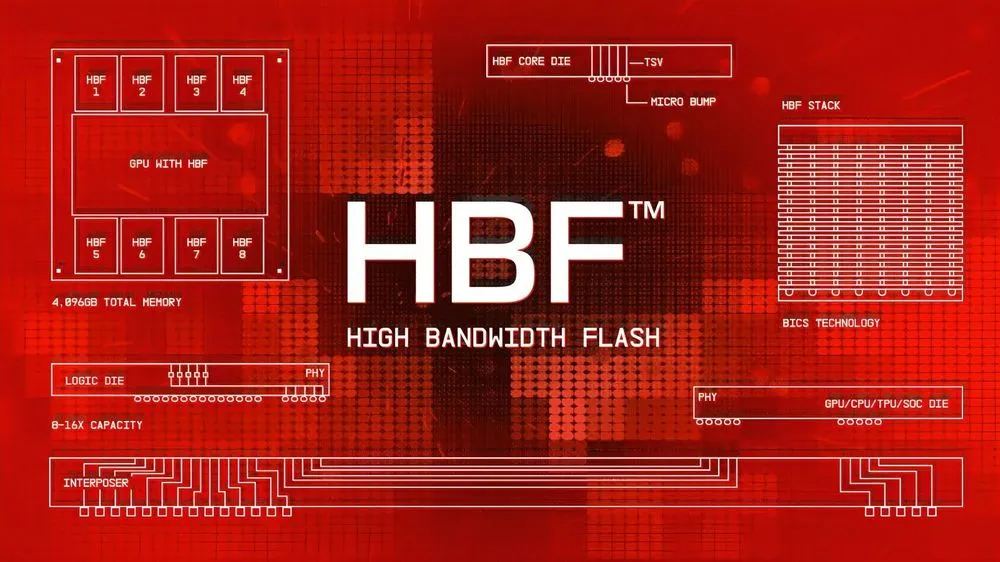
At its Investor Day on August 13, 2026, Sandisk revealed that it has taped out its first High Bandwidth Flash (HBF) memory die. The company also outlined plans to ship samples of AI inference products incorporating HBF in 2027. This comes just after Sandisk and SK hynix published their first public specification in early August, marking HBF's progression from standard-setting to finalizing manufacturing designs in parallel.
However, this does not mean Sandisk has committed to mass production starting in 2028. The publicly released Investor Day materials contain no mention of a mass production year; it is Mizuho Securities that has suggested mass production ramp-up and revenue recognition could potentially begin in 2028. What this update actually confirms is limited to the tape-out and the 2027 product samples.
What Tape-Out Advances, and What Remains
Tape-out refers to the milestone where circuit design is finalized and manufacturing data is handed off to the fab. It is distinct from completing a working mass-production product. What follows is fabricating prototype wafers to verify electrical characteristics, then proceeding through stacking, packaging, and controller integration, followed by evaluation within customer systems.
In the roadmap Sandisk presented in August 2025, the company stated it would deliver initial HBF memory samples in the second half of 2026 and samples of inference devices using HBF in early 2027. The latest materials state that the "first HBF memory die has been taped out" and that "the first HBF inference product samples are expected in 2027." While the timing for the latter has been maintained, the company has not explicitly confirmed completion of memory sample shipments. Whether the transition from prototype die to evaluation-ready memory can occur within the previously stated second-half-2026 window remains the near-term point to watch.
Goldman Sachs, in a research note following the Investor Day, also reported that the first HBF memory product has been taped out, with initial samples expected in 2027. The timing of mass production is a separate matter.
The Gap Targeted by 512GB and 3.0TB/s
HBF is a read-optimized memory that stacks NAND flash rather than DRAM, positioned close to GPUs and CPUs. Sandisk's concept aims to match HBM-equivalent read bandwidth while increasing capacity by 8 to 16 times. In its 2025 technical materials, the company set first-generation targets at 512GB using 16-layer stacking, with read bandwidth of 1.6TB/s.
The initial specification published by Sandisk and SK hynix through the Open Compute Project (OCP) defines 8-layer and 16-layer NAND stacking, with capacity up to 512GB. Bandwidth is divided into Grades 1 through 3, ranging from approximately 0.4TB/s to 3.0TB/s. The specification adopts UCIe—a public interface designed for chiplets—for connections to processors, and also defines electrical characteristics, reliability standards for stacked packaging, and software guidelines for read/write operations.
SK hynix describes HBF as a new memory tier that sits between HBM and SSDs. Sandisk has presented both a configuration mixing HBF with HBM and one composed of HBF alone. The company also envisions configurations using HBF as memory decoupled from compute units, as well as tiered configurations using HBM as a cache—indicating the design is not narrowly focused on uniformly replacing HBM.
Four Units vs. Eight: How to Read the Internal Simulation
The most eye-catching figure from Investor Day is an internal simulation showing that four GPUs equipped with HBF achieved the same token output as eight GPUs equipped with HBM. The model used was Qwen3-480B-A35B, which requires 960GB in bfloat16. Both configurations set total bandwidth per GPU at 12.8TB/s, with memory capacity set at 4TB for HBF and 192GB for HBM.
This difference does not mean HBF doubles a GPU's computational capability. Rather, because HBF's capacity allows the 960GB model to be housed close to the compute unit, fewer GPUs are needed for the purpose of holding the model. Sandisk also calculated that in a minimal configuration, HBF would require just 1 GPU while HBM would require 8. This cannot be directly applied to processing where model capacity fits within HBM, or to training workloads that strongly demand write performance and low latency.
The result is also not a benchmark measured on mass-production hardware by a third party. A separate internal simulation from 2025, under conditions reading 8-bit trained weights of Llama 3.1 405B, showed the performance gap between HBF and a hypothetically capacity-unlimited HBM within 2.2%. Sandisk itself notes that results vary depending on conditions. Future product samples will require real-world data covering latency, endurance, thermal behavior, and error handling.
2028 Mass Production Is Not Yet a Company Target
Mizuho Securities' note suggested that following the 2027 samples, mass production could potentially ramp up and contribute to revenue in 2028. The wording used was "potentially"—this is not a confirmed schedule from Sandisk. Goldman Sachs' public note also touches on the 2027 samples but does not list a 2028 mass production start as a company plan.
Mass production will require, in addition to confirming die functionality, mechanisms to manage yield for 16-layer stacking, heat generation, and NAND rewrite endurance tailored to use cases. Furthermore, it will not become a real product unless designers of GPUs and AI accelerators adopt HBF and software properly utilizes the new memory tier. Google and Tenstorrent have participated in OCP's HBF workstream, but no announcements have been made regarding incorporation into specific accelerators.
The tape-out, revealed just 10 days after the initial specification was published, serves as evidence that HBF has moved past the conceptual-diagram-only stage. The next set of judgment points will be whether memory samples reach customers in the second half of 2026, whether the 2027 inference products can reproduce the stated bandwidth and capacity figures, and whether the 2028 mass production outlook becomes backed by customer adoption and actual orders.