

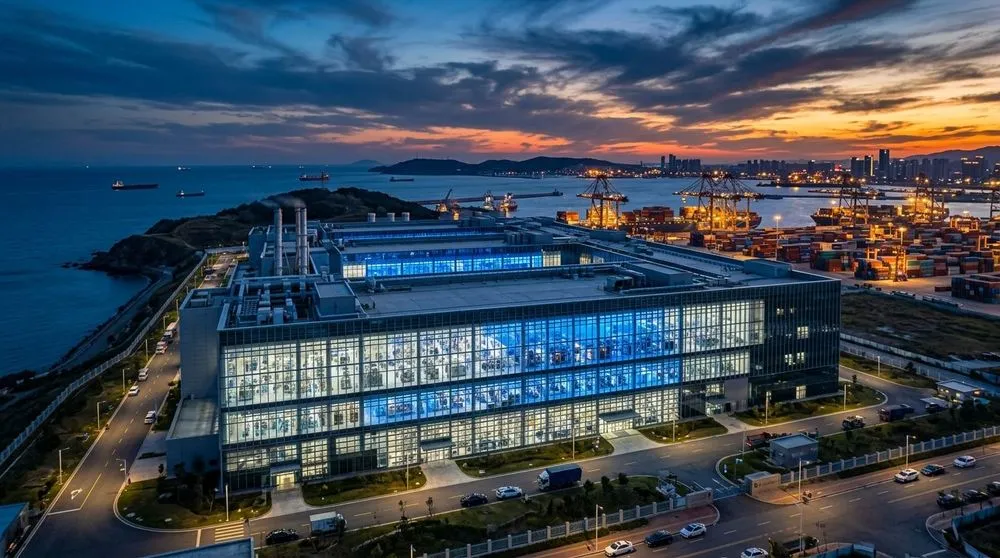
In October 2020, SK hynix signed an agreement to acquire Intel's NAND flash business for $9 billion. At the time, it was the largest M&A deal in SK hynix's history and a strategic move to expand its DRAM-heavy business portfolio into NAND. Five and a half years later, Solidigm—the US subsidiary born from that acquisition—has begun pre-IPO fundraising targeting a corporate valuation of 50 trillion won (approximately $35.1 billion).
According to a report by Chosun Biz, part of the Chosun Ilbo group, on August 7, Solidigm is sounding out investment interest from global alternative asset managers and sovereign wealth funds. Morgan Stanley and Goldman Sachs have been named as candidate lead underwriters, and the company has reportedly begun recruiting an executive to oversee SEC (US Securities and Exchange Commission) filings and external financial reporting.
SK hynix itself only listed on Nasdaq via ADRs (American Depositary Receipts) on July 10. Issuing 177.9 million ADSs at $149 per share, the company raised approximately $26.5 billion—the largest-ever US stock market listing by a foreign company. The fact that subsidiary listing preparations are advancing right after the parent company demonstrated such fundraising power suggests that the SK Group is deepening its access to US capital markets in stages.
However, in a disclosure filed on August 7, SK hynix stated that "Solidigm is considering various options to strengthen its competitiveness, but no concrete plans have been finalized," adding that details would be announced by September 4.
AI Has Pushed the NAND Market into "Structural Shortage"
The backdrop making Solidigm's listing discussion feel realistic is a sudden shift in the NAND flash market. According to TrendForce data, combined revenue of the top five NAND flash companies exceeded $38.9 billion in Q1 2026, marking an 83.7% increase quarter-on-quarter. Demand for the large-capacity storage needed to build AI servers has far outstripped supply, and TrendForce notes that contract prices have also surged sharply. The 83.7% revenue increase reflects contributions from both expanded shipment volumes and rising unit prices.
| Metric | Q4 2025 | Q1 2026 | Change |
|---|---|---|---|
| Top 5 NAND Companies Combined Revenue | Approx. $21.2B | Approx. $38.9B | +83.7% |
| SK hynix Group NAND Revenue | Approx. $5.2B | Approx. $7.53B | +44.6% |
| SK hynix Group Market Share | 22.1% | 17.6% | -4.5pt |
| Samsung NAND Revenue | Approx. $6.6B | Approx. $13.51B | +104.7% |
| Total Enterprise SSD Market | Approx. $9.9B | Approx. $18.46B | +86.1% |
SK hynix Group (the combined figures of SK hynix and Solidigm) ranks second with $7.53 billion in revenue, behind Samsung ($13.51 billion, 31.6% share). While its share itself declined from 22.1% to 17.6%, this was because Samsung's growth rate of 104.7% was exceptional—in absolute terms, SK hynix Group posted substantial revenue growth.
Solidigm's presence is particularly notable in the enterprise SSD segment. SK hynix Group's enterprise SSD revenue reached $4.64 billion in Q1. Solidigm launched the world's first 122TB QLC eSSD, the "D5-P5336," in November 2024, capturing demand for large-capacity storage for AI inference workloads. A single drive can hold every movie released in theaters during the 1990s in 4K quality, 2.6 times over. Plans for a next-generation 245TB-class eSSD are also underway, with shipments expected within 2026, and Solidigm Vice President Avi Shetty has stated, "There's no ceiling on demand in sight. This is just the beginning."
The Reality of 8 Trillion Won in Cumulative Losses and a 4,484% Debt Ratio
Looking only at product strategy and market conditions, Solidigm's listing appears to be a natural progression. But opening the financial statements reveals a different landscape.
From its founding in 2021 through 2023, Solidigm recorded cumulative net losses of approximately 8 trillion won. This resulted from a sharp downturn in the NAND market compounded by one-time integration-related costs. In the first half of 2024, total equity fell to negative 906 billion won, plunging the company into a state of complete capital impairment.
The turning point came in 2024. Alongside a recovery in AI demand, the company achieved profitability, posting a full-year net profit of 830.7 billion won. Total equity also recovered to positive 307.9 billion won, escaping capital impairment.
The problem is that even with profitability restored, the debt structure has not been resolved. The 2025 debt ratio stood at 4,484.6%. Compared to the generally healthy benchmark of 200% or below, this is roughly 22 times that level. This figure reflects the weight that operating funds SK hynix poured into Solidigm after the acquisition (approximately $2.6 billion as of H1 2024) and the final payment balance to Intel (completed with a payment of approximately $2.24 billion in March 2025) have placed on the subsidiary's balance sheet.
| Financial Metric | 2021–2023 Cumulative | 2024 | 2025 |
|---|---|---|---|
| Net Profit/Loss | Approx. -8 trillion won | +830.7 billion won | Not disclosed |
| Total Equity | Negative | +307.9 billion won | Not disclosed |
| Debt Ratio | - | - | 4,484.6% |
| Comparison to Healthy Level | - | - | Approx. 22x |
If Solidigm can raise 5 to 10 trillion won through the pre-IPO round, this could potentially be applied to improving its debt structure. However, whether the target valuation of 50 trillion won will be accepted by the market depends on how investors weigh both the sustainability of NAND market growth and the improvement of Solidigm's financial condition.
The Dalian Plant: A "Geopolitical Bottleneck"
Solidigm's manufacturing base is concentrated at a plant in Dalian, China—a location that has created structural constraints amid US-China tech competition.
While a groundbreaking ceremony for Dalian Plant 2 was held in May 2022, export controls from the US Department of Commerce's Bureau of Industry and Security (BIS) have continued to block the import of advanced equipment such as EUV lithography systems. In August 2025, along with Intel's Dalian plant and Samsung's China plant, the facility was removed from VEU (Validated End-User) designation, meaning individual export licenses are now required for equipment imports.
The situation began to shift in 2026. BIS introduced an annual licensing system to replace VEU, granting SK hynix approval to ship pre-approved equipment during 2026. Following this, prospects emerged for the resumption of Dalian Plant 2's expansion in the latter half of 2026. According to a July report by South Korea's News Tomato, domestic partner companies have begun transferring idle NAND equipment to Dalian, and preliminary purchase orders (POs) have also been issued to overseas suppliers.
Under the plan, a new line for 238-layer NAND (V8 generation) will be established at Plant 2, adding wafer processing capacity of 30,000 to 50,000 units per month. Equipment installation is set to begin in the latter half of 2026, with a phased ramp-up through the first half of 2027. At the existing Plant 1, conversion of lines to 192-layer NAND and replacement of aging equipment is already underway.
However, clear uncertainties remain in this plan. While the annual license covers equipment shipments for 2026, there is no guarantee that renewal will be approved for 2027. BIS has indicated it will permit continued operation of existing plants, while also making clear that it will not approve applications aimed at expanding production capacity or upgrading technology at Chinese facilities. Whether the construction of Plant 2's new line qualifies as "existing operation" or "capacity expansion" remains unclear.
The Technology Gap: Dalian Stuck at 192 Layers While the Korean Headquarters Advances to 321 Layers
The lagging technology generation at the Dalian plant also bears on medium- to long-term competitiveness. Currently, Dalian Plant 1 operates at 192-layer NAND, more than two generations behind the 321-layer NAND that SK hynix's headquarters is mass-producing in Korea. Even the 238-layer (V8) technology planned for Plant 2 would be one generation behind the headquarters' cutting edge.
This gap is no accident. At Dalian, where export controls prevent the import of leading-edge equipment, updates to technology nodes are physically constrained. The 192-layer floating gate NAND that Solidigm uses in its 122TB QLC eSSD also falls behind in layer count compared to competitors who have achieved over 270 layers with charge trap technology.
However, layer count alone does not determine competitiveness. Solidigm's QLC eSSDs have carved out a unique position as products that combine large capacity with low power consumption for read-intensive AI inference workloads. The 122TB D5-P5336 can reduce storage power consumption by up to 84% compared to traditional HDD+TLC hybrid configurations while compressing rack space to a quarter of the original footprint. As power and space become bottlenecks in AI data centers, this efficiency carries value that offsets the difference in layer count.
Three Verification Points Remaining on the Path to Listing
The fate of Solidigm's pre-IPO and Nasdaq listing hinges on the following three points.
First, the pace of improvement in the financial structure. A debt ratio of 4,484.6% will not resolve overnight even with capital reinforcement from pre-IPO fundraising. Investors will likely try to discern whether profitability is sustainable or merely a cyclical rebound in the NAND market.
Second, whether equipment installation at Dalian Plant 2 actually begins in the latter half of 2026 as planned. If installation proceeds within the scope of the annual license and the 2027 license renewal is also approved, constraints on production capacity would ease. Conversely, if approval is not granted, Solidigm would face its listing without having secured a means to expand its manufacturing base.
Third, the separation between manufacturing and sales functions. According to reports, manufacturing functions at the Dalian plant are held by SK hynix's Chinese subsidiary (SK hynix Semiconductor Dalian), while Solidigm itself operates primarily as a sales-focused company. A listing by a sales company without manufacturing assets makes it difficult for investors to build a basis for valuation. How this structure will be handled in pre-IPO valuation negotiations remains to be seen.
When SK hynix acquired Intel's NAND business for $9 billion, some in the industry harbored skepticism, arguing that "unlike DRAM, NAND is difficult to differentiate technologically and faces intense competition, making it most vulnerable to downturns." In the first half of 2023, approximately 80% of SK hynix's consolidated operating loss of about $4.49 billion originated from the NAND division. Three years have passed since then. AI storage demand has transformed the structure of the NAND market, and Solidigm is transforming from an "unfortunate acquisition" into a "50 trillion won IPO candidate." Yet at its foundation lie a 4,484.6% debt ratio and a Chinese plant constrained by geopolitics. Whether the listing succeeds will depend on how much of both factors the market chooses to price in.