

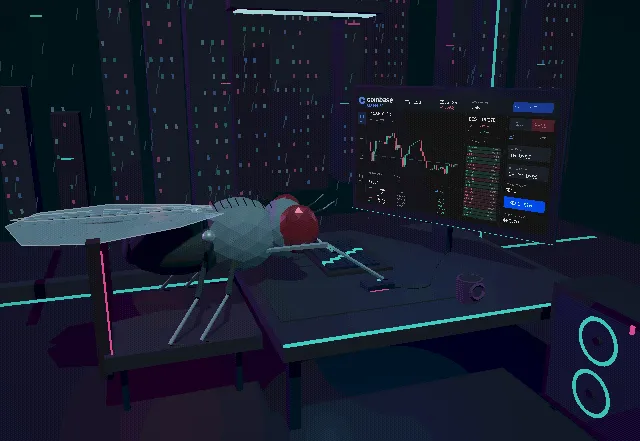
What happens when a simulation that directly mimics a biological brain's circuitry is handed control of a real financial market? In September 2026, open-source developer Alex Wormuth released Stonkfly, experimental software that wires a published whole-brain connectome of an insect directly into a simulated market environment. Roughly 160,000 virtual neurons, extracted from a neuroscience database, are shown Bitcoin price charts and asked to make buy-or-sell decisions.
The experiment spread rapidly on social media under the framing that "a fly's brain is day-trading crypto." But behind the flashy headlines, a close reading of the published codebase and technical documentation reveals not a reckless auto-trading algorithm, but an experimental software bridge connecting large-scale connectome data to an exchange API. Moreover, the developer himself repeatedly inserts extremely rigorous self-disclaimers throughout the documentation, stating that "no ability to learn profitably has been demonstrated whatsoever."
Can mimicking neural circuitry actually extract meaningful patterns out of market noise? This article examines the origin of the biological dataset Stonkfly relies on, the engineering of the signal chain that converts candlestick charts into neural firing, and the objective verification standards the development documentation itself imposes.
Where Hype Ends and Open-Source Implementation Begins
Stonkfly's existence became publicly known when the UK tech news site The Register published an article on September 11, 2026. The piece reported that Alex Wormuth, a software engineer at the cryptocurrency exchange Coinbase, had launched a project giving $100 to a simulated insect nervous system to trade Bitcoin.
Wormuth himself announced the experiment's launch on his X (formerly Twitter) account as follows: "I gave $100 to a fly brain so it could trade Bitcoin. When the fly makes a profit, its dopaminergic neurons get stimulated. Neuron activity controls buy/sell decisions and executes trades on Coinbase. Will the fly get rich?"
Taken at face value, this post could give the impression that a biological intelligence is exploiting market inefficiencies to build self-compounding wealth. But a direct inspection of the project's repository (nftechie/stonkfly on GitHub) and its publicly available dashboard (stonkfly-three.vercel.app) reveals disclaimers from the developer that are extremely sober and defensive.
A prominent warning on the dashboard reads, in capital letters, "CHANGING CONNECTIONS ≠ PROVEN SKILL." Directly beneath it is the explicit statement: "Profitable learning hasn't been demonstrated."
The Register's article was written in a satirical, humorous tone, joking about a future in which central banks might delegate monetary policy decisions to virtual insect brains. But as a matter of technical fact, Stonkfly is a "disembodied nervous system" with no physical body model whatsoever. Unlike the Eon Systems research reported by The Register back in March 2026—in which a full-body fruit fly model was made to walk and groom itself in a virtual space—Stonkfly has no connected motor muscles or physical simulation environment. What exists is purely a software interface: on-screen charts are converted into neuronal excitation, and the firing rates of an output layer are tallied and forwarded to an API.
The 120 Million Synaptic Structures Provided by MaleCNS v1.0
What Stonkfly uses as its computational substrate is not a fictional neural network but a precise wiring diagram (connectome) derived from actual biological research. Specifically, it uses the "MaleCNS v1.0" dataset published by the FlyEM project at the Howard Hughes Medical Institute's (HHMI) Janelia Research Campus.
According to Janelia's published logs, MaleCNS went through a preview release, "v0.9," published on October 3, 2025, before its official release as "v1.0" on June 8, 2026. This represents the first complete male connectome of its kind for the adult male fruit fly (Drosophila melanogaster), covering the entire central nervous system—the central brain, optic lobes, and the ventral nerve cord that controls the thoracic and abdominal muscles. Whereas widely studied prior datasets such as "FlyWire" targeted the adult female brain, MaleCNS was offered as a groundbreaking biological resource enabling synapse-resolution comparison of structural differences between the sexes.
According to Stonkfly's technical documentation and The Register's reporting, the scale of this network's graph structure is as follows:
- Constituent nodes (virtual neurons): 166,700
- Directed connections: 25,582,938
- Synaptic contacts: 124,177,617
Approximately 166,700 cells are interconnected in a mesh through more than 124 million synaptic junctions. This figure represents an enormous scale as a graph architecture. However, the project's documentation and dashboard explicitly warn against equating this number with "a precise reproduction of a living organism."
The dashboard states clearly that the membrane potential calculations for each neuron are based on "approximate electrical dynamics," and positions the entire system as a "SIMPLIFIED WIRING DIAGRAM." Inside an actual fruit fly's brain, a vast array of biochemical variables operate simultaneously that go far beyond simple connectivity relationships in a graph—local concentrations of diverse neurotransmitters, receptor subtype distributions, interactions with glial cells, and global modulation by peptide hormones, to name a few. What Stonkfly runs on a computer is nothing more than a simulation applying simplified mathematical firing dynamics to the skeleton of a connectivity matrix reconstructed from static electron microscope images.
The Four-Stage Signal Chain from Candlesticks to Order Execution
How does cryptocurrency price movement inside the Stonkfly system get converted into neural activity and then output as an order? The project's architecture is cleanly separated into four distinct phases: data acquisition, visual projection, network propagation, and behavioral decision-making.
The first stage is "construction of visual input." Stonkfly does not inject numeric price data (such as a floating-point number like "BTC = 62,500 USDC") directly from the exchange API into the neurons. Instead, it fetches the BTC-USDC market price from Coinbase's public data feed and renders it locally as an RGB candlestick chart image. Just as a human looks at a display, the fly brain observes the market indirectly through a rendered two-dimensional image pattern.
Regarding the receptive surface for this visual information, it's worth noting that two differing explanations exist in the published materials. The dashboard's specification describes a sensory interface allocated 3,335 luminance inputs and 811 R8 photoreceptor cell inputs, with a caveat that this mapping itself is "an approximation." Meanwhile, Tom's Hardware's technical reporting describes the candlestick chart as being split into left and right compound eyes, presented as a 320×180-pixel display area with an overlapping central visual field. These represent the interface's resolution and receptive-field allocation described at differing levels of abstraction; pixels and individual receptor cells are not in strict one-to-one physical correspondence.
The second stage is "internal network dynamics." The markets under observation are three tokens—Bitcoin (BTC), Ethereum (ETH), and Solana (SOL)—which the system cycles through in round-robin fashion, presenting them to the virtual compound eyes in sequence. The incoming light stimulus fires neurons in the optic lobe, which propagate in a chain reaction through synaptic connections across the network. According to the timing configuration reported by Tom's Hardware, market data is fetched once every 60 seconds, whereas the internal "thinking" and firing-state updates of the brain model run by default every 500 milliseconds (twice per second). Note that, according to the dashboard's own description, the chart display itself—which redraws once per second in the browser—is not in itself a trigger that induces learning or trading.
The third stage is "behavioral readout and risk management." A fixed readout layer tallies the firing rates of specific groups of output neurons, and the system can only propose one of three actions: "Buy," "Sell," or "Hold." Critically, no reasoning layer akin to a large language model (LLM) is involved in trading decisions whatsoever.
Furthermore, even if a neuron fires "Buy," that signal doesn't flow unconditionally into the market. An independent software module called the Position Manager intervenes, calculating order size by cross-referencing current cash balance, held cryptocurrency quantities, and strict risk-limit parameters. Proposals that fail to meet the conditions are rejected. Only approved orders are routed to the exchange API (Coinbase Advanced) via Coinbase AgentKit.
As a fourth stage, a "single-worker structure" is employed to preserve overall system integrity. According to the dashboard's explanation, a single backend process (worker) exclusively holds and manages both the ledger updates and the brain's internal state. The dashboard displayed in a web browser merely reads periodic snapshots written out by the backend. Therefore, no matter how many users around the world simultaneously open browser tabs to view the dashboard, the trading virtual brain does not multiply, nor does it place orders in parallel.
A Reinforcement Learning Loop Converting Profit and Loss into Pseudo-Dopamine
What Stonkfly implements as the foundation for attempting to "learn" is an artificial reward-delivery mechanism tied to the profit and loss of the portfolio. While some media coverage used emotionally charged expressions such as "the fly feels pleasure when it makes a profit," what actually runs in the code is nothing more than an extremely mechanical software rule.
The basic feedback rules described in the dashboard and GitHub documentation are as follows:
- If the portfolio's total net asset value increases by +0.01 USDC or more from the most recent reference point, it is judged a profit.
- If net asset value decreases by -0.01 USDC or more, it is judged a loss.
- The moment either threshold is crossed, an excitatory pulse signal lasting 200 milliseconds is injected into a specific group of dopaminergic neurons within the simulation.
The target neurons receiving this injection correspond to cell groups known in the actual biological brain to be involved in reward learning and aversive learning. When a profit occurs, positive stimulation is sent to the identified "PAM11" cell group (15 cells); when a loss occurs, stimulation goes to the "PPL101" cell group (2 cells).
Upon receiving this pulse input, a built-in "candidate memory rule" activates, altering the transmission efficiency (weight) of the relevant synapses that were active immediately beforehand. As Wormuth himself has clearly stated to both The Register and Tom's Hardware, this mechanism is a software-engineered reinforcement signal—it is not a model of a biological organism's pain, pleasure, or fear. There are no pain receptors present in the code.
データを表で見る
| Net Asset Change (USDC) | |
|---|---|
| T0 (baseline) | 0 |
| T1 (+0.005) | 0.005 |
| T2 (+0.012) | 0.01 |
| T3 (+0.008) | 0.008 |
| T4 (-0.015) | -0.02 |
This learning loop's design carries serious constraints from both an engineering and statistical standpoint. First, the profit/loss calculation used as the signal's baseline includes unrealized gains and losses on held assets, and trading fees paid to the exchange are counted directly as losses.
Second, and far more critical, is the "credit-assignment problem." As the project's own documentation frankly points out, the feedback signal is generated based on changes in the value of the entire portfolio, not the success or failure of any single trade. For example, if the fly just executed a "buy" and the asset value then rises by 0.01 USDC due to a sudden overall market uptick, the model cannot distinguish whether that increase was due to the soundness of its trading judgment or simply a broader rally. The structure does not exclude the possibility that a positive reward could be mistakenly assigned to a previous erroneous decision.
As a result, the repository's explanatory documentation delivers a clear conclusion: "Even if synaptic connections change, that does not mean the system has learned a way to trade profitably." The documentation further states flatly: "No profitable learning, strategy improvement, biological realism, or live-money track record has been demonstrated in this repository's testing."
Cryptocurrency markets are highly volatile, and during periods when the overall market is trending upward, even completely random buying and selling can temporarily increase assets. The project itself warns that to truly determine whether learning has taken place, comparison against benchmarks—such as simply holding cash (Cash baseline) or simply buying and holding the asset (Buy-and-Hold exposure baseline)—is necessary, rather than relying on raw dollar-denominated profit or loss. This is because "the mere fact that crypto prices are rising can make any buyer look like a skilled trader."
The Separation of Operating Modes and the Reality of the Safety Design
The architecture for actually running Stonkfly incorporates multiple layers of defense to prevent unexpected financial losses. The code implements both a "Paper Trading" mode, which moves virtual funds within a simulated environment, and a "Live Trading" mode, which sends signed orders to the actual exchange API.
The system's default behavior is paper trading. In this mode, it fetches real-time BTC-USDC prices from Coinbase's public feed while simulating fictitious executions against a virtual starting balance of $100. The graphs and balances displayed on the public dashboard are, by design, primarily reflections of the results from this paper trading, and are clearly distinguished from real market orders to prevent any confusion between actual and simulated executions. All monetary figures on the dashboard are denominated in USDC, with the valuation updated every second by referencing Coinbase's standard USD/USDC rate.
On the other hand, when running in live mode, strict constraints designed to protect the exchange API—referred to on the dashboard as "ANTI-REKT LIMITS"—are hard-coded into the system.
- The maximum order amount per trade is capped at $10.
- The number of trade attempts is limited to a maximum of 24 within a 24-hour period.
- There is no capability for leveraged trading or short selling; the system is restricted to spot buying and selling only (Long-only, Spot-constrained).
- Even if the nervous system fires a signal, the Position Manager will not force a trade execution if conditions are not met ("Trades are never forced").
The documented operating requirements for building and running this system on a local machine include a macOS or Linux environment, Python 3.11, a C++17-compatible compiler, and a recommended 16GB or more of RAM. Continuously processing a connectivity matrix and firing calculations across more than 160,000 nodes on a CPU or GPU demands resources approaching the upper end of typical consumer PC environments.
So, on the publicly released dashboard visible to the world, how much trading has this fly brain actually carried out? The observed facts at the time of reporting stood in stark contrast to the heated expectations. At the time of the investigation reported by The Register, and corroborated around the same period by the crypto media outlet BeInCrypto, the public dashboard's execution history displayed "No fills yet," with zero completed trades.
Even as market data updated and voltage rippled through the neural network, the output layer had not reached the point of generating a valid order command exceeding the set threshold and passing inspection by the Position Manager. The state of the public live environment can change moment by moment, but at least in the period immediately following the project's release, there existed nowhere the objective fact that "the fly brain made a profit in the market."
What Stonkfly's Engineering Essence Reveals in Comparison with Prior Research
The attempt to reconstruct biological connectomes on a computer represents one of the fastest-advancing frontiers in computational neuroscience in recent years. To objectively evaluate Stonkfly's distinctiveness and its limitations, it is necessary to organize the differences with prior research in the same field.
A representative point of comparison is the virtual fruit fly emulation experiment by Eon Systems, whose results were reported in March 2026. Both projects share a starting point in a biological neural wiring diagram, but their purposes and system configurations differ fundamentally.
| Comparison Item | Eon Systems' Embodied Emulation | Stonkfly (Alex Wormuth) |
|---|---|---|
| Primary purpose | Verifying biological validity, generating behavior (walking, grooming, etc.) | Experimental interface connecting a connectome to a financial API |
| Connectome used | FlyWire-based (adult female fruit fly, whole brain) | MaleCNS v1.0 (adult male fruit fly, entire central nervous system) |
| Scale of nervous system | Approx. 140,000 neurons, approx. 50 million synaptic connections | 166,700 nodes, approx. 124 million synaptic contacts |
| Presence of body model | Yes (NeuroMechFly v2, driven on the MuJoCo physics engine) | No (disembodied nervous system, no body) |
| Time synchronization interval | Brain and body physics synced every 15 milliseconds | "Thinking" every 500ms, market data updated every 60s |
| Input/output targets | Physical contact, vision, and joint motion within virtual space | Rendered price chart images and exchange order API |
| Learning/adaptation model | Leaky integrate-and-fire (LIF) model, reproducing biological behavior | Loss/profit pulses to PAM11/PPL101, heuristic plasticity |
| Official verification status | Explicitly described as "an early first step involving many simplifications" | Explicitly stated that "no profitable learning has been demonstrated" |
The Eon Systems project used a female brain model with about 140,000 neurons and roughly 50 million synaptic connections, connecting it to "NeuroMechFly v2," a biomechanical insect model running on the physics engine "MuJoCo." The brain and body exchanged feedback at a minuscule timestep of 15 milliseconds, aiming to reproduce physical leg contact with the ground and antenna movement. Even so, the Eon Systems research team described their own achievement as "a work-in-progress with many significant simplifications," emphasizing that it remained far from a complete reproduction of a living organism.
In contrast, Stonkfly uses a cutting-edge dataset—a complete male central nervous system (brain and ventral nerve cord)—while entirely stripping away any body simulation. In its place, what has been constructed is a peculiar conversion bridge: it turns financial market time-series data into images fed into a retina, and translates patterns of motor output into discrete API requests of buy, sell, or hold.
The true novelty of this project lies not in winning at financial trading, but in the fact that it has implemented, as open source, adapter code linking an insect's neural network—originally evolved for biological survival and mating behavior—to an entirely unrelated modern financial protocol. The very attempt to treat a biological wiring diagram as a kind of computational resource and drop it into an artificial reinforcement-learning environment is, in itself, an academically intriguing approach.
But whether it functions as an intelligent trading judgment is an entirely separate question. A fruit fly's visual system is optimized for detecting the approach of predators and stabilizing its own flight motion in space. There is no logical basis for believing that the ability to read human psychology or liquidity distortions behind price formation, from the geometric patterns of green and red candlesticks drawn on a two-dimensional plane, is somehow embedded within a wiring structure carved by evolution.
If, in the future, Stonkfly or a successor project claims that "a fly brain has cracked the market," readers and investors will need to judge the truth of such claims against the following rigorous standards.
First, whether the trading track record statistically and significantly outperforms, across a meaningful number of trials, a simple market average of the cryptocurrency in question (buy-and-hold) or a risk-free asset (holding cash). Second, whether the profits obtained are causally linked to weight updates from the plasticity rule—rather than being an accidental byproduct of a rising market trend—as proven through ablation experiments (comparison against a control group with the learning function disabled). And third, whether, in an environment using real money, it can maintain reproducible positive returns even after deducting trading fees and slippage.
At present, as the Stonkfly repository itself states, not a single piece of evidence satisfying these conditions exists. A virtual insect with 120 million synapses has been dropped into the raging currents of the market, merely flickering with electrical pulses. Whether one calls this sight "future intelligence" or "an elaborate random number generator" is a question whose answer is already written into the project's own carefully worded disclaimers.