


The long-standing dilemma faced by thermoelectric materials—conducting electricity while blocking heat—has been resolved through a new structure that "sandwiches" two-dimensional nanoscale thin films within a three-dimensional bulk crystal. Within a specific temperature range, iron vacancies (defects) align in a regular pattern, dramatically altering the electronic state and causing the power factor—a key indicator of power generation performance—to surge to 30 times that of conventional iron selenide. Vacancies deliberately arranged within the crystal create variation in the bonding strength between atoms, powerfully scattering the waves that carry heat (phonons) and achieving an ultra-low thermal conductivity below that of practical materials.
Day after day, enormous amounts of heat are discarded into the atmosphere from factories and automobile engine compartments, with no practical use found for it. Estimates suggest that within Japan alone, roughly 40% of the energy input as primary energy resources ends up released into the environment as unused waste heat from the industrial and transportation sectors at the final consumption stage. In particular, mid-to-low temperature waste heat below 200°C emitted from chemical plants and power stations is especially difficult to recover and reuse, and in practice is largely left untapped. Thermoelectric generation—which extracts electricity directly from this vast reservoir of unused thermal energy—has long been a major focus of research as a critical piece in realizing a carbon-neutral society.
Conducting Electricity, Blocking Heat—Confronting a Contradiction in Physics
The performance of thermoelectric materials is evaluated using a dimensionless figure of merit called $ZT$. This value is expressed by the formula . In other words, one must maximize the product of the square of the Seebeck coefficient $S$—which generates a high voltage—and the electrical conductivity —which conducts electricity well (this product being the power factor)—while minimizing the thermal conductivity , which indicates how easily heat escapes, as much as possible. This is because electricity is generated by the movement of electrons within a material subjected to a temperature difference, but if that very temperature difference is immediately equalized through thermal conduction, power generation grinds to a halt.
Conducting electricity smoothly while blocking only the movement of heat—this requirement stands as a formidable wall in physics. Generally, metals that conduct electricity well also have high thermal conductivity, because electrons carry heat along with them as they move. Furthermore, raising the carrier concentration to boost electrical conductivity causes the Seebeck coefficient to drop. For years, materials scientists have groped their way through this web of trade-offs, searching for a narrow optimal solution.
The Illusory High Performance Shown by Single-Layer Thin Films, and the Barrier to Three-Dimensionalization
In recent years, iron-based superconductors have thrown a stone into this stagnant pond. Superconductors, known for having zero electrical resistance, typically exhibit an extremely small Seebeck coefficient and are not candidates for thermoelectric materials. However, when one variety of these materials—iron selenide (FeSe)—was thinned down to an ultra-thin film just one atomic layer thick (about 1 nanometer), the situation changed entirely. Electrons confined to this two-dimensional space exhibited strong correlation effects, recording a massive power factor that surpassed even bismuth telluride (), a practical material used at room temperature.
From here, an obvious question emerges: can the exceptional power generation capability possessed uniquely by this two-dimensional thin film be carried over into a three-dimensional "bulk crystal" that we can physically touch and assemble into modules?
Simply thickening FeSe into a bulk crystal causes the distinctive two-dimensional electronic state to vanish, leaving only mediocre performance. Furthermore, bulk FeSe has an excessively high thermal conductivity of about 4.5 W/(m K) near room temperature, making it impossible to maintain a temperature difference.
A research team at Science Tokyo took an extremely architectural approach to this challenge. What they synthesized was a layered compound composed of thallium (Tl), iron (Fe), and selenium (Se): . This compound has a crystal structure in which FeSe layers, only 0.3 nanometers thick, alternate with layers of thallium atoms. In essence, they baked—from the very start, in bulk form—a "molecular-scale mille-feuille" in which the monolayer FeSe that generates a massive power factor is sandwiched between insulating layers of thallium.
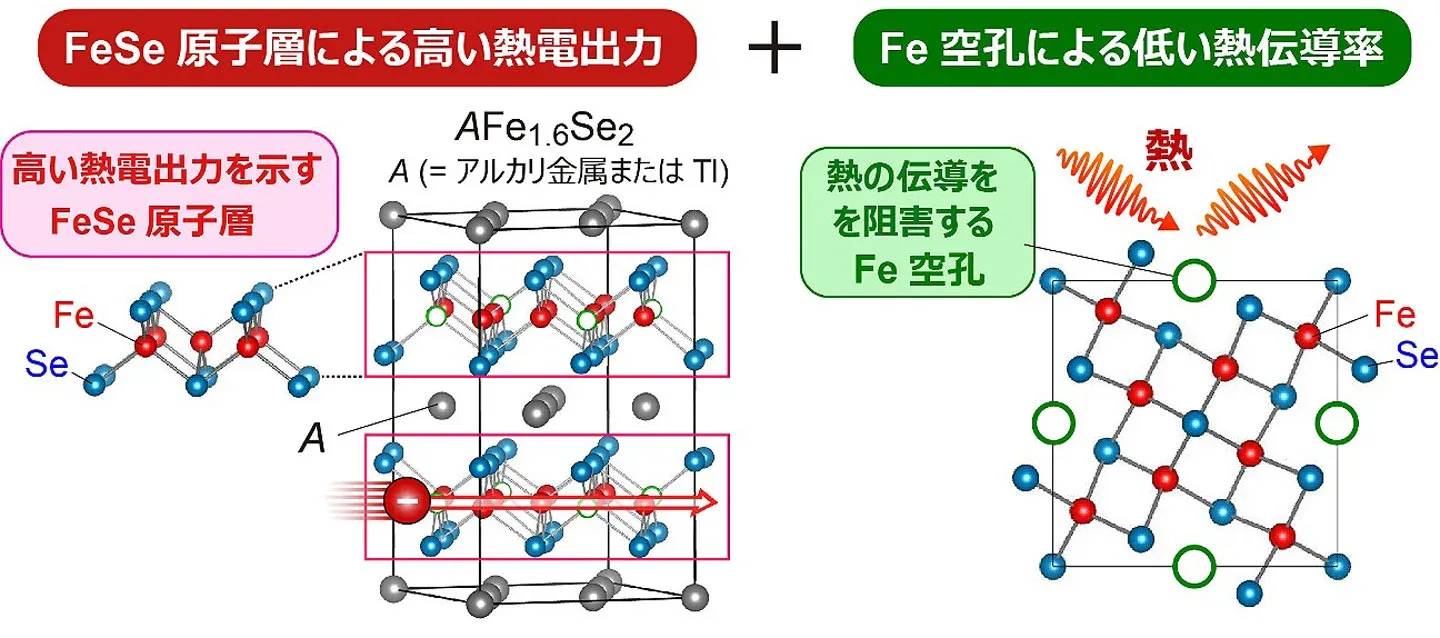
Ordered Defects Rewrite Electron Behavior
Another notable feature of this crystal is that approximately 20% of the iron atoms that should be present within the FeSe layer are missing, forming deliberate vacant sites (vacancies). Normally, defects within a crystal are regarded as troublesome obstacles that impede the flow of electricity. However, in , these vacancies function as a precision mechanism that boosts thermoelectric performance.
As the material is heated, it undergoes a dramatic change at around 180°C (near 450 K). At lower temperatures, the iron vacancies maintain a regularly aligned "ordered phase," but as the temperature rises, a phase transition occurs into a "disordered phase" in which the arrangement of vacancies becomes random.
When the research team measured the electrical properties, they confirmed a remarkable phenomenon in this ordered phase. At 50°C, the Seebeck coefficient showed a large absolute value of minus 110 µV/K. This is incomparable to the roughly 10 µV/K value exhibited by bulk FeSe. Analysis using first-principles calculations and other methods revealed that the regular arrangement of vacancies reconstructs the electronic state, opening an energy gap known as a "Mott gap." This creates the conditions necessary to generate high voltage while maintaining electrical conductivity.
As a result, the power factor—a direct indicator of power generation performance—reached 5.2 µW/(cm K^2) in the ordered phase at 50°C. This represents an overwhelming leap of approximately 30 times compared to ordinary bulk FeSe. On the other hand, once the temperature exceeds 180°C and the vacancies become disordered, the Seebeck coefficient plummets to around 34 µV/K, and the power factor sinks accordingly. The "order" of the structure itself was the detonator that awakened the latent potential of the two-dimensional thin film within the bulk crystal.
Atomic-Level Inhomogeneity That Silences Heat Waves
However, the true value of a thermoelectric material is only proven once it also achieves suppression of thermal conductivity—the other formidable adversary.
Heat is carried through a crystal by waves of atomic vibration, known as "phonons." The harder a material is and the more uniformly its atoms are bonded, the more freely phonons race through the crystal without dissipating.
The thermal conductivity of turned out to be even lower than the researchers had expected. In the ordered phase at 50°C, thermal conductivity was a mere 0.7 W/(m K)—less than a quarter of the value for bulk FeSe under the same conditions (approximately 3.2 W/(m K)). Moreover, at 500°C, after the phase transition renders the vacancies disordered, thermal conductivity dropped to an extreme value of 0.2 W/(m K).
| Material | State / Temperature Range | Thermal Conductivity [W/(m K)] | Characteristics / Applications |
|---|---|---|---|
| Ordered phase (50°C) | 0.7 | This study. Combines ordered vacancy arrangement with high power factor | |
| Disordered phase (500°C) | 0.2 | This study. Vacancy disorder suppresses thermal conductivity to the extreme | |
| Bulk FeSe | Polycrystalline (50°C) | ~3.2 | Iron-based superconductor. High thermal conductivity makes it unsuitable as a thermoelectric material |
| Polycrystalline (near room temperature) | ~1.0–1.5 | A representative existing high-performance thermoelectric material | |
| SnSe | Polycrystalline (mid-to-high temperature) | ~0.4–0.6 | A layered thermoelectric material known for its ultra-low thermal conductivity |
Behind this overwhelming thermal insulation performance lies a multi-layered physical mechanism. First, the thallium atoms separating the layers are extremely heavy and bond only weakly with the FeSe layers, causing the group velocity of low-frequency phonons to slow down markedly.
Second, there is the "bonding inhomogeneity" caused by the iron vacancies. Around each vacancy, the atomic arrangement is distorted, creating variation in the strength of the bonds between iron and selenium. Just as sound waves are diffusely reflected and dissipated by an irregular wall surface, phonons carrying heat also collide with this disorder in bonding strength and are scattered, drastically shortening their lifetime. In the disordered phase, since the arrangement of vacancies itself becomes random, this scattering effect is further amplified, thoroughly obstructing the propagation of heat.
As a result of all this, the overall thermoelectric performance indicator, $ZT$, recorded approximately 0.2 in the ordered phase at 50°C. Although this absolute value has not yet reached the level required for practical application, it represents a full two-orders-of-magnitude improvement compared to ordinary bulk FeSe.
The Next Steps Toward Room-Temperature Operation and Detoxification
The approach of "embedding" a two-dimensional nanomaterial within a bulk material, combined with deliberate control of vacancies to scatter phonons—this two-pronged design philosophy has opened up an entirely new frontier in the development of high-performance thermoelectric materials, one that differs fundamentally from the conventional approach centered on fine-tuning composition. Waste heat below 200°C, discharged endlessly from factories and automobiles, has long been overlooked for lack of an effective recovery method. This discovery serves precisely as a prototype for a new thermoelectric material capable of functioning in this previously untapped temperature range.
The remaining challenges are clear. The model compound used in this study, , has a carrier mobility several orders of magnitude lower than that of the FeSe monolayer thin film, meaning its potential electrical conductivity has not been fully drawn out. It has been suggested that the polycrystalline nature of the crystal, or the presence of vacancies itself, may be scattering electrons. Going forward, it will be necessary to use single crystals with aligned crystal orientation or epitaxial thin films to evaluate the inherent electronic conductivity within the FeSe layer.
Furthermore, with an eye toward practical societal implementation, replacing the toxic thallium with an alkali metal such as potassium or rubidium is also an urgent task. Similar alkali metal-based compounds exhibit high superconducting transition temperatures, suggesting they may possess electronic states closer to those of FeSe thin films. However, compounds using alkali metals tend to react readily with moisture and oxygen in the air, giving them a fatal weakness: chemical instability. How to eliminate the toxic thallium while securing stability in the atmosphere and achieving precise control over vacancy concentration will be the focal point of the next round of experiments.
Unused thermal energy fills our society. The materials needed to gather it up are no longer things one waits to stumble upon by chance. Designing atomic layers one by one, and manipulating even defects as part of the structure itself—at the intersection of quantum mechanics and materials science, a new blueprint for energy conversion is beginning to take shape.