

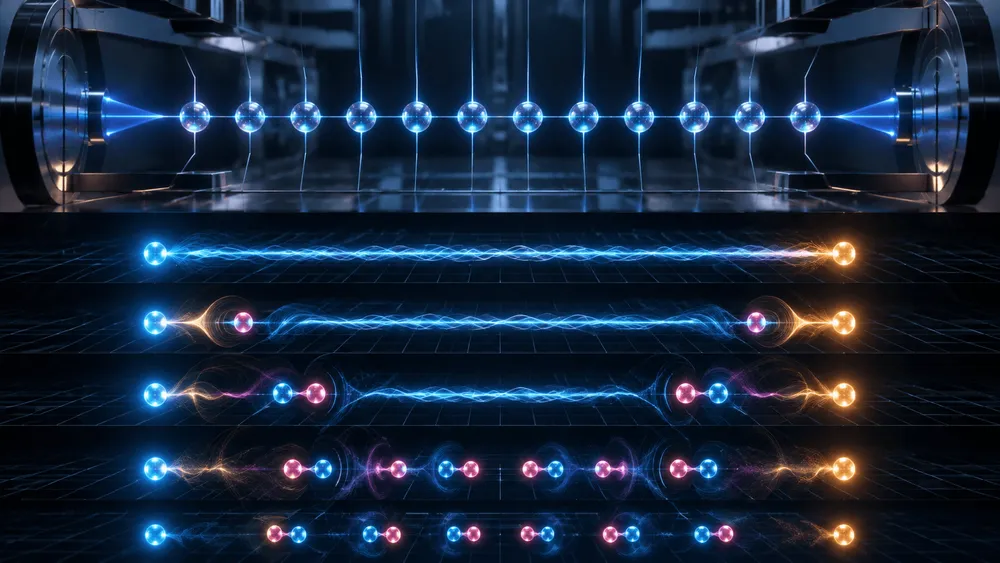
When a quark and an antiquark are pulled apart, energy accumulates in the "string" that forms between them. Once enough energy builds up, a new particle-antiparticle pair is created and the string breaks. This phenomenon, known as "string breaking," is closely tied to "quark confinement"—the fact that quarks cannot be isolated on their own.
String breaking is also important for understanding "hadronization," the process by which protons, neutrons, and other hadrons form from quarks and gluons in high-energy particle collisions. However, calculating how this process unfolds over time using classical computers is extremely difficult.
On September 23, 2026, an international research team including the Duke Quantum Center (DQC) reported in Nature Physics that they used a quantum simulator built from 13 ytterbium ions to observe the process of string breaking in both time and space.
However, the team did not actually create real quarks or antiquarks in the laboratory.
What the team reproduced was a simplified physical model that captures the essential features of quark confinement: a "1+1-dimensional (Z_2) lattice gauge theory." By controlling the quantum states of 13 ions and mapping their behavior onto this theory, the researchers were able to probe the time evolution of string breaking—something that is normally very difficult to observe directly.
The results showed that particle pairs do not appear uniformly throughout the string. Instead, they form near the ends of the string and then spread inward. The team concluded that this represents a string-breaking mechanism distinct from the conventional "Schwinger mechanism."
Why can't a single quark be isolated?
Quarks exist inside protons and neutrons, the building blocks of matter. Yet quarks are never observed in isolation.
In quantum chromodynamics (QCD), when a quark and an antiquark are pulled apart, the color electric field between them is thought to become concentrated into a thin region, forming what is called a "string" or "flux tube."
As the distance between the quarks increases, the energy stored in this string grows as well.
Eventually, it becomes energetically favorable to create a new quark-antiquark pair, and this pair is produced, splitting the original string.
As a result, rather than a single isolated quark, new composite particles form, combining with the newly created quarks and antiquarks.
String breaking is an important process for understanding both the formation of many hadrons in high-energy collisions and the cooling of the early universe.
The challenge lies in calculating the exact moment when the string breaks.
Lattice QCD has achieved great success in studying static properties of protons, neutrons, and other particles. However, when trying to compute how a quantum system evolves in real time using probabilistic methods, a difficulty known as the "sign problem" arises.
Other computational approaches, such as tensor networks, are also being studied, but extending them to complex high-energy phenomena—where many particles are created and quantum entanglement rapidly increases—is far from straightforward.
This is where "quantum simulation" comes in: reproducing the same mathematical model using a different, more controllable quantum system.
What the research team studied this time was likewise not real QCD itself, but a one-dimensional (Z_2) lattice gauge theory that captures features such as confinement and string breaking.
| Item | What was actually done in this study |
|---|---|
| Phenomenon reproduced | Dynamics of confinement and string breaking |
| Theoretical model | 1+1-dimensional (Z_2) lattice gauge theory |
| Experimental apparatus | Quantum simulator using 13 trapped ions |
| Identity of "particles" | Effective charges mapped onto ion quantum states |
| Creation of real quarks | Not performed |
| Main finding | String breaking in which charge pairs form near the string's ends and spread inward |
| Comparison with classical computation | Experimental results verified against numerical calculations |
Reproducing strings and charges with 13 ions
The experiment used 13 ytterbium-171 ions ((^{171}\mathrm{Yb}^+)) arranged in a line within an ion trap.
The two internal states of each ion were used as qubits—or more precisely, as pseudo-spins.
Using lasers, the research team individually controlled the interactions between ions as well as the effective magnetic field applied to each one.
This allowed the spin states of the ions to correspond to the behavior of charges and electric fields in the (Z_2) lattice gauge theory.
A key challenge in this experiment was reproducing the behavior of a larger system using a device with only a finite number of ions—13 in this case.
In small quantum simulators, "boundary effects," such as waves reflecting off the edges, can significantly influence the results in ways unrelated to the phenomenon actually being studied.
To address this, the research team assumed that virtual chains of spins extended beyond the 13 ions on either side, and calculated the influence these virtual chains would have on the ions within the system.
By reproducing this effect as a local magnetic field applied to each ion, the team created an environment that effectively resembled a segment extracted from a much larger one-dimensional system, despite using only a limited number of ions.
Starting from this configuration, the team performed a "quantum quench"—an abrupt change in the parameters of the Hamiltonian—and then measured how the charges and the string evolved over time.
Strengthening the string confined the charge
The research team first examined how a single, isolated charge would move.
When there was no string tension, a charge placed at its initial position spread out over time across the chain of ions.
On the other hand, when the string tension was increased, the charge could no longer travel far and instead oscillated near its initial position.
This behavior corresponds to "confinement" in this (Z_2) lattice gauge theory.
Next, the team prepared a configuration in which a string was stretched between two fixed charges, and then abruptly changed the string tension.
They observed that a new charge pair formed, splitting the string.
What drew particular attention here was where exactly the charge pair appeared.
The particle pair emerged not from the string's center, but from its ends
The "Schwinger mechanism" is a well-known theory describing how a sufficiently strong electric field generates particle-antiparticle pairs.
Simplified, in a sufficiently strong and uniform electric field, particle pairs are created throughout the entire space. The rate of pair production depends strongly on parameters such as the strength of the electric field.
What was observed in this study differed from that picture.
According to the team's measurements, new charge pairs did not appear uniformly throughout the string. Instead, they showed a tendency to form near the ends of the string, where the fixed charges were located.
Under conditions of weak string tension, the charge pairs that formed oscillated near the ends.
When the tension was increased, the charges formed near the ends gradually spread into the interior of the string.
Furthermore, within the range of parameters examined in this study, the time at which pair production began at the ends, as well as the oscillation period, did not change significantly even when the string tension or coupling strength were varied.
This differs from the conventional Schwinger mechanism, in which the production rate shows a strong exponential dependence on parameters.
Based on these results, the research team concluded that a distinct string-breaking mechanism originating from the ends of the string was at work in this system.
| Comparison point | Conventional Schwinger mechanism | String breaking observed in this study |
|---|---|---|
| Location where charge pairs appear | Generated spatially throughout a uniform electric field | Forms near the ends of the string |
| Dependence on parameters | Production rate varies strongly | Within the range studied, start time and period show relatively small variation |
| Subsequent motion | Particle pairs form throughout space | Charges formed at the ends spread into the interior |
| Team's interpretation | Conventional pair production | A string-breaking mechanism distinct from the Schwinger mechanism |
The theoretical analysis also examined the reason behind this behavior.
Near the ends of the string, the influence of the surrounding vacuum region reduces the energy required to create a charge pair. This makes it easier for charge pairs to form near the ends.
Once formed, these charge pairs then spread into the interior of the string through quantum mechanical motion.
Even a relatively simple perturbative model was able to qualitatively reproduce the main features observed in the experiment.
Moreover, the time evolution of charge distribution and electric field obtained from the 13 ions agreed well with numerical simulations performed on classical computers.
This is also an important result confirming that the quantum simulator accurately reproduces the intended physical model.
Not a reproduction of real quarks
Understanding this achievement also requires understanding its limitations.
What the research team experimentally realized was a one-dimensional (Z_2) lattice gauge theory.
QCD, which describes real quarks and gluons, is an (SU(3)) gauge theory in three-dimensional space, and is far more complex.
Therefore, one cannot conclude that the endpoint-initiated string breaking observed here occurs in exactly the same way in the real world of quarks.
The paper itself notes that future experiments will be needed to clarify how relevant this mechanism is to high-energy collisions and cosmology.
Furthermore, this achievement does not demonstrate "quantum advantage"—that is, it does not show that a quantum computer has outperformed a classical one.
Indeed, the research team compared their experimental results with classical numerical calculations and confirmed that they agreed.
The significance of this work lies not in having already solved a problem beyond the reach of classical computation, but in having demonstrated control techniques that use a quantum simulator to experimentally create a non-equilibrium string-breaking process and directly track its evolution over time.
As this approach is extended to larger systems and higher-dimensional gauge theories, quantum simulators may eventually be able to probe regimes where classical computation becomes intractable.
Next steps: two dimensions, and gauge theories closer to reality
Research on lattice gauge theories using quantum simulators is not limited to trapped ions.
Efforts are also underway using superconducting qubits and neutral atoms to reproduce charge confinement and string dynamics.
The paper itself notes that, after the experiment was completed, charge and string dynamics using a two-dimensional array of superconducting qubits were reported elsewhere, and that companies such as QuEra Computing are studying string breaking in 2+1-dimensional lattice gauge theories using Rydberg atom arrays.
A distinctive feature of the trapped-ion approach used in this study is its ability to finely control both long-range interactions between ions and local fields applied individually to each ion.
The research team envisions extending these control techniques to larger quantum systems and to two-dimensional systems as well.
The ultimate goal is to move beyond the current simplified (Z_2) model toward more complex gauge theories.
This experiment using 13 ions did not create real quarks, nor did it fully reproduce QCD.
Even so, it demonstrated that the non-equilibrium dynamics of string breaking—previously studied mainly through equations and numerical calculations—can be created within a controllable quantum system and observed in both time and space.
The next question is whether the endpoint-initiated string breaking discovered here will also appear in larger systems and in models closer to two or three dimensions. If this approach can be extended that far, quantum simulators may become a new tool for probing regimes of high-energy physics that remain difficult to calculate.