

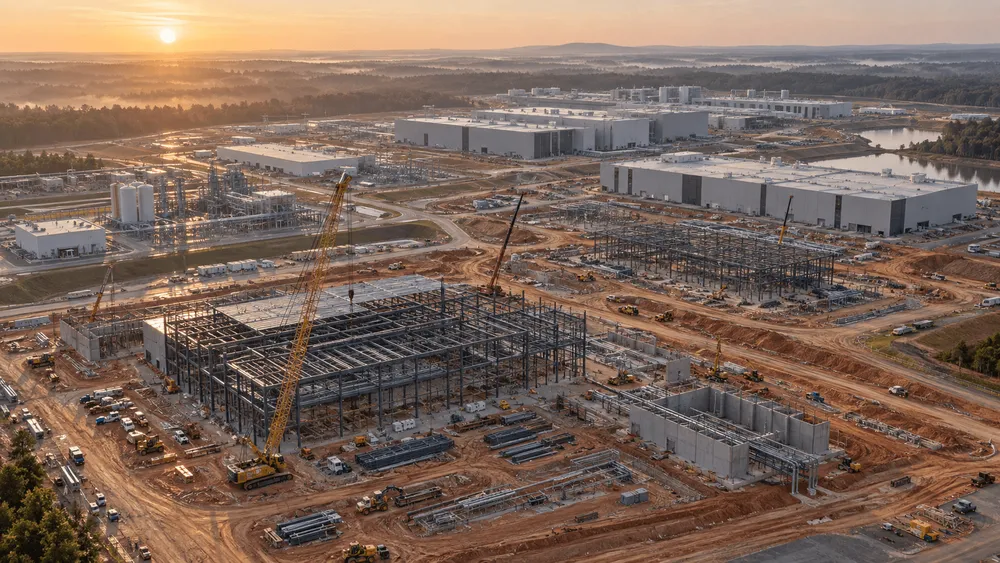
On September 9, 2026, USA Rare Earth broke ground on a rare earth metals and magnets plant in Blacksburg, South Carolina. The company has put the estimated investment at $1.2 billion, with plans to employ roughly 490 people at an approximately 800,000-square-foot facility. The plant is designed to produce 6,400 tons of sintered neodymium-iron-boron (NdFeB) permanent magnets and 5,000 tons of strip-cast metal and alloy annually, with commissioning slated to begin in 2028. Yet between breaking ground and the United States achieving self-sufficiency in magnets lies a long road involving payment conditions tied to financing, raw material sourcing, and customer qualification.
The 6,400-Ton Figure Represents 64% of the Company's US Plan
The 6,400 tons planned for Blacksburg represents 64% of the 10,000 tons of annual magnet production capacity that USA Rare Earth says it will establish domestically by 2029. That figure comes from a simple calculation: 6,400 ÷ 10,000 × 100. At the company's existing Stillwater plant, commissioning of the first production line was completed in March 2026, with plans to raise output to the equivalent of 600 tons per year by the end of that year. The target for the first quarter of 2027, including a second line, is 1,200 tons per year—meaning Blacksburg's planned capacity is more than five times that figure.
Judging by scale alone, the new plant is not a supplementary expansion. It is designed to be the centerpiece of USA Rare Earth's domestic magnet business. That said, both the 6,400-ton and 10,000-ton figures are equipment capacity targets, not actual annual production or sales volumes. What is planned for 2028 is the start of commissioning, not the achievement of full operation or commercial-scale production—no timeline for either has been disclosed.
Mass production of sintered magnets is not a process that ends once equipment is installed in a building. Rare earths and metals must be powderized, refined, and shaped before undergoing sintering and heat treatment. They must then go through machining, surface treatment, and magnetization to meet the dimensions and heat resistance customers require. The experience gained from starting up a smaller line at Stillwater provides a foothold, but the yield and quality achievable when scaling up more than fivefold at Blacksburg remain figures yet to be verified.
Separating the $1.2 Billion from the Contractual $400 Million
Against the publicly stated investment of $1.2 billion, the incentive agreement's assumed investment is $800 million, while the minimum investment required to maintain tax incentives is $400 million. All three figures appear in connection with the same project, but they mean different things. The $1.2 billion is the overall facility estimate disclosed at the September groundbreaking announcement. The $800 million is the assumed amount stated in the fee-in-lieu-of-tax and incentive agreement signed with Cherokee County in June. The $400 million is the minimum amount to be invested over eight years to maintain that tax incentive—it is not an estimate of the cost to complete the plant.
| Disclosed / Contractual Figure | Amount | What It Represents | Limitations |
|---|---|---|---|
| Groundbreaking announcement | $1.2 billion | Estimated facility investment | Cost breakdown and funding source undisclosed |
| Local incentive agreement | $800 million | Assumed investment under contract | Gap with the $1.2 billion figure unexplained |
| Tax incentive maintenance requirement | $400 million | Minimum investment over 8 years | Not the cost to complete the plant |
The arrangement is also not one in which USA Rare Earth acquires all the land and buildings outright. The company is leasing an approximately 800,000-square-foot facility on roughly 129.9 acres of land for 20 years, with two 10-year renewal options. It is a net lease under which the landlord substantially completes the base building while USA Rare Earth bears not only rent but also operating costs, property taxes, and insurance. Base rent increases by 2.5% annually.
Under the local incentive program, qualifying assets are assessed at a reduced 4% assessment ratio—rather than the standard rate—for a fee-in-lieu-of-tax arrangement lasting up to 40 years. This is not a program in which investing $400 million exempts the company from the remaining cost of the plant; rather, it is a contract that lightens the long-term tax burden in exchange for imposing investment and employment conditions on the company. Failure to meet the minimum investment threshold or other conditions could result in reduced benefits or even the clawback of benefits already received.
The SEC filing from June noted that the lease's effectiveness was conditioned on the landlord acquiring the land and completing financing within 90 days. The September groundbreaking indicates that this plan has moved forward to the site. However, the groundbreaking announcement cites the site as 124 acres, while the lease documents state approximately 129.9 acres—no explanation has been given for the discrepancy. Employment figures also differ: the groundbreaking announcement cites approximately 490 jobs, while the local incentive agreement assumes approximately 325. Public relations figures and contractual terms should not be conflated; actual performance needs to be tracked against both investment amount and employee count.
The Government's $475 Million Is Not a Lump-Sum Grant
The US Department of Commerce has committed up to $277 million in direct funding and up to $1.3 billion in loan guarantees to USA Rare Earth as a whole. NIST lists this as a finalized support package, indicating that support will be allocated across the Texas mine, the Stillwater, Oklahoma facility, and Blacksburg. Here, the $1.3 billion is not a grant received from the government—it is a mechanism under which the Commerce Department guarantees repayment of borrowing from the Federal Financing Bank (FFB).
According to SEC filings, the new second magnet plant is allocated $60 million in direct funding and $325 million in loan guarantees, while the second metals plant receives $15 million and $75 million respectively. In total, that amounts to $75 million in direct funding and $400 million in loan guarantees, for a combined $475 million. NIST's page for Blacksburg lists magnet, metal and alloy, and strip-casting equipment as eligible for support at that site. However, since the project name in the SEC document is "second plant" and does not explicitly name the city, it cannot be definitively confirmed that the full $475 million flows unconditionally into Blacksburg.
Moreover, the funds are not disbursed in a lump sum upon signing. Payments are structured around project-specific milestones, including facility completion, equipment installation, and certification of production capacity. Conditions also include purchase agreements with customers and target production volumes. In addition to USA Rare Earth's own cash contributions, the company must satisfy financial ratios, liquidity requirements, and permitting conditions—failure to meet these could lead to delayed or reduced payments, or even the return of funds already disbursed. Government support is not funding that eliminates construction risk; it is funding that ties progress on the project to the burden borne by the private side.
A Process Longer Than the Building Itself: Raw Materials and Customer Qualification
Gaps remain further upstream in USA Rare Earth's supply chain than the plant itself. The Round Top deposit in Texas is positioned as a future domestic raw material source, but according to the 2025 Form 10-K, it remains at the exploration stage and has not yet established proven or probable reserves that can be commercially mined. The company itself states that until Round Top can meet raw material demand, it will need to procure rare earth oxides and metal feedstocks from third parties at appropriate volumes and prices.
America's import dependence cannot be captured by a single market-share figure either. According to the US Geological Survey's Mineral Commodity Summaries 2026, the net import reliance for rare earth compounds and metals in 2025 stood at 67%. Import sources from 2021 to 2024 were China at 71%, Malaysia at 12%, Japan and Estonia each at 5%, and other countries making up 7%. While this does not represent the import ratio for magnet products themselves, it shows that dependence on overseas sources persists even on the raw material side feeding into magnet plants.
Downstream, the work of converting equipment capacity into confirmed orders still lies ahead. As of the 2025 Form 10-K, the company had not yet generated revenue from magnet manufacturing, and it noted that there was no guarantee that discussions and memoranda with customers would convert into binding contracts. Only after consistently delivering quality that meets individual specifications, completing customer qualification, and winning orders amid price competition—including from Chinese producers—will the 6,400-ton facility become actual supply capability.
Accordingly, the start of commissioning in 2028 alone will not determine success or failure. The key indicators to watch will be whether certified production capacity figures, actual annual production volumes, customer purchase agreements, and the share of domestic raw materials are disclosed in sequence going forward. If all of these come together, the Blacksburg groundbreaking will mark a turning point in which the United States connects mining to magnet manufacturing entirely within its own borders.