
サイエンス
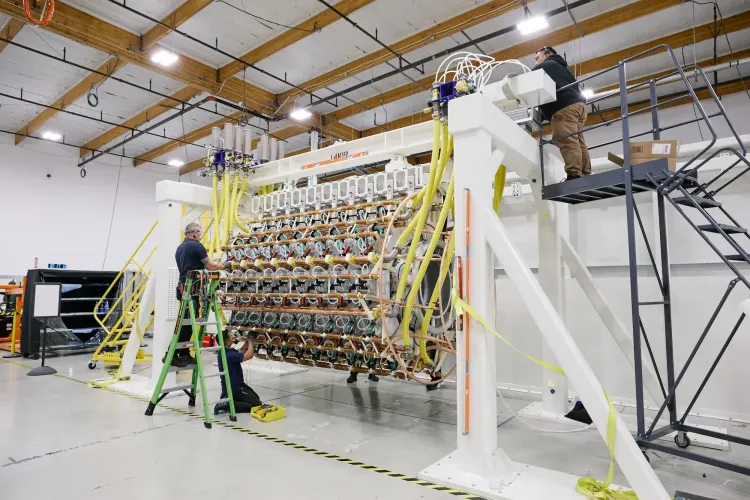
Pacific Fusion、80ナノ秒で440GWを放つ核融合パルサー試作機を検証
Pacific Fusionは核融合燃料を圧縮する電源モジュールの試作機を検証し、実証施設建設の節目となる約440GWのピーク出力を達成した。この成果は技術的な進捗を資金調達と連動させるマイルストーンとなり、次段階の実物大装置開発を加速させる。

別名: NIF, National Ignition Facility, 国立点火施設
ローレンス・リバモア国立研究所にある巨大なレーザー核融合施設。192本の高出力レーザーを用いて燃料ターゲットを圧縮し、2022年に世界で初めて科学的エネルギー純益(イグニッション)を達成した。
Pacific Fusionは核融合燃料を圧縮する電源モジュールの試作機を検証し、実証施設建設の節目となる約440GWのピーク出力を達成した。この成果は技術的な進捗を資金調達と連動させるマイルストーンとなり、次段階の実物大装置開発を加速させる。

実現すれば人類の抱えるエネルギー問題を解決するとされる核融合発電において、最大の懸念事項は常に「コスト」であった。いかにして、反応を開始させるための莫大なエネルギーコストを、売電価格よりも低く抑えるか。この難題に対し、カ […]
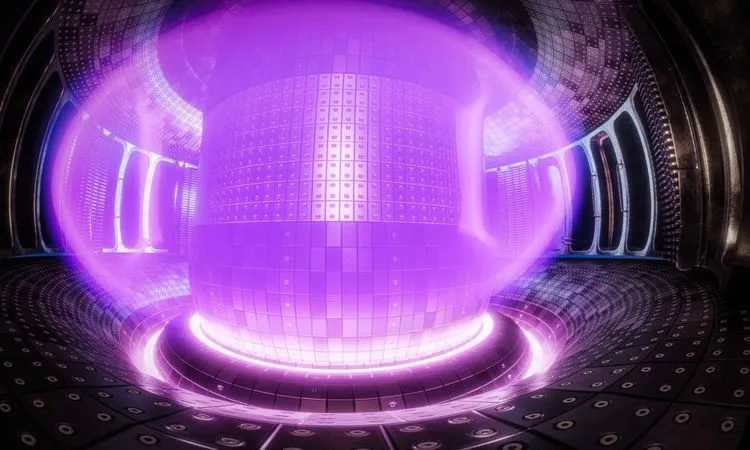
米国エネルギー省が、国家戦略として掲げる核融合技術の実用化に向けた「核融合科学技術ロードマップ」を発表した。これは、長年「未来のエネルギー」とされてきた核融合発電を、歴史上最も速いタイムラインで商業化するための包括的な計 […]
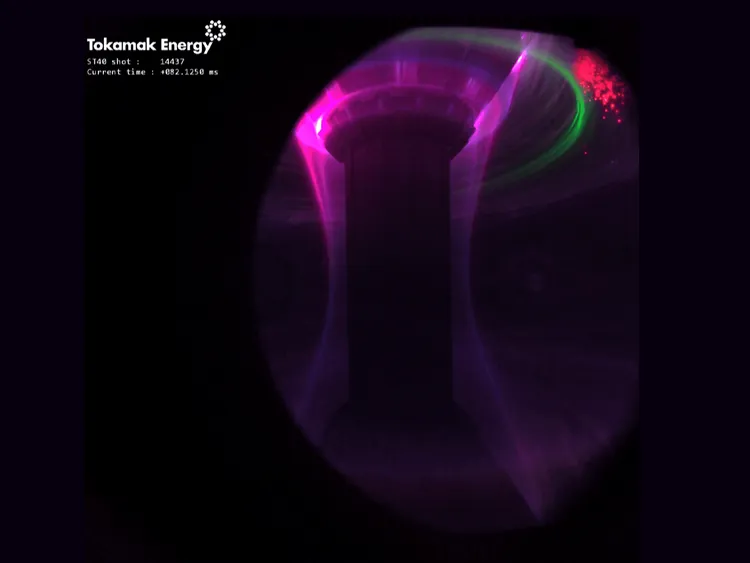
英国の核融合スタートアップ「Tokamak Energy」が、人類のエネルギー史における新たな一ページを刻むかもしれない、驚異的な映像を公開した。それは、同社の球状トカマク装置「ST40」の内部で荒れ狂う、太陽の中心より […]
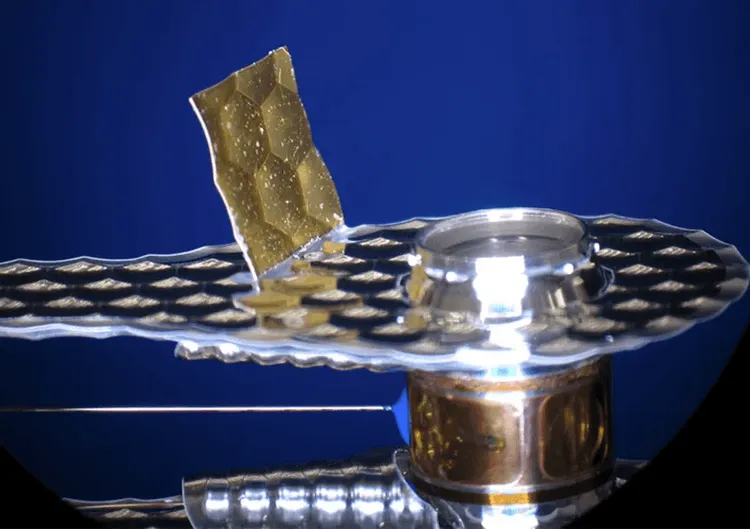
2025年6月、米国の核融合研究が新たな地平を切り拓いた。ロスアラモス国立研究所(LANL)が主導するチームは、あえてエネルギーを外部に逃がす「窓」を設けた革新的な装置「THOR」を用い、核融合点火を達成するという離れ業 […]
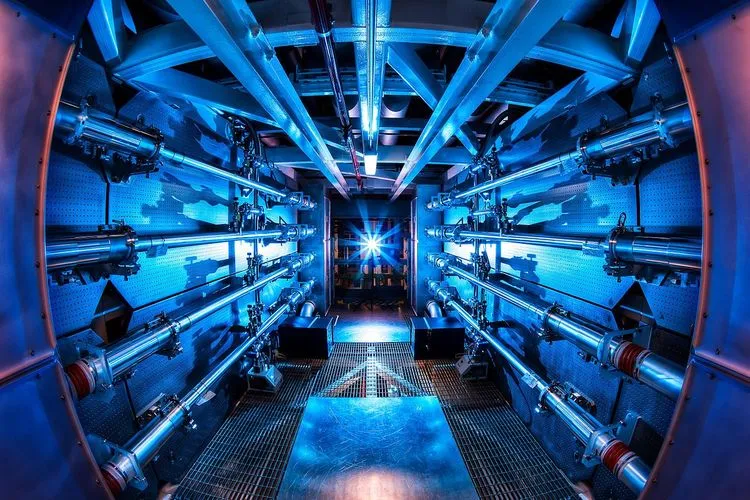
米国のローレンス・リバモア国立研究所 (LLNL)の国立点火施設 (NIF)が、レーザー核融合実験で8.6メガジュール(MJ)という驚異的なエネルギー出力を達成し、自己記録を大幅に更新したというニュースが報じられた。20 […]
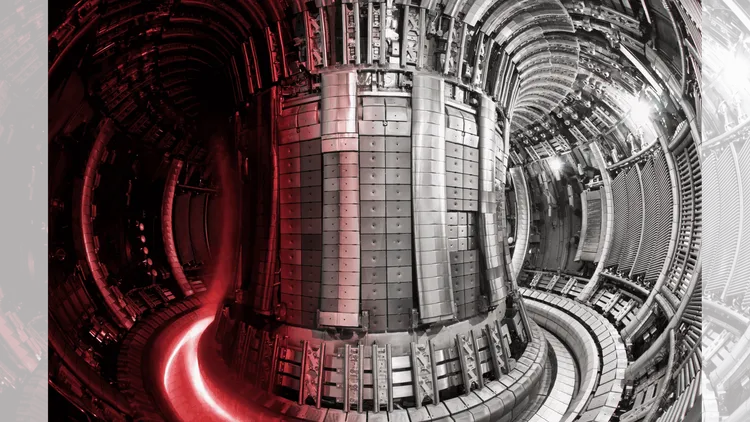
英国の核融合炉、Joint European Torus(JET)は、核融合炉の最終テストでわずか0.21ミリグラムの燃料から69.26メガジュールの熱が得られた事を発表した。これは、米国の国立点火施設(NIF)が達成し […]
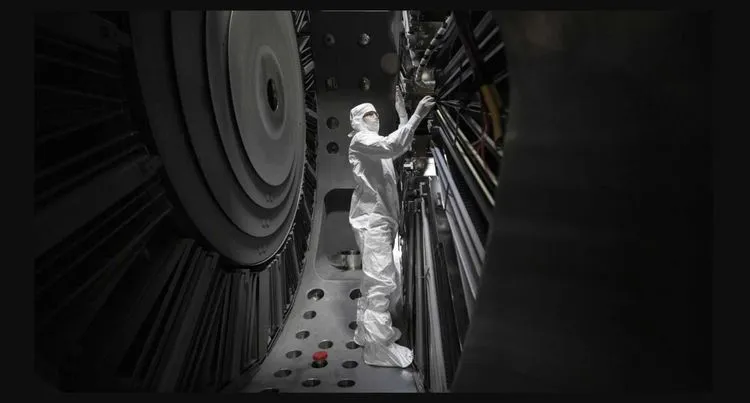
先日、レーザー核融合により、人類初の「核融合反応による正味のエネルギー利得(Net Energy Gain)」が米・ローレンス・リバモア国立研究所の国立点火施設によって確認されたが、アメリカはこの研究を更に推し進めるため […]
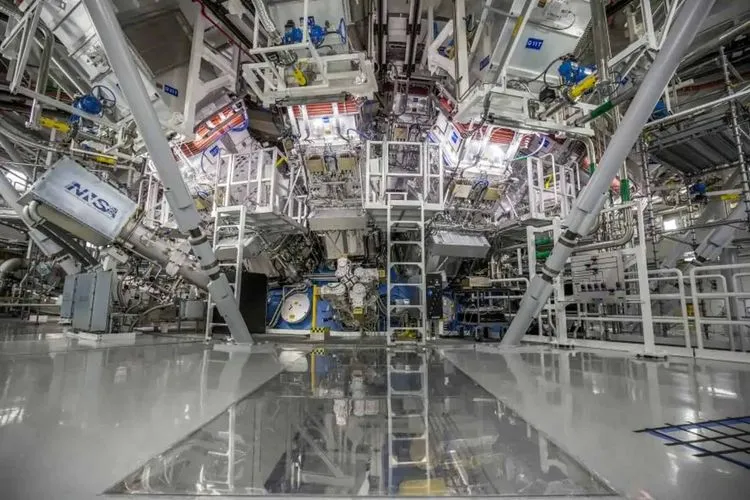
米国・ローレンス・リバモア国立研究所(LLNL)の発表によると、地球上で初めて、制御された核融合反応によって、運転に必要な電力を上回る電力が生成された(正味のエネルギー獲得:Net energy gain)ことが正式に確 […]
An inertial fusion implosion on the National Ignition Facility, conducted on August 8, 2021 (N210808), recently produced more than a megajoule of fusion yield and passed Lawson's criterion for ignition [Phys. Rev. Lett. 129, 075001 (2022)10.1103/PhysRevLett.129.075001]. We describe the experimental improvements that enabled N210808 and present the first experimental measurements from an igniting plasma in the laboratory. Ignition metrics like the product of hot-spot energy and pressure squared, in the absence of self-heating, increased by ∼35%, leading to record values and an enhancement from previous experiments in the hot-spot energy (∼3×), pressure (∼2×), and mass (∼2×). These results are consistent with self-heating dominating other power balance terms. The burn rate increases by an order of magnitude after peak compression, and the hot-spot conditions show clear evidence for burn propagation into the dense fuel surrounding the hot spot. These novel dynamics and thermodynamic properties have never been observed on prior inertial fusion experiments.
Compound parabolic concentrator (CPC) targets are utilized at the National Ignition Facility Advanced Radiographic Capability (NIF-ARC) laser to enhance the acceleration of electrons and production of high energy photons, for laser durations of 10 ps and energies up to 2.4 kJ. A large enhancement of mean electron energy (>2 ×) and photon brightness (>10×) is found with CPC targets compared to flat targets. Using multiple diagnostic techniques at different spatial locations and scaling by gold activation spatial data, photon spectra are characterized for [Formula: see text] MeV. Beam width and pointing variations are given. The efficient production of MeV photons at [Formula: see text] W/cm2 with CPCs is observed, with doses of >10 rad in air at 1 m for [Formula: see text] MeV; these exceed those previously reported with laser-driven sources. Using this source, sub-mm resolution radiographs are generated through large areal density radiograph objects. These results are promising for the development of bright MeV x-ray and particle sources on Petawatt class laser systems.
Recent indirect drive inertial confinement fusion implosions on the National Ignition Facility (NIF) [Spaeth et al., Fusion Sci. Technol. 69, 25 (2016)] have crossed the threshold of ignition. However, performance has been variable due to several factors. One of the leading sources of variability is the quality of the high-density carbon (HDC) shells used as ablators in these experiments. In particular, these shells can have a number of defects that have been found to correlate with the appearance of ablator mix into the hot spot and a degradation in nuclear yield. These defects include pits on the ablator surface, voids in the ablator bulk, high-Z debris from the Hohlraum wall that adheres to the capsule surface, and finally the inherent granular micro-structure of the crystalline HDC itself. This paper summarizes high-resolution modeling of each of these mix sources in two recent high-performance NIF implosion experiments. The simulated impact from a range of individual capsule defects is found to be broadly consistent with the trends seen in experiment, lending credence to the modeling results and the details of the mixing process that they reveal. Interestingly, modeling of the micro-structure inherent to HDC shows that this perturbation source results in considerable mixing of the deuterium–tritium fuel with ablator material during the implosion. The reduction in fuel compression from this mix results in an approximately factor of two reduction in neutron yield in current implosions and emphasizes the importance of mitigating this significant performance degradation.
We have developed an experimental platform at the National Ignition Facility that employs colliding planar shocks to produce warm dense matter with uniform conditions and enable high-precision equation of state measurements. The platform uses simultaneous x-ray Thomson scattering and x-ray radiography to measure the density, electron temperature, and ionization state in warm dense matter. The experimental platform is designed to create a large volume of uniform plasma (approximately 700×700×150μm3) at pressures approaching 100 Mbar and minimize the distribution of plasma conditions in the x-ray scattering volume, significantly improving the precision of the measurements. Here, we present the experimental design of the platform and compare hydrodynamic simulations to x-ray radiography data from initial experiments studying hydrocarbons, producing uniform densities within ±25% of the average probed condition. We show that the platform creates a homogeneous plasma that can be characterized using x-ray Thomson scattering. Thus, the new platform enables accurate measurements of plasma conditions necessary to test models for the equation of state and ionization potential depression in the warm dense matter regime.