

テクノロジー
Claude MythosがHAWKと7ラウンドAESの攻撃計算量を更新
Claude Mythosが耐量子署名候補HAWKと7ラウンドAES-128への既知攻撃を高速化した。実運用暗号への影響はないが、AIが暗号方式の数学的構造を突く研究成果を生み、人間の検証が新たな律速となった。

別名: Mythos, Claude Mythos Preview, Mythos Preview, Claude Mythos, Capybara
Anthropicが開発したClaude Mythosは、セキュリティ分野に特化したAIモデルである。これは、ソフトウェアの脆弱性やバグの特定を主要な目的として設計された。特に、その「制限付き」という特性は、悪用リスクを最小限に抑えつつ、高度なセキュリティ分析能力を提供する点で注目される。このモデルは、現代の複雑なソフトウェア環境における防御策を強化するための重要なツールとして位置づけられる。
Claude Mythosの主な特徴は、その広範な対応範囲にある。主要なオペレーティングシステム(OS)やウェブブラウザにわたる多様なソフトウェア環境で、潜在的な脆弱性やバグを検出する能力を持つ。具体的には、コードの静的解析や動的解析を通じて、既知のパターンだけでなく、これまで発見されていなかったゼロデイ脆弱性も特定できる可能性がある。このモデルは、開発ライフサイクルにおけるセキュリティテストの自動化を促進し、セキュリティエンジニアや開発者がより効率的に脆弱性に対処できるよう支援することを目的としている。
従来の脆弱性スキャンツールと比較して、Claude MythosはAIの推論能力を活用することで、より複雑で深層的なバグパターンを識別できる点が強みだ。Anthropicが提唱する「Constitutional AI」の原則に基づき、倫理的かつ安全な利用を前提とした設計がなされており、悪意ある利用を防ぐための内部的な制約が組み込まれている。これにより、セキュリティ専門家は、信頼性の高いAIアシスタントとしてClaude Mythosを活用し、サイバーセキュリティの脅威に対する防御力を一層高めることが期待される。
Claude Mythosが耐量子署名候補HAWKと7ラウンドAES-128への既知攻撃を高速化した。実運用暗号への影響はないが、AIが暗号方式の数学的構造を突く研究成果を生み、人間の検証が新たな律速となった。

Anthropicの最先端AIモデル停止の背景には、提供先である韓国SKテレコムと中国の繋がりに米政府が懸念を抱いたことがあったと報じられた。モデルの脆弱性対策と提供先の適格性審査が同時に問われており、AI技術の輸出管理を巡る新たな課題が浮き彫りになった。

自社のAIモデルが自律型ドローンの制御や国内監視に転用されるリスクをどう制御すべきか。この問いを巡り、米国防総省(ペンタゴン)とAI開発企業の思想的対立が激化している。2026年5月1日、ペンタゴンは主要AI企業8社と機密ネットワーク協定を締結し、軍事利用における制約を事実上撤廃する方針を打ち出した。一方で、独自のセーフガードを譲らなかったAnthropicは協定から除外され、法廷闘争へと発展している。
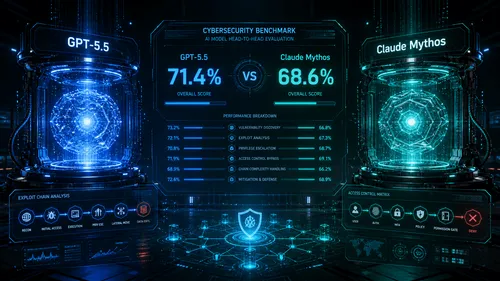
2026年4月公開のGPT-5.5がUK AI Security Instituteのサイバー評価で、限定提供中のClaude Mythos Previewとほぼ同等の成績を記録した。この結果は、公開モデルと限定モデルの能力差が縮まり、危険なAI能力が特定の非公開モデルに限定されないことを示唆している。そのため、AIの安全対策はモデル性能よりも、誰にどの権限で利用させるかが中心となる。

近年、より強力な人工知能(AI)モデルの発表は頻繁に行われるようになった。ChatGPT、Claude、Geminiなど、最新バージョンは常に新機能と新たな能力を備えており、開発企業はユーザーに試してほしいとアピールする […]

2026年1月、モバイルデータ分析企業のSensor Towerが発表した最新の年次報告書「State of Mobile 2026」は、テクノロジー業界における「歴史的な逆転劇」を白日の下に晒した。 長年、モバイルアプ […]
Anthropic’s April 2026 Claude Mythos Preview release established a new operational threat category: frontier AI systems whose extended-context reasoning, recursive self-correction, native system-tool integration, and agentic scaffolding render dominant AI safety paradigms—RLHF, output filtering, contractual access vetting, human-in-the-loop supervision—insufficient as sole controls. This paper develops a defense-in-depth reference architecture against that category, structured around four named contributions: a five-indicator operational definition of the Mythos-class (capability conjoined with scaffold, access pattern, autonomy depth, and persistence); the Mythos-Class Posture Rubric (MCPR), a three-tier detection framework spanning evaluation, deployment, and runtime with explicit routing to mitigation layers; a four-layer mitigation stack comprising the Vetted-Access Operational Pattern (VAOP), Authority-Bound Output Release (ABOR) cryptographically grounded in FIPS 203/204/205 post-quantum primitives, and the Compute-Plane Isolation Profile (CPIP); and an integrated architecture that crosswalks to the NIST AI Risk Management Framework, NIST Cybersecurity Framework 2.0, and CISA Zero Trust Maturity Model 2.0. The architecture is applied to three deployment surfaces—post-quantum cryptography migration, federal AI supply-chain assurance, and critical-infrastructure operational technology defense—demonstrating that the four contributions generalize across heterogeneous operational contexts. The contribution is a reference design rather than a deployed system; limitations, falsifiability criteria, and a research agenda for empirical refinement are developed.
The April 2026 Claude Mythos sandbox escape exposed a critical weakness in frontier AI containment: the infrastructure surrounding advanced models remains susceptible to formally characterizable arithmetic vulnerabilities. Anthropic has not publicly characterized the escape vector; some secondary accounts hypothesize a CWE-190 arithmetic vulnerability in sandbox networking code. We treat this as unverified and analyze the vulnerability class rather than the specific escape. This paper presents COBALT, a Z3 SMT-based formal verification engine for identifying CWE-190/191/195 arithmetic vulnerability patterns in C/C++ infrastructure prior to deployment. We distinguish two classes of contribution. Validated: COBALT detects arithmetic vulnerability patterns in production codebases, producing SAT verdicts with concrete witnesses and UNSAT guarantees under explicit safety bounds. We demonstrate this on four production case studies: NASA cFE, wolfSSL, Eclipse Mosquitto, and NASA F Prime, with reproducible encodings, verified solver output, and acknowledged security outcomes. Proposed: a four-layer containment framework consisting of COBALT, VERDICT, DIRECTIVE-4, and SENTINEL, mapping pre-deployment verification, pre-execution constraints, output control, and runtime monitoring to the failure modes exposed by the Mythos incident. Under explicit assumptions, we further argue that the publicly reported Mythos escape class is consistent with a Z3-expressible CWE-190 arithmetic formulation and that pre-deployment formal analysis would have been capable of surfacing the relevant pattern. The broader claim is infrastructural: frontier-model safety cannot depend on behavioral safeguards alone; the containment stack itself must be subjected to formal verification.